

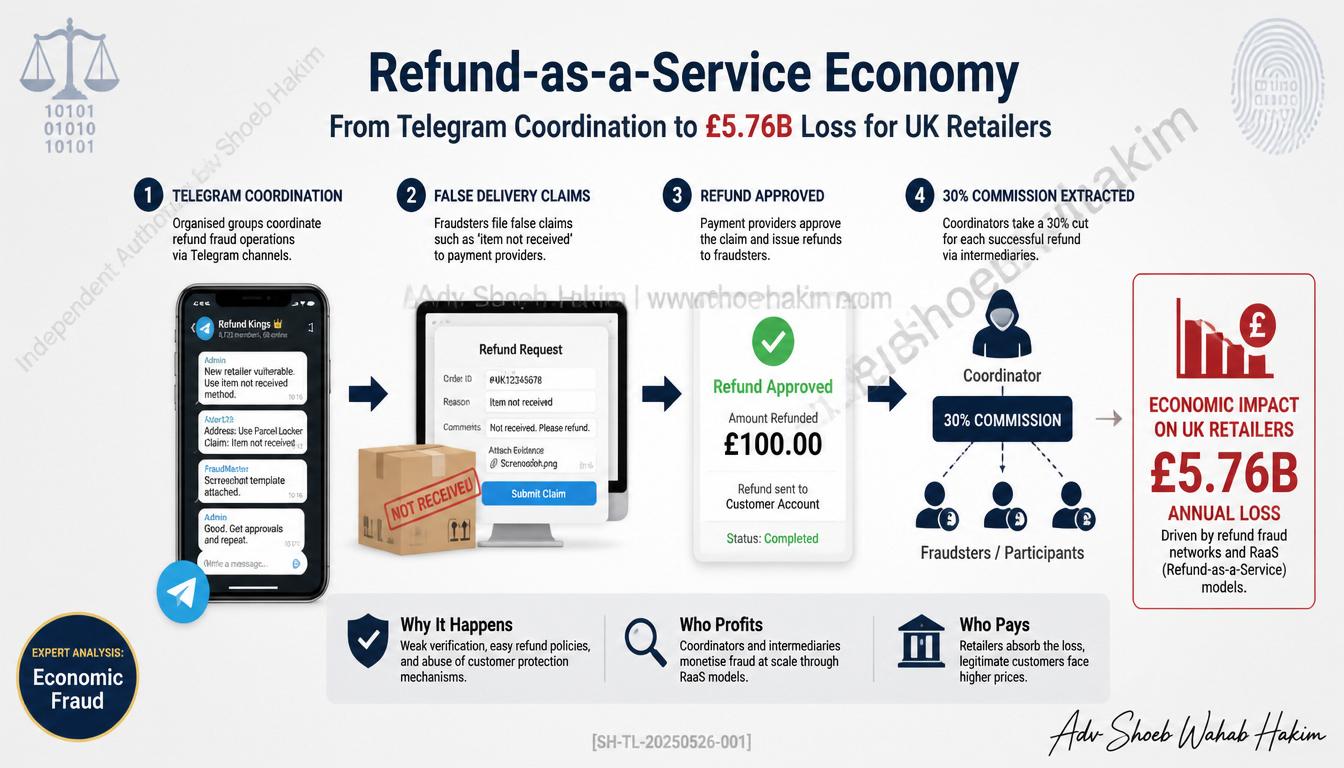
Nearly 500,000 posts analysed. “Refund-as-a-service” vendors taking up to 30% of refund value. Most offenders are teenagers who believe they are “untouchable.”
Introduction
A 19-year-old believes they are “untouchable.” They post openly on Telegram about refund fraud. They share their name, their location, their techniques. They do not believe retailers or law enforcement will catch them.
This research proves they are wrong. But the losses are already staggering.
New research supported by the University of Portsmouth, funded by Cifas (the UK’s leading fraud prevention service), reveals that refund fraud could be costing UK online retailers up to £5.76 billion a year.
The report, “Mapping the Online Economy of Refund Fraud,” analysed nearly 500,000 posts across cybercrime forums, Telegram, Nulled, and Cracked. Fraudsters have been using these channels to openly share techniques, target retailers, and sell fraudulent refunds as a paid service.
This article analyzes the key findings and their implications for retailers, law enforcement, and consumers.
The Scale of the Problem
| Metric | Figure |
|---|---|
| Annual cost to UK online retailers | Up to £5.76 billion |
| Posts analysed | Nearly 500,000 |
| Platforms analysed | Cybercrime forums, Telegram, Nulled, Cracked |
| “Refund-as-a-service” vendor commission | Up to 30% of refund value |
The growth trajectory: Researchers warn that refund fraud will continue to grow without targeted public awareness — particularly aimed at young people — and stronger collaboration between retailers, law enforcement, and the fraud prevention community.
Who Are the Offenders?
Demographics:
- Most offenders are young males
- Age range: 14-30 years old
- Average age: 19
- Many are students or unemployed
The “Untouchable” Mindset:
Some users showed risky behaviours while online — sharing receipts and personal details about themselves such as their names and where they lived — often with the belief they were “untouchable” and that retailers and law enforcement would not catch them.
Links to Other Crimes:
Refund fraud is frequently linked to other criminal activity including:
- Card fraud
- Identity fraud
- Money laundering
Common Refund Fraud Methods
| Method | Description |
|---|---|
| Claiming items did not arrive | Fraudster claims package never delivered |
| Partial or empty boxes | Claiming box arrived partially filled or empty |
| Fake tracking IDs | Simulating returns with fabricated tracking numbers |
| Substitute or counterfeit goods | Returning fake products instead of originals |
| Wardrobing | Wearing items (clothing, accessories) and returning them |
| Food delivery refund abuse | Fraudulently claiming food never arrived |
The “Refund-as-a-Service” Economy
What is it?
Fraudsters openly advertise refund services on cybercrime channels. For a fee (typically up to 30% of the refund value), they guarantee a successful fraudulent refund.
How it works:
- Customer contacts fraudster
- Fraudster provides instructions or performs the fraud on the customer’s behalf
- Refund is obtained
- Fraudster takes commission
The scale:
This is not isolated offending. This is an organised, professionalised criminal enterprise operating openly on public platforms.
Expert Warnings
Professor Mark Button, Co-Director of the Centre for Cybercrime and Economic Crime at the University of Portsmouth:
“Criminals have professionalised refund fraud and are exploiting the opportunity‑rich environment that online retail presents. Weak systems and a perception they are ‘untouchable’ have allowed this issue to scale rapidly.”
Mike Haley, CEO of Cifas:
“Refund fraud is not harmless – it is organised, widespread and costing UK retailers billions. Those losses hit honest customers through higher prices and stricter returns. This research makes clear that we need better data and intelligence‑sharing, stronger deterrence, and far greater education to challenge the belief that this behaviour is acceptable.”
The Impact on Honest Customers
Refund fraud is not a victimless crime.
The consequences for honest customers:
- Higher prices (retailers pass on fraud losses)
- Stricter return policies (legitimate returns become harder)
- Slower processing (increased scrutiny affects everyone)
- Reduced trust in online retail
The Call for Action
The research recommends:
1. Targeted Public Awareness
Particularly aimed at young people. Many offenders do not realise that refund fraud is a serious crime with real consequences.
2. Stronger Collaboration
Between retailers, law enforcement, and the fraud prevention community. Information sharing is essential to disrupt organised fraud networks.
3. Industry-Wide Database
An urgent call for an industry-wide database, like Cifas’ National Fraud Database, that enables retailers to track known offenders and share intelligence more effectively.
4. Better Data and Intelligence-Sharing
Retailers must share information about known fraudsters across the industry. Currently, fraudsters exploit information silos.
5. Stronger Deterrence
Offenders currently believe they are “untouchable.” Law enforcement must demonstrate that they are not.
What Retailers Can Do
Immediate steps:
- Implement better tracking verification systems
- Use AI to detect suspicious return patterns
- Cross-reference returns across channels
- Train staff to identify common refund fraud methods
Medium-term steps:
- Participate in industry-wide intelligence sharing
- Join fraud prevention databases (like Cifas)
- Collaborate with law enforcement on prosecutions
Long-term steps:
- Advocate for stronger legal deterrents
- Support public awareness campaigns
- Invest in fraud prevention technology
What Law Enforcement Can Do
- Treat refund fraud as organised crime, not isolated offending
- Monitor cybercrime forums and Telegram channels
- Prosecute “refund-as-a-service” vendors
- Publicise successful prosecutions to deter others
What Consumers Can Do
- Understand that refund fraud is a crime
- Know that it affects honest customers through higher prices
- Report suspected fraud to retailers
- Do not engage with “refund-as-a-service” vendors
The Research Context
The report builds on the work of the Centre for Cybercrime and Economic Crime at the University of Portsmouth.
The Centre aims to bring together, coordinate, and expand expertise in cybercrime and economic crime. As one of the largest groups of active researchers in these fields in the UK, the members are at the forefront of advancing understanding of the challenges posed by cybercrime and economic crime.
Their work helps develop solutions that address these risks and strengthen societal and organisational security and resilience.
Conclusion
New research supported by the University of Portsmouth reveals that refund fraud could be costing UK online retailers up to £5.76 billion a year.
The report analysed nearly 500,000 posts across cybercrime forums, Telegram, Nulled, and Cracked. Fraudsters have been using these channels to openly share techniques, target retailers, and sell fraudulent refunds as a paid service. Some “refund-as-a-service” vendors were taking up to 30 per cent of the refund value for a guaranteed outcome.
Most offenders are young males aged 14-30, with an average age of 19. Many are students or unemployed, and refund fraud is frequently linked to card fraud, identity fraud, and money laundering.
Refund fraud is not harmless. It is organised, widespread, and costing UK retailers billions. Those losses hit honest customers through higher prices and stricter returns.
The research makes clear that we need better data and intelligence‑sharing, stronger deterrence, and far greater education to challenge the belief that this behaviour is acceptable.
Q: What is “Refund-as-a-Service” in the context of retail fraud? Ans: UK Refund Fraud Economy research identifies “Refund-as-a-Service” as a professionalized criminal model where fraudsters openly advertise on platforms like Telegram. For a fee—usually up to 30% of the item’s value—they guarantee a successful fraudulent refund on the buyer’s behalf.
Q: How does refund fraud affect honest consumers? Ans: Refund fraud is not a victimless crime. The £5.76 billion in annual losses is directly passed on to honest customers through higher retail prices, stricter and slower return policies, and increased friction during legitimate customer service interactions.
Q: What are the most common methods used by these fraudsters? Ans: Common techniques include claiming an item never arrived, returning partial or empty boxes, using fabricated tracking IDs to simulate a return, sending back counterfeit goods, and “wardrobing” (wearing clothing and returning it).
How much is refund fraud estimated to cost UK online retailers annually?
- Ans: Up to £5.76 billion.
What is the typical commission taken by “Refund-as-a-Service” vendors?
- Ans: Up to 30% of the refund value.
What is the average age of the offenders operating these refund scams?
- Ans: 19 years old.
True or False: Refund fraud is an isolated crime with no links to other criminal activities.
- Ans: False; it is frequently linked to card fraud, identity fraud, and money laundering.
Adv. Shoeb Hakim
Fraud Prevention & Economic Crime Advisor
📌 Follow me on LinkedIn for daily fraud prevention and economic crime insights: https://www.linkedin.com/in/shoebhakim
📌 Visit my website for more articles: https://www.shoebhakim.com
📌 Visit my website for legal knowledge: https://www.vakilverse.com
📌 Visit my website for research fellowship: https://www.legalcomplaince.in
♻️ Share this article with your network.
Disclaimer: This article is for informational purposes only and does not constitute legal advice.
Hashtags: #RefundFraud #OnlineRetail #EcommerceFraud #Cifas #UniversityOfPortsmouth #Cybercrime #EconomicCrime #FraudPrevention #RetailCrime #Wardrobing #RefundAsAService #OrganisedFraud #ConsumerFraud #RetailLosses #FraudResearch #CifasDatabase #NationalFraudDatabase #RetailCollaboration #PublicAwareness #YoungOffenders #TelegramFraud #DarkWebFraud #CardFraud #IdentityFraud #MoneyLaundering #ProfessorMarkButton #MikeHaley #CentreForCybercrimeAndEconomicCrime #CifasCEO #PortsmouthUniversity #FraudTrends #OnlineShopping #ReturnFraud #ReturnPolicyAbuse #EmptyBoxScam #FakeTracking #CounterfeitReturns #FoodDeliveryFraud #RetailSecurity #LossPrevention #FraudAnalytics #AIFraudDetection #IntelligenceSharing #LawEnforcementCollaboration #FraudDeterrence #AdvShoebHakim