Updated: August 2026 | Reading Time: 9 minutes

Introduction
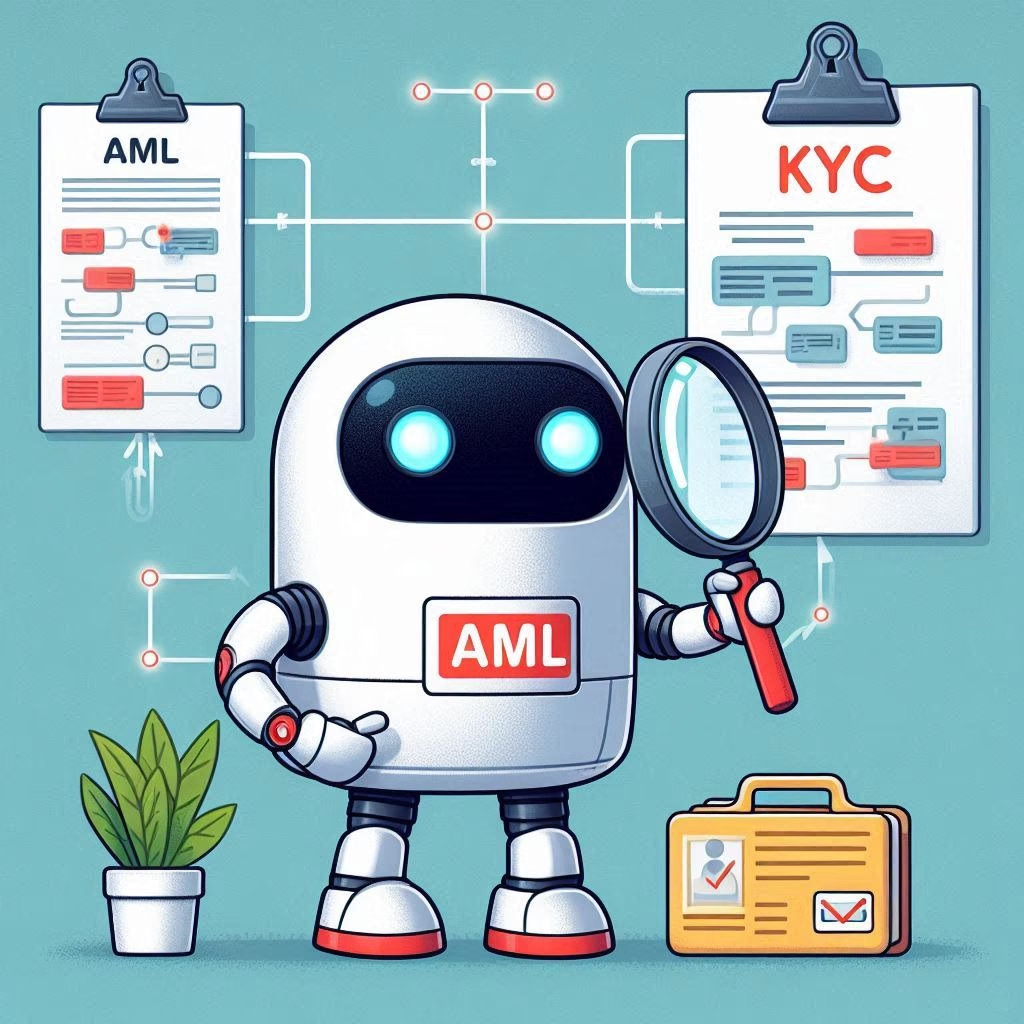
Understanding the difference between AML and KYC is essential for compliance professionals, bankers, and anyone working in the financial services industry. While these two terms are often used interchangeably, they serve distinct but interconnected purposes in the fight against financial crime.
Anti-Money Laundering (AML) and Know Your Customer (KYC) are both critical components of financial regulations aimed at preventing illegal activities[reference:0]. However, they operate at different levels: AML is the comprehensive framework that encompasses policies, procedures, and regulations to detect and prevent money laundering, while KYC is a specific subset of that framework focused on verifying customer identity and assessing risk[reference:1].
Authored by Adv. Shoeb Hakim—a criminal defence, AML, digital forensics, and cybercrime specialist who has trained police since 1995—this comprehensive guide breaks down the difference between AML and KYC, their components, and why both are essential for maintaining the integrity of the financial system in 2026.
What Is the Difference Between AML and KYC?
The fundamental difference between AML and KYC lies in their scope and purpose:
- AML (Anti-Money Laundering) is a broad, comprehensive regulatory framework designed to prevent, detect, and report money laundering and other financial crimes. It includes multiple components such as customer due diligence, transaction monitoring, suspicious activity reporting, record-keeping, and compliance programs[reference:2].
- KYC (Know Your Customer) is a specific process within the AML framework focused on verifying the identity of customers and assessing their risk profile before and during the business relationship[reference:3][reference:4].
Think of it this way: KYC is what you do to know your customer; AML is the broader system that governs how you monitor, detect, and respond to suspicious activity over time[reference:5].
Key Differences Between AML and KYC
To fully grasp the difference between AML and KYC, let’s examine them across several dimensions:
1. Scope
AML: Encompasses a broad range of policies, procedures, and regulations designed to detect and prevent money laundering and other financial crimes[reference:6]. It includes risk assessment, transaction monitoring, illicit activity flagging, and suspicious activity reporting[reference:7].
KYC: Focuses specifically on customer identification and risk assessment[reference:8]. It involves collecting and verifying personal information, such as name, address, and identification documents[reference:9].
2. Objective
AML: The primary goal is to prevent criminals from disguising illegally obtained funds as legitimate income and to detect and report suspicious behavior[reference:10].
KYC: The main aim is to confirm customer identity, assign risk, and ensure that financial institutions know who their customers are and understand the nature of their business[reference:11].
3. Timing
AML: Operates in real-time and retrospectively through ongoing transaction monitoring and surveillance[reference:12].
KYC: Primarily occurs at customer onboarding and during periodic refreshes[reference:13]. KYC functions as a point-in-time snapshot, whereas AML acts as a continuous recording[reference:14].
4. Components
AML: Includes customer due diligence, transaction monitoring, suspicious activity reporting, record-keeping, compliance programs, sanctions screening, and risk assessments[reference:15].
KYC: Involves collecting and verifying personal information, conducting risk assessments, and understanding the nature of customer activities[reference:16].
5. Relationship
AML: KYC is one component of the broader AML framework[reference:17]. AML governs how you monitor and respond over time[reference:18].
KYC: KYC delivers the verified identity data that AML monitoring depends on, but AML does not stop when KYC is done[reference:19].
The Relationship: How KYC Fits into AML
Understanding the difference between AML and KYC requires recognising how they work together. KYC is the foundation upon which effective AML programs are built[reference:20].
Here is how they interact:
- KYC establishes who the customer is at onboarding by verifying identity documents, understanding the nature of their business, and assessing their risk profile[reference:21].
- AML governs what you do with that information over time through transaction monitoring, sanctions screening, and suspicious activity reporting[reference:22].
- KYC data feeds into AML systems, providing the baseline against which transactions are monitored for anomalies[reference:23].
In essence, KYC is the “who” and AML is the “what”—KYC tells you who your customer is, and AML tells you what they are doing with their money.
Regulatory Framework: AML and KYC in 2026
The difference between AML and KYC is also reflected in how they are regulated. Here are the key regulatory developments in 2026:
FATF 40 Recommendations
The Financial Action Task Force (FATF) 40 Recommendations serve as the global benchmark against which every country’s AML program is measured[reference:24]. Key recommendations include:
- Recommendation 10 (Customer Due Diligence): Requires financial institutions to verify customer identities, understand the nature of customer relationships, and assess money laundering risks[reference:25]. This is the foundation of KYC requirements[reference:26].
- Recommendation 24 (Transparency of Legal Persons): Addresses beneficial ownership of companies[reference:27].
- Recommendation 25 (Transparency of Legal Arrangements): Addresses beneficial ownership of trusts[reference:28].
RBI KYC Master Direction (India)
The Reserve Bank of India’s Master Direction on KYC governs all aspects of customer identification for regulated entities[reference:29]. Key 2026 updates include:
- Risk-based KYC update cycles: High-risk customers must update KYC every two years, medium-risk customers every five years, and low-risk customers every ten years[reference:30].
- Digital onboarding provisions: Updated to address emerging risks in digital onboarding[reference:31].
- Video-based Customer Identification Process (V-CIP): Enabled for remote verification[reference:32].
SEBI KYC Reforms (India)
SEBI proposed wide-ranging reforms in January 2026 to simplify client onboarding through a centralised KYC framework[reference:33]. Key measures include:
- Mandatory periodic KYC reviews every five years from the date of account creation or last update[reference:34][reference:35].
- Centralised KYC information sharing at KYC Registration Agencies (KRAs) level[reference:36].
- Digital KYC for NRIs and overseas investors to enable seamless digital onboarding[reference:37].
EU AMLR (Anti-Money Laundering Regulation)
Regulation (EU) 2024/1624 creates a directly applicable “single rulebook” for AML/CFT across the EU, effective from 10 July 2027[reference:38]. Key provisions include:
- Risk-based AML/CFT measures and customer due diligence[reference:39]
- Standardised KYC update cycles: High-risk customers at least annually, standard customers every five years[reference:40]
- Business verification and beneficial ownership requirements[reference:41]
FinCEN Developments (USA)
Key 2026 developments from FinCEN include:
- Risk-based relief from repeat beneficial ownership verification requirements[reference:42]
- Proposed AML program reform introducing a two-pronged framework[reference:43]
- Customer Identification Program (CIP) rules for stablecoin issuers under the GENIUS Act[reference:44]
Why Both AML and KYC Matter in 2026
Understanding the difference between AML and KYC is not just an academic exercise—it has practical implications for compliance professionals:
For Compliance Officers
- KYC ensures you know who your customers are at onboarding[reference:45]
- AML ensures you monitor what they do over time[reference:46]
- Together, they form a comprehensive defence against financial crime[reference:47]
For Financial Institutions
- KYC failures can lead to onboarding criminals who then use your institution for money laundering
- AML failures can lead to undetected suspicious activity and regulatory penalties
- Both are required for regulatory compliance and maintaining customer trust
For Customers
- KYC protects customers from identity theft and fraud
- AML protects the financial system from being used for criminal purposes
- Both contribute to a safer, more trustworthy banking environment
Common Misconceptions About AML and KYC
When discussing the difference between AML and KYC, several misconceptions often arise:
| Misconception | Reality |
|---|---|
| AML and KYC are the same thing | KYC is a specific subset of the broader AML framework[reference:48] |
| KYC is only done at onboarding | KYC requires periodic updates based on risk profile[reference:49] |
| AML is just about filing SARs | AML includes KYC, transaction monitoring, sanctions screening, risk assessment, and more[reference:50] |
| Once KYC is done, compliance is complete | KYC is the beginning; AML monitoring continues throughout the relationship[reference:51] |
Conclusion
The difference between AML and KYC is clear: AML is the comprehensive framework that includes policies, procedures, and regulations to prevent money laundering and financial crimes, while KYC is the specific process within that framework focused on verifying customer identity and assessing risk[reference:52][reference:53].
Both are essential for maintaining the integrity of the financial system. KYC provides the foundation by establishing who the customer is, while AML ensures ongoing monitoring and detection of suspicious activity[reference:54]. In 2026, with evolving regulations from FATF, RBI, SEBI, FinCEN, and the EU AMLR, understanding this distinction is more important than ever for compliance professionals.
Whether you are a compliance officer, a banker, or a customer, recognising the difference between AML and KYC helps you appreciate how these interconnected frameworks work together to protect the financial system from exploitation by criminals.
Frequently Asked Questions
Q1: What is the main difference between AML and KYC?
The main difference between AML and KYC is that AML is a broad regulatory framework to prevent money laundering, while KYC is a specific process within that framework focused on verifying customer identity and assessing risk[reference:55].
Q2: Is KYC part of AML?
Yes, KYC is a specific component of the broader AML framework[reference:56]. KYC establishes who the customer is, while AML governs how you monitor and respond over time[reference:57].
Q3: Which comes first, AML or KYC?
KYC comes first at customer onboarding to verify identity and assess risk[reference:58]. AML monitoring begins after onboarding and continues throughout the customer relationship[reference:59].
Q4: What are the key components of AML?
AML includes customer due diligence (including KYC), transaction monitoring, suspicious activity reporting, record-keeping, compliance programs, sanctions screening, and risk assessments[reference:60].
Q5: What are the key components of KYC?
KYC involves collecting and verifying personal information (name, address, identification documents), conducting risk assessments, and understanding the nature of customer activities[reference:61].
Q6: How often should KYC be updated?
In India, RBI requires high-risk customers to update KYC every two years, medium-risk customers every five years, and low-risk customers every ten years[reference:62]. SEBI has also proposed mandatory KYC reviews every five years[reference:63].
Q7: What happens if a bank fails AML or KYC compliance?
Consequences include severe financial penalties, reputational damage, loss of customer trust, operational restrictions, legal action against directors, and in extreme cases, license revocation.
📚 Related Compliance Guides on Adv. Shoeb Hakim’s Website:
- Compliance Officer in a Stock Broking Company: Duties & 2026 Guide
- Compliance Department Roles and Responsibilities: 2026 Guide
- Group Legal, Compliance & Secretariat (LCS): Functions & 2026 Guide
- AML Interview Questions and Answers: 2026 Guide
- Importance of AML in Banking: 2026 Guide
📌 Explore More on Adv. Shoeb Hakim’s Website:
- Read More Articles on the Blog
- Book a Consultation with Adv. Shoeb Hakim
- Contact Adv. Shoeb Hakim
- Careers & Opportunities
By Adv. Shoeb Hakim
Criminal defence, AML, digital forensics, and cybercrime specialist; former Head of AML & Client ID (AVP), Credit Suisse; training police and judiciary since 1995.
📌 Connect: https://www.linkedin.com/in/shoebhakim | https://shoebhakim.com/shoeb-hakim-blog/
📌 Visit my website for more articles: https://shoebhakim.com
📌 Visit my website for legal knowledge: https://www.vakilverse.com
📌 Visit my website for research fellowship: https://www.legalcomplaince.in
Disclaimer: This content is for informational purposes only and does not constitute legal advice. Readers should consult qualified legal counsel for advice on their specific circumstances.
Additional Page Metadata
- Author: Adv. Shoeb Hakim
- Author Bio: Adv. Shoeb Hakim is a Mumbai-based criminal defence, AML, digital forensics and cybercrime specialist. Former Head of AML & Client ID (AVP) at Credit Suisse. Has been training police and judiciary since 1996. Provides expert commentary on anti-money laundering, KYC compliance, financial crime prevention, and regulatory risk management.
- Article Publisher: Adv. Shoeb Hakim
- Article Section: Anti-Money Laundering | KYC Compliance | Financial Crime | Regulatory Compliance | Risk Management
- Article Tags: Difference Between AML and KYC, AML vs KYC, Anti-Money Laundering, Know Your Customer, KYC Compliance, AML Framework, FATF 40 Recommendations, RBI KYC Master Direction, SEBI KYC Reforms, EU AMLR, FinCEN, Financial Crime, Adv Shoeb Hakim
#DifferenceBetweenAMLAndKYC #AMLvsKYC #AntiMoneyLaundering #KnowYourCustomer #AMLCompliance #KYCCompliance #FATF #RBI #SEBI #FinCEN #EUAMLR #FinancialCrime #BankingCompliance #CustomerDueDiligence #RiskManagement #MoneyLaundering #ComplianceMatters #FinancialSecurity #AdvShoebHakim