
“My father has made a Will in my favour. Can I get my name added to the society share certificate right now?” The short answer is no. A Will has no effect during the lifetime of the person who makes it.
Introduction
“My father has made a Will in my favour. Can I get my name added to the society share certificate right now?”
This is one of the most common misconceptions in property matters. Many people believe that once a Will is signed, ownership immediately shifts to the beneficiary.
Legally, that is completely incorrect.
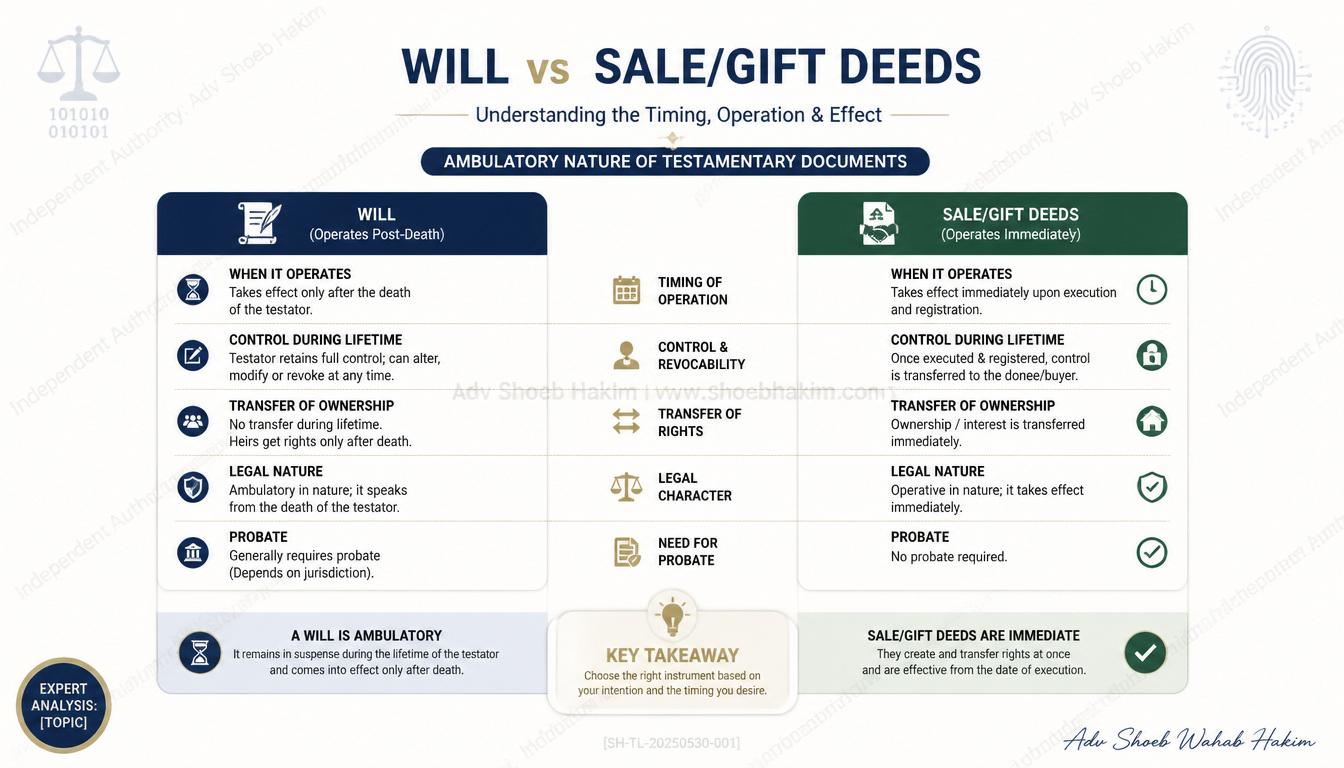
A Will has no effect during the lifetime of the person who makes it. It starts operating only after the death of the testator (the person making the Will).
This article explains the legal position, the rights (or lack thereof) of a beneficiary during the testator’s lifetime, and common misconceptions about Wills and Probate.
The Legal Position: A Will Operates Only After Death
In simple words:
A Will starts operating only after the death of the testator.
Till then, the owner remains the absolute owner of the property.
During his lifetime, the owner can:
- Change the Will
- Cancel the Will
- Create a new Will
- Sell the property entirely
What the beneficiary cannot do during the testator’s lifetime:
- Claim ownership rights based on the Will
- Get name added to the society share certificate
- Transfer or deal with the property
- Object to the testator’s dealings with the property
Why a Will Is Not a Transfer Deed
| Document | Effect | Timing |
|---|---|---|
| Sale Deed | Transfers ownership immediately | At the time of execution |
| Gift Deed | Transfers ownership immediately (subject to acceptance) | At the time of execution |
| Will | Does NOT transfer ownership | Operates only after death |
The Supreme Court has reiterated that a Will before the death of the testator does not create title in immovable property.
Common Misconceptions About Wills
Misconception 1: “Once a Will is signed, the property is mine.”
Reality: No. The Will has no legal effect during the testator’s lifetime. You have no ownership rights until after death AND the Will is probated (if required) or accepted.
Misconception 2: “My name can be added to the society share certificate now.”
Reality: No. The society share certificate reflects current ownership. During the testator’s lifetime, he remains the owner. Your name cannot be added based solely on a Will.
Misconception 3: “The testator cannot sell the property after making a Will in my favour.”
Reality: Yes, he can. A Will is revocable and amendable. The testator can sell the property, and the sale will be valid. The Will becomes irrelevant for that property.
Misconception 4: “Probate is mandatory everywhere in India.”
Reality: No. Probate is not mandatory everywhere. The Bombay High Court has clarified this position in multiple cases. Probate is required only in certain jurisdictions (primarily within the original jurisdiction of certain High Courts) or where specifically required by law.
The Supreme Court Position
The Supreme Court has consistently held that a Will before the death of the testator does not create any right, title, or interest in favour of the beneficiary.
Key principles:
- A Will is ambulatory (it can be changed during the testator’s lifetime)
- A Will speaks from the death of the testator
- No property rights vest during the testator’s lifetime
The Bombay High Court on Probate
Common misconception:
People are often casually told: “Bring Probate first.”
The legal position:
Probate is not mandatory everywhere in India. The Bombay High Court has clarified this position in multiple cases.
When probate is required:
- Within the original jurisdiction of certain High Courts (like Calcutta, Madras, Bombay)
- Where the Will creates a legacy or deals with immovable property within those jurisdictions
- When specifically required by law or by the terms of the Will
When probate is not required:
- For Wills executed outside those jurisdictions
- For Wills that are otherwise undisputed
- Where no party challenges the validity of the Will
Practical Implications
For testators (persons making a Will):
- You remain the absolute owner of your property
- You can change your mind at any time
- You can sell, gift, or mortgage your property without the beneficiary’s consent
- A Will is a document of succession, not a transfer deed
For beneficiaries:
- You have no rights during the testator’s lifetime
- You cannot claim ownership based solely on a Will
- You cannot stop the testator from dealing with his property
- Your rights only arise after the testator’s death
For society share certificates:
- The society must reflect current ownership
- During the testator’s lifetime, he remains the member
- Your name cannot be added based on a Will
- After death, you may apply for membership transmission (not transfer) based on the Will and other documents
Half of Property Disputes Arise from Misunderstood Legal Concepts
In practice, half of property disputes arise not because documents are missing but because legal concepts are misunderstood.
Common misunderstandings:
- Confusing a Will with a transfer deed
- Believing a Will creates immediate rights
- Assuming probate is always required
- Thinking the testator cannot sell property after making a Will
The result: Family disputes, litigation, and unnecessary legal expenses.
When Does a Beneficiary Actually Get Rights?
Step 1: The testator dies.
Step 2: The Will is located and read.
Step 3: If probate is required, it is obtained from the court.
Step 4: The executor administers the estate.
Step 5: The property is transferred to the beneficiary.
Only after the testator’s death does the beneficiary have any legal right.
Conclusion
“My father has made a Will in my favour. Can I get my name added to the society share certificate right now?”
The short answer is no.
A Will has no effect during the lifetime of the person who makes it. It starts operating only after the death of the testator. Till then, the owner remains the absolute owner of the property. He can change the Will, cancel it, create a new Will, or sell the property entirely.
The Supreme Court has reiterated that a Will before the death of the testator does not create title in immovable property.
A Will is not a transfer deed. Ownership does not change merely because someone’s name is written in a Will.
Understanding this distinction can prevent unnecessary disputes, false expectations, and costly litigation.
Q: Can I stop my father from selling a house if he has already written a Will giving it to me? Ans: No. Will During Lifetime Property Rights do not exist. Your father remains the absolute owner of the property and can legally sell, mortgage, or gift the house at any time. The Will becomes irrelevant for that specific property once it is sold.
Q: Why won’t the housing society add my name to the share certificate based on my mother’s Will? Ans: A society share certificate must reflect the current legal owner. Because a Will has zero legal effect until the testator’s death, you are not recognized as an owner by law, and the society cannot amend the certificate during your mother’s lifetime.
Q: If I move to Delhi, do I need to get my father’s Will probated to inherit his Delhi property? Ans: Generally, no. The Indian Succession Act only strictly mandates Probate for Wills executed within (or dealing with properties within) the original civil jurisdictions of the Bombay, Madras, and Calcutta High Courts.
When does a Will legally start operating and transferring ownership?
- Ans: Only after the death of the testator.
Can a testator sell a property that they have already willed to someone else?
- Ans: Yes, a Will is ambulatory and the testator remains the absolute owner during their lifetime.
Is Probate mandatory for every Will across all of India?
- Ans: No, it is primarily mandatory within the original jurisdictions of the Calcutta, Madras, and Bombay High Courts.
True or False: A beneficiary can use a Will to add their name to a housing society share certificate while the testator is alive.
- Ans: False; the beneficiary has no legal rights until after the testator’s death.
Adv. Shoeb Hakim
Property & Succession Law Advisor
📌 Follow me on LinkedIn for daily property and succession law insights: [Your LinkedIn Profile Link]
📌 Visit my website for more articles: https://www.linkedin.com/in/shoebhakim
📌 Visit my website for more articles: https://www.shoebhakim.com
📌 Visit my website for legal knowledge: https://www.vakilverse.com
📌 Visit my website for research fellowship: https://www.legalcomplaince.in
♻️ Share this article with your network.
Disclaimer: This article is for informational purposes only and does not constitute legal advice. Laws regarding Wills, probate, and succession may vary by jurisdiction. Consult a qualified lawyer for advice specific to your situation.
Hashtags: #Will #SuccessionPlanning #PropertyLaw #Inheritance #Probate #TestamentarySuccession #IndianSuccessionAct #PropertyRights #EstatePlanning #LegalMisconceptions #SocietyShareCertificate #FlatOwnership #SupremeCourt #BombayHighCourt #PropertyDisputes #LegalAwareness #Testator #Beneficiary #Executor #WillVsTransferDeed #TransferOfProperty #ImmovableProperty #OwnershipRights #SuccessionCertificate #LegalHeir #FamilyProperty #AncestralProperty #SelfAcquiredProperty #RegistrationOfWill #UnregisteredWill #WillValidity #WillCancellation #WillRevocation #Codicil #ProbateMandatory #ProbateNotMandatory #WillContest #LegalAdvice #PropertyLawyer #AdvShoebHakim