On the International Day in Support of Victims of Torture, we revisit the custodial deaths of Jayaraj and Bennix—a case that remains a wound on India’s conscience.
Introduction
Five years ago, Jayaraj and Bennix were tortured to death in a Tamil Nadu police station. Their crime? Keeping a mobile shop open beyond curfew during the COVID-19 lockdown.
Nine policemen were convicted and sentenced to death in April 2026. A rare moment of accountability. But has anything really changed?
On the International Day in Support of Victims of Torture—observed on 26 June, the date the UN Convention Against Torture entered into force —we revisit the Sathankulam case. Not as a historical tragedy, but as a mirror reflecting the systemic rot that continues to enable custodial violence.
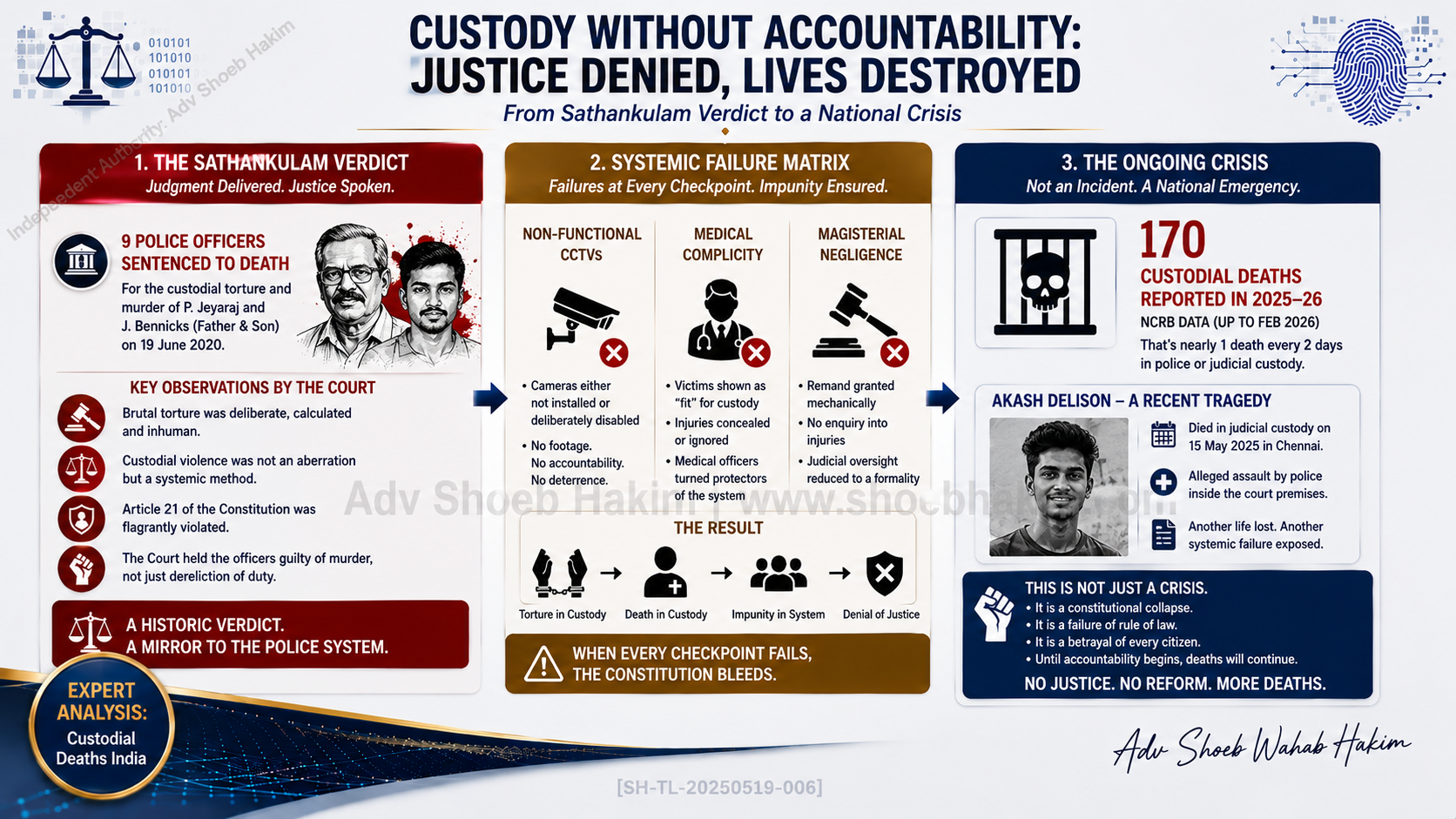
The truth is uncomfortable: Between 2021 and 2026, custodial deaths in India ranged between 140 and 176 annually . In 2025-26 alone, 170 people died in custody . India has not ratified the UN Convention Against Torture . UN experts have warned of “systemic policing failures” . The system that enabled Sathankulam remains largely intact.
The Case That Shook India
The Crime:
Jayaraj, a 59-year-old mobile shop owner in Sathankulam, Thoothukudi district, and his 31-year-old son Bennix were detained on 19 June 2020 for allegedly keeping their shop open beyond permitted hours .
What followed was unspeakable cruelty. According to the CBI chargesheet:
- The father and son were stripped and beaten with lathis
- They were tortured through the night
- DNA evidence showed their blood on police station walls, floors, and lathis
- They were forced to wipe their own blood off the floor with their clothes
Despite their injuries, a government medical officer declared them “fit for remand” . The magistrate failed to physically examine them . The system—designed to protect—failed at every level.
Bennix died on 22 June 2020. Jayaraj died on 23 June 2020 .
The Cover-Up:
The police initially claimed the two had verbally abused officers, resisted arrest, and sustained injuries by rolling on the ground . Eyewitnesses and the CBI investigation contradicted this entirely .
The CBI chargesheet described the torture as a “criminal conspiracy” by the accused police officers, who were aware that the “deliberately inflicted” and “severe bleeding injuries” were sufficient to cause death .
The Verdict: A Rare Moment of Accountability
In April 2026, a sessions court in Madurai convicted nine police personnel and sentenced all nine to death .
| Aspect | Details |
|---|---|
| Verdict date | 6 April 2026 |
| Convicted | Nine police personnel (a tenth died before chargesheet) |
| Sentence | Death penalty |
| Category | “Rarest of rare” case |
What the judge said:
“If ordinary citizens had committed the same crime, they would have received ordinary punishment. But here, the crime was committed by the police themselves.”
The judge referenced the murder of George Floyd, the 2019 custodial death of Ajeeth Kumar, and noted: “The act was committed by policemen who were mentally sound, educated, and salaried government employees” .
Human rights activist Henri Tiphagne called the verdict comprehensive, but cautioned that punishing individual officers is not the same as systemic reform .
What Hasn’t Changed
The Data:
The Systemic Failures:
- No anti-torture law: India has signed but not ratified the UN Convention Against Torture. Torture is not explicitly criminalised in domestic law .
- Culture of impunity: Police personnel often perceive violence as a necessary means to achieve justice, especially when the formal legal process is seen as slow . The hierarchical structure of police forces fosters a culture where aggression is valorised .
- Magisterial failure: Magistrates often fail to scrutinise grounds for arrest, physically examine accused persons, or engage meaningfully to uncover signs of mistreatment .
- Medical complicity: Doctors frequently fail to document custodial torture adequately. In the Sathankulam case, the doctor noted injuries as “abrasions” rather than the severe trauma they were .
- CCTV non-compliance: The Supreme Court mandated CCTV cameras in police stations (Paramvir Singh Saini v. Baljit Singh, 2020). Compliance is minimal, and cameras are often “conveniently non-functional” .
- UN warnings: In February 2026, UN experts urged the Indian government to launch independent investigations into “alarming allegations of hundreds of extrajudicial killings and torture-related deaths” .
- High risk classification: The Global Torture Index (2026) classifies India as a “high risk” country for torture and ill-treatment by police and security forces .
The Institutional Failure
As Anup Surendranath, Professor of Law at NALSAR, observed:
“Custodial violence should not be dismissed as the actions of a few ‘bad apples’ within the system. Such behaviour is perpetuated by entrenched social hierarchies and an enduring colonial mindset within the police, where the public, particularly marginalised communities, is viewed not as citizens to be protected, but as subjects to be controlled.”
The Sathankulam verdict is not justice—it is a deflection:
Amnesty International responded to the death sentences by stating:
“The death penalty is the ultimate cruel, inhuman, and degrading punishment. It neither deters torture nor delivers systemic change. Justice for Jayaraj, Bennix and thousands of others lies in transforming the institutions that enabled their deaths and ensuring it will never happen again.”
The Case That Continues: Akash Delison
In March 2026, Akash Delison, a 26-year-old Dalit man, died in custody in Tamil Nadu . His parents allege he was brutally tortured by police. His autopsy documents over two dozen external and internal injuries, including broken bones, brain haemorrhages, and swelling in his heart and lungs .
Almost two months later, his body remains in the morgue. His parents refuse to conduct the last rites until the police responsible are arrested .
His father said:
“Akash wanted to become a lawyer so that he could help our community. They [the police] have snuffed out the life of an active young man who had big dreams for the future.”
What Must Change
1. Criminalise Torture
India must ratify the UN Convention Against Torture and enact a standalone domestic law explicitly criminalising torture .
2. Independent Oversight
Police Complaints Authorities, as mandated by the Supreme Court in Prakash Singh v. Union of India (2006), must be established with genuine independence—not including serving police officers .
3. End the Culture of Impunity
As The New Indian Express editorial stated: “It is not the death sentence—which has no place in a system of reformative justice—but the certainty of punishment that is the true deterrent” .
4. Reform Policing Culture
Training must sensitise police personnel to implicit biases and adopt scientific interrogation techniques . The colonial mindset of policing as control, not service, must be dismantled.
5. Empower Marginalised Communities
Those most often subjected to custodial violence belong to vulnerable communities—Dalits, Adivasis, Muslims, LGBTQIA+ individuals, and migrant labourers . They must be enabled to access legal and constitutional remedies .
6. Enforce Supreme Court Directives
CCTV installation in police stations must be enforced. Magistrates must fulfil their statutory role as the first line of defence against police excesses . The arrest of the accused must be accompanied by a physical examination and meaningful engagement .
Conclusion
On this International Day in Support of Victims of Torture, we remember Jayaraj and Bennix. We also remember Akash Delison, Ajith Kumar, and the 170 others who died in custody in 2025-26.
The verdict in the Sathankulam case was rare. It was necessary. But it was not enough.
As Anup Surendranath wrote in the Times of India:
“If Sathankulam is to mean anything, it must push us beyond the shallowness of the death penalty. It must force us to ask what we are really doing to prevent other Jayaraj and Bennix.”
The institutions that enabled custodial violence remain largely unchanged. Until India criminalises torture, enforces independent oversight, and ends the culture of impunity, the next Sathankulam is only a matter of time.
Five years after Jayaraj and Bennix, the question remains: Has anything really changed?
The answer, sadly, is not enough. The fight for justice must continue.
KNOWLEDGE CHECK QUIZ
Q: What specific event was the catalyst for the tragic custodial deaths of Jayaraj and Bennix in 2020? Ans: They were detained by the Sathankulam police for allegedly keeping their mobile shop open 15 minutes beyond the permitted hours during the COVID-19 lockdown.
Q: In April 2026, what judicial sentence was awarded to the nine convicted police personnel in the Sathankulam case? Ans: The sessions court in Madurai classified the murders as a “rarest of rare” case and sentenced all nine convicted police personnel to the death penalty.
Q: Which landmark 2020 Supreme Court judgment mandated the installation of audio-video CCTV cameras in all police stations across India? Ans: Paramvir Singh Saini v. Baljit Singh (2020).
Q: What ongoing 2026 case highlights the continuation of custodial violence against marginalized communities in Tamil Nadu? Ans: The custodial death of Akash Delison, a 26-year-old Dalit man who died in March 2026 after suffering brutal external and internal injuries, prompting his family to refuse his body until the responsible officers are arrested.
───
FREQUENTLY ASKED QUESTIONS (FAQ)
Q: Has India ratified the United Nations Convention Against Torture (UNCAT)? Ans: No. India signed the UN Convention Against Torture in 1997 but has never ratified it. Furthermore, India lacks a standalone, comprehensive domestic law that explicitly defines and criminalizes torture by state actors.
Q: Why do courts and human rights groups emphasize the role of Magistrates in preventing custodial deaths? Ans: The Magistrate is the first independent judicial officer an arrested person sees (within 24 hours of arrest). They have a statutory duty to physically examine the accused, inquire about police mistreatment, and ensure the arrest was legally justified. When Magistrates fail to perform this duty and mechanically grant police remand, they silently enable the torture to continue.
Q: If the police claim the CCTV cameras were “not working” during an alleged torture incident, what legal recourse is available? Ans: The Supreme Court has specified that Station House Officers (SHOs) are responsible for the maintenance and functionality of CCTVs. If footage is “lost” or cameras are non-functional during a critical period, defense lawyers can argue for adverse inference (presuming the police are hiding evidence of abuse), file for contempt of the Supreme Court’s orders, and demand independent probes by Oversight Committees.
Adv. Shoeb Hakim
Human Rights & Criminal Justice Advisor
📌 Follow me on LinkedIn for daily human rights and criminal justice insights: https://www.linkedin.com/in/shoebhakim
📌 Visit my website for more articles: https://www.shoebhakim.com
📌 Visit my website for legal knowledge: https://www.vakilverse.com
📌 Visit my website for research fellowship: https://www.legalcomplaince.in
♻️ Share this article with your network.
Disclaimer: This article is for informational purposes only and does not constitute legal advice.
Hashtags: #AdvShoebHakim #InternationalDayInSupportOfVictimsOfTorture #CustodialViolence #JayarajAndBennix #PoliceReform #HumanRights #TorturePrevention #JusticeForJayaraj #Sathankulam #PoliceAccountability #EndTorture #RuleOfLaw #CriminalJusticeReform #UNConventionAgainstTorture #CustodialDeaths #PoliceBrutality #Justice #HumanRightsIndia #PoliceExcesses #MagisterialOversight #MedicalNegligence #CCTVInPoliceStations #PrakashSingh #ParamvirSinghSaini #UNHumanRights #AkashDelison #AjithKumar #GeorgeFloyd #RarestOfRare #DeathPenaltyDebate #CertaintyOfPunishment #Impunity #SystemicReform #PoliceCulture #Decolonisation #BNSS #CRPC #IndianEvidenceAct #Section27 #NHRC #AmnestyInternational #GlobalTortureIndex #OMCT