

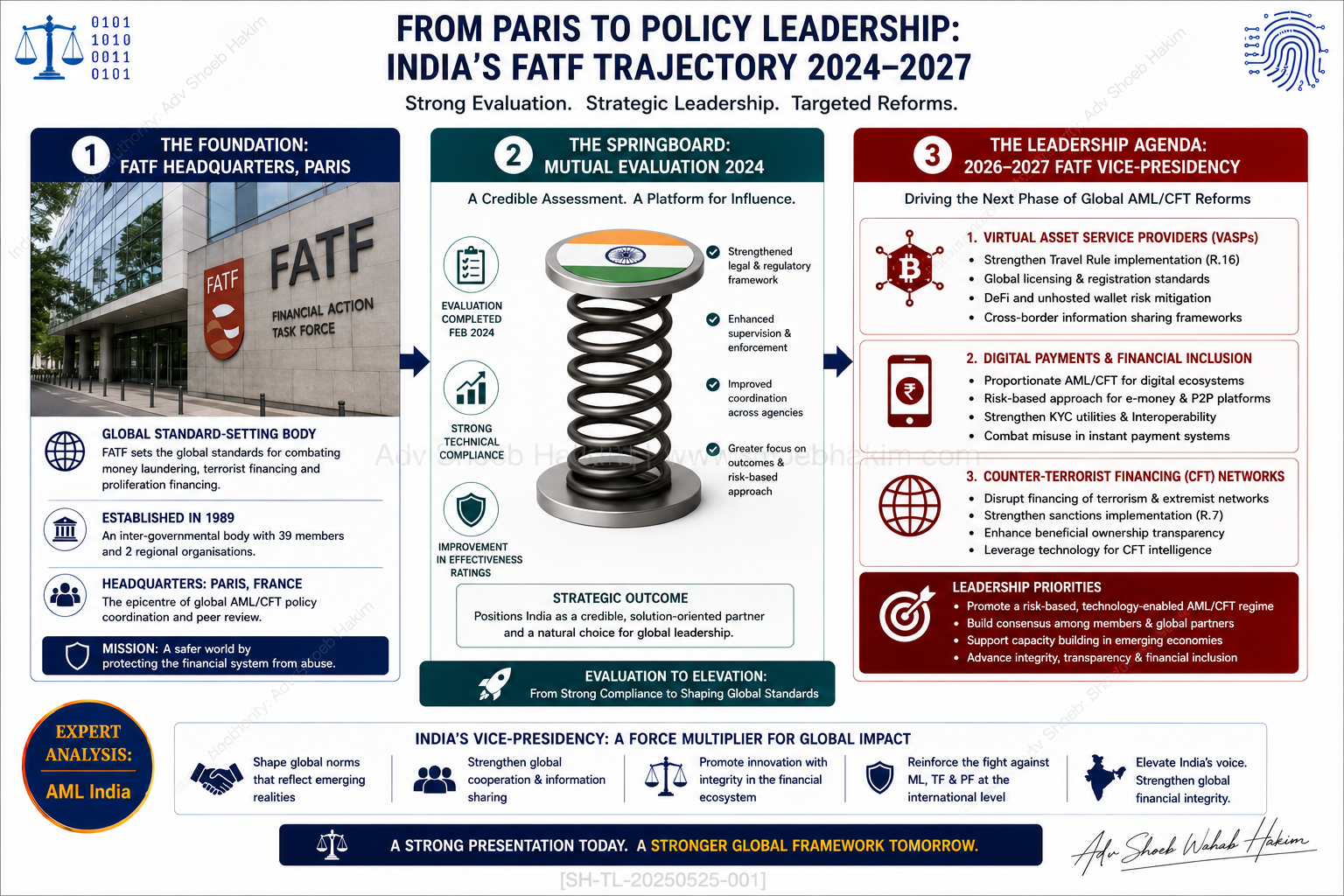
For the first time in its 37-year history, India has been elected to the Vice-Presidency of the Financial Action Task Force, the global standard-setting body for anti-money laundering and counter-terrorist financing.
Introduction
For the first time in its 37-year history, India has secured the Vice-Presidency of the Financial Action Task Force (FATF). Vivek Aggarwal, a 1994-batch Indian Administrative Service (IAS) officer of the Madhya Pradesh cadre and currently Secretary, Ministry of Culture, has been appointed Vice-President for the term July 2026 to June 2027.
This is not just a diplomatic honour—it is a recognition of India’s growing influence in the global fight against money laundering and terrorist financing. This article analyzes the significance of this achievement, the individual appointed, and its implications for India’s role in global financial governance.
The Appointment
The FATF Plenary, the organisation’s highest decision-making body, approved Aggarwal’s appointment at its meeting held at the FATF’s headquarters in Paris.
Who Is Vivek Aggarwal?
Vivek Aggarwal is a 1994-batch IAS officer with more than 30 years of administrative experience.
Key roles held:
His qualifications: Aggarwal has worked in several key roles in both the Union and state governments, covering areas such as finance, agriculture, urban development, infrastructure, and public policy.
The Significance of the Appointment
A first for India: This is the first time India will hold the Vice-Presidency of the FATF. The country has been a member of the influential body since 2010.
What this reflects:
The Vice-President’s role: The FATF Vice-President assists the President in guiding the organisation’s work and shaping global policy responses to emerging financial threats. The Presidency runs on a two-year term, with the Vice-President playing a key supporting role.
The FATF: An Overview
The FATF’s mandate: The FATF leads global action to tackle money laundering, terrorist and proliferation financing. The body sets international standards to ensure national authorities can effectively go after illicit funds linked to drugs trafficking, the illicit arms trade, cyber fraud, and other serious crimes.
FATF Recommendations: First issued in 1990, the FATF Recommendations were revised in 1996, 2001, 2003, 2012, and most recently in February 2025 to ensure they remain up to date and relevant. They are intended to be of universal application.
India’s Journey to FATF Leadership
India’s membership: India has been a member of the FATF since 2010.
The Mutual Evaluation: India’s last Mutual Evaluation report was released in 2024, during Aggarwal’s tenure as Additional Secretary in the Union Finance Ministry.
The outcome: The Ministry of Finance highlighted that India’s elevation to the FATF leadership reflects the confidence and trust it has earned within the FATF Global Network, which comprises more than 200 jurisdictions.
The Statements
Vivek Aggarwal:
“This appointment is a recognition of India’s collective effort and of the strength of our anti-money-laundering and counter-terrorist-financing framework. I am deeply honoured to serve, and look forward to working with the FATF Global Network to keep the international financial system safe, inclusive and resilient.”
Revenue Secretary Arvind Shrivastava:
“It is a proud milestone for the country and reaffirms India’s continued commitment to strengthening the integrity of the international financial system.”
Ministry of External Affairs Spokesperson Randhir Jaiswal:
*”A major win for India” that strengthens the country’s continued efforts to fight global terrorist financing networks. Aggarwal’s “profound expertise” as the former head of India’s FATF delegation will help the organisation move forward its mandate to secure financial integrity.
Implications for India
| Aspect | Impact |
|---|---|
| Global influence | India’s voice in shaping international AML/CFT standards is strengthened |
| Policy shaping | India can influence emerging standards on virtual assets and digital payments |
| Mutual Evaluation | India’s strong performance is validated |
| Financial integrity | India’s commitment to international financial security is reinforced |
| International cooperation | India’s role in global financial governance is enhanced |
The appointment is being viewed as a major endorsement of India’s expanding role in global financial governance at a time when cross-border financial crimes, illicit fund flows, and terrorism financing continue to pose serious challenges to economies worldwide.
The Global Context
Financial crime challenges: Cross-border financial crimes, illicit fund flows, and terrorism financing continue to pose serious challenges to economies worldwide.
Virtual asset risks: The FATF has focused on emerging risks associated with virtual asset service providers and digital payment systems. India has contributed to shaping global policy on these issues.
International cooperation: The FATF relies on international cooperation to implement its Standards. More than 200 countries and jurisdictions have committed to implement the FATF’s Standards as part of a co-ordinated global response to preventing organised crime, corruption, and terrorism.
Conclusion
In a landmark recognition of India’s growing leadership in the global fight against money laundering and terrorist financing, Vivek Aggarwal, a 1994-batch IAS officer of the Madhya Pradesh cadre and currently Secretary, Ministry of Culture, has been elected and appointed Vice-President of the FATF for the term July 2026 to June 2027.
This is the first time India will hold the Vice-Presidency of the FATF. The appointment reflects India’s strong performance in its recent Mutual Evaluation, its active contribution to shaping global policy on emerging risks, and the confidence and trust it has earned within the FATF Global Network of more than 200 jurisdictions.
Vivek Aggarwal’s appointment places an Indian official in one of the most influential leadership positions within the Paris-based intergovernmental watchdog, which sets international standards for combating money laundering, terrorist financing, and the financing of weapons proliferation.
In his statement, Aggarwal described the development as recognition of India’s collective efforts to strengthen its anti-money laundering and counter-terrorist financing framework, adding that he looks forward to working with the FATF Global Network to keep the international financial system safe, inclusive, and resilient.
India’s assumption of the FATF Vice-Presidency marks a new chapter in its engagement with global financial institutions and strengthens its voice in shaping international standards for financial security.
KNOWLEDGE CHECK QUIZ
Q: Who was appointed as the incoming Vice-President of the Financial Action Task Force (FATF) for the 2026-2027 term? Ans: Vivek Aggarwal, a 1994-batch IAS officer of the Madhya Pradesh cadre, currently serving as Secretary, Ministry of Culture, and former Director of FIU-IND.
Q: At which specific event and location was this historic appointment approved? Ans: The appointment was approved during the FATF Plenary, the organization’s highest decision-making body, held in Paris from June 17 to 19, 2026.
Q: Why is this appointment considered a historic diplomatic milestone for India? Ans: It marks the first time in the 37-year history of the FATF that an Indian official has been elected to the Vice-Presidency of the global anti-money laundering and counter-terrorist financing watchdog.
Q: How does the FATF Vice-President role intersect with the Presidency? Ans: The FATF Presidency runs on a two-year term. The Vice-President (Vivek Aggarwal) directly assists the incoming President (Giles Thomson of the UK) in steering the organization’s global mandate and shaping policy responses to emerging financial threats.
FREQUENTLY ASKED QUESTIONS (FAQ)
Q: Does India’s appointment to the FATF Vice-Presidency mean domestic financial regulations will become stricter? Ans: Yes. To maintain unparalleled credibility while leading a global watchdog, India’s domestic regulatory agencies (RBI, ED, FIU) will aggressively enforce AML/CFT compliance. The government cannot afford high-profile domestic money laundering failures while simultaneously dictating global standards in Paris.
Q: How will this leadership role impact the cryptocurrency and digital asset sector? Ans: Vivek Aggarwal brings profound expertise from his time leading FIU-IND, where India recently brought crypto exchanges under strict AML regulation. Expect the FATF to issue highly aggressive, globally binding mandates regarding Virtual Asset Service Providers (VASPs), specifically enforcing the “Travel Rule” to eliminate pseudonymity in digital transfers.
Q: What is the significance of the 2024 “Mutual Evaluation” mentioned in the context of this appointment? Ans: A Mutual Evaluation is a grueling, peer-reviewed audit of a country’s ability to actually implement FATF standards. India’s highly successful 2024 evaluation proved that its anti-terror financing and AML frameworks are globally robust. This success directly earned India the trust and credibility required to secure the Vice-Presidency among the 200+ member jurisdictions.
Adv. Shoeb Hakim
Financial Crime & AML Advisor
📌 Follow me on LinkedIn for daily financial crime and AML insights: https://www.linkedin.com/in/shoebhakim
📌 Visit my website for more articles: https://www.shoebhakim.com
📌 Visit my website for legal knowledge: https://www.vakilverse.com
📌 Visit my website for research fellowship: https://www.legalcomplaince.in
♻️ Share this article with your network.
Disclaimer: This article is for informational purposes only and does not constitute legal advice.
Hashtags: #AdvShoebHakim #FATF #India #VivekAggarwal #AML #CFT #MoneyLaundering #TerroristFinancing #FinancialCrime #GlobalGovernance #IndiaLeads #FinancialSecurity #AntiMoneyLaundering #MutualEvaluation #VirtualAssets #DigitalPayments #Paris #G20 #FinancialIntegrity #IAS #IndianDiplomacy #FinancialActionTaskForce #FATFPlenary #InternationalStandards #FinancialIntelligence #FIUIndia #RevenueDepartment #MinistryOfFinance #MinistryOfCulture #GlobalFinancialSystem #FinancialStability #IllicitFinance #CrossBorderCrime #OrganisedCrime #Corruption #CyberFraud #DrugTrafficking #ArmsTrafficking #ProliferationFinancing #FinancialRegulation #Compliance #BankingSector #FinancialInstitutions #AntiMoneyLaunderingFramework #CounterTerroristFinancing #InclusiveFinancialSystem #ResilientFinancialSystem #IndiaRising #IndiaOnWorldStage #FinancialDiplomacy
Leave a Reply