

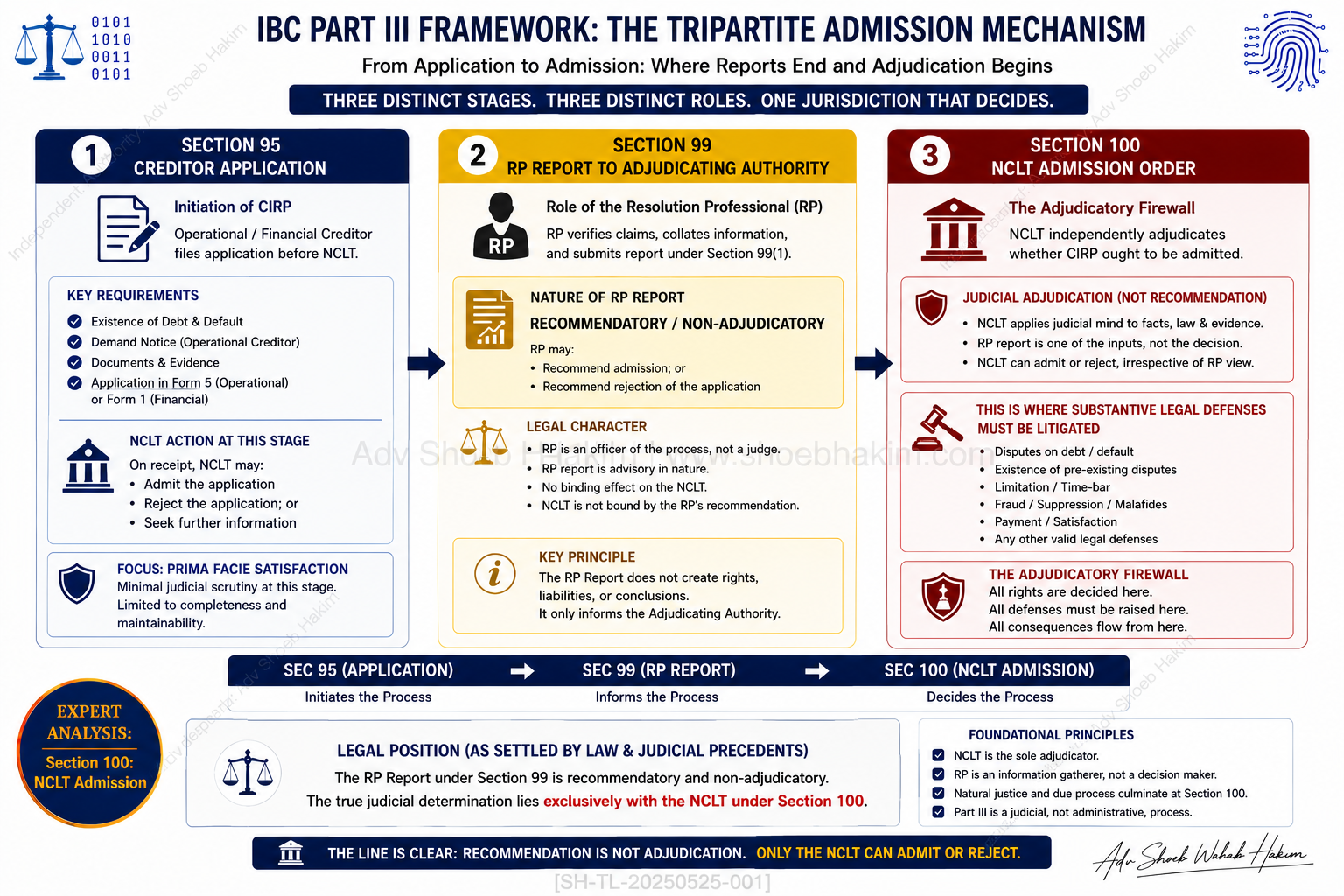
The Tribunal held that the RP’s report under Section 99 is only recommendatory. The adjudicatory function begins before the Adjudicating Authority under Section 100.
Introduction
An approved Resolution Plan. A discharged debt. A guaranteed liability that should have been extinguished. The Personal Guarantor argued that no enforceable liability survived. The NCLT said: the RP’s report is only recommendatory. The adjudicatory function begins before this Tribunal. The application was admitted.
In SBI v. Anil Dhirajlal Ambani (NCLT Mumbai), the Tribunal admitted the Section 95 application against Anil Ambani as personal guarantor for loans extended to Reliance Communications Ltd. (RCOM) and Reliance Infratel Ltd. (RITL).
This article analyzes the judgment, the key legal principles reaffirmed, and the implications for personal guarantors and financial creditors.
Brief Facts
| Aspect | Details |
|---|---|
| Applicant | State Bank of India (SBI) |
| Respondent | Anil Dhirajlal Ambani (Personal Guarantor) |
| Corporate Debtors | Reliance Communications Ltd. (RCOM) and Reliance Infratel Ltd. (RITL) |
| Application | Section 95 IBC – Personal Guarantor Insolvency |
| RP’s Recommendation | Admission recommended |
| Challenge | Personal Guarantor challenged RP’s report through Interlocutory Application (IA) |
Background:
SBI filed an application under Section 95 of the IBC seeking initiation of insolvency resolution against Anil Ambani as personal guarantor for loans extended to RCOM and RITL.
Arguments of the Personal Guarantor
| Argument | Details |
|---|---|
| RP failed to conduct proper inquiry | Under Section 99, RP must conduct independent inquiry |
| RP accepted SBI’s version | Without independently examining legal and factual issues |
| Complex questions required examination | Effect of approved RCOM Resolution Plan, discharge/extinguishment of debt, legality of invocation of guarantee |
| RP wrongly refused documents | From the Resolution Professional of RCOM |
| Detailed replies ignored | Documents submitted showing no enforceable liability survived |
| RP’s report was non-speaking | Inconclusive and violative of principles of natural justice |
Analysis of the Adjudicating Authority (NCLT)
Key findings:
1. RP’s report is recommendatory
- RP is not expected to adjudicate complex legal disputes
- Determination of subsistence of debt, effect of Resolution Plan, and extinguishment of guarantee are matters for the Tribunal under Section 100
2. Dilip B. Jiwrajka principle
The Tribunal relied upon the Supreme Court judgment in Dilip B. Jiwrajka, which clarified that:
- RP performs only a fact-finding/recommendatory function
- Adjudicatory function begins before the Adjudicating Authority under Section 100
3. RP had considered available material
- RP was justified in leaving legal issues open
- Legal issues are for the Tribunal to decide
4. The Tribunal found:
| Finding | Conclusion |
|---|---|
| Debt and default | Prima facie existed |
| Guarantee | Was a continuing guarantee |
| Resolution Plan | Had not extinguished the guarantor’s liability |
| Actual payment | Under the Resolution Plan had not occurred |
The Dilip B. Jiwrajka Principle
The Supreme Court in Dilip B. Jiwrajka v. Union of India clarified:
| Aspect | Finding |
|---|---|
| RP’s function | Fact-finding/recommendatory |
| Adjudicatory function | Begins before the Adjudicating Authority under Section 100 |
| Nature of Section 99 report | Recommendatory, not adjudicatory |
| Legal disputes | To be decided by the Tribunal, not the RP |
Section 95 and Section 99 of the IBC
| Section | Provision |
|---|---|
| Section 95 | Application by creditor for insolvency resolution of personal guarantor |
| Section 99 | Inquiry by Resolution Professional and submission of report |
| Section 100 | Admission of application by Adjudicating Authority |
The process:
- Creditor files application under Section 95
- RP conducts inquiry under Section 99
- RP submits report recommending admission or rejection
- Adjudicating Authority decides under Section 100
The Outcome
| Aspect | Result |
|---|---|
| IA challenging RP’s report | Dismissed |
| RP’s recommendation | Accepted |
| Section 95 application | Admitted |
| Insolvency resolution process | Allowed to proceed under Section 100 |
The Tribunal accepted the RP’s recommendation and allowed the insolvency resolution process against the Personal Guarantor to proceed under Section 100 of the IBC.
Implications of the Judgment
For Personal Guarantors:
| Implication | Details |
|---|---|
| Section 99 report is not final | The adjudicatory process begins at Section 100 |
| Legal disputes are for the Tribunal | Not for the RP to decide |
| Continuing guarantee survives | Resolution Plan may not extinguish liability |
| Prima facie debt and default | Sufficient for admission |
For Financial Creditors:
| Implication | Details |
|---|---|
| Section 95 application | Can be admitted based on prima facie case |
| Guarantor liability | Survives the Resolution Plan |
| RP’s report | Is recommendatory, not adjudicatory |
For Resolution Professionals:
| Implication | Details |
|---|---|
| Section 99 report | Is only recommendatory |
| Fact-finding function | RP should not adjudicate legal disputes |
| Available material | Should be considered and left for the Tribunal |
The Continuing Guarantee Question
What is a continuing guarantee?
A guarantee that covers a series of transactions or a fluctuating balance. It does not terminate with a single transaction.
Why it mattered in this case:
- The guarantee was a continuing guarantee
- The Resolution Plan did not extinguish the guarantor’s liability
- Actual payment under the Resolution Plan had not occurred
- Therefore, the guarantor’s liability survived
The Supreme Court’s Position
The Supreme Court in Dilip B. Jiwrajka established the principle that the RP’s report under Section 99 is only recommendatory. The adjudicatory function begins before the Adjudicating Authority under Section 100.
The NCLT applied this principle:
- RP had considered the available material
- RP was justified in leaving legal issues open
- The Tribunal would decide the legal issues under Section 100
Practical Takeaways
For practitioners:
- Section 99 report is not final – It is the starting point, not the end
- Legal disputes are for the Tribunal – Not for the RP to decide
- Continuing guarantee survives – Resolution Plan may not extinguish liability
- Prima facie case is sufficient – For admission under Section 100
For personal guarantors:
- Challenge the RP’s report – But know that the Tribunal will decide
- Raise legal issues – Before the Tribunal, not just before the RP
- Prove discharge – If the guarantee has been discharged or extinguished
- Submit documents – To establish that no enforceable liability survives
Conclusion
In SBI v. Anil Dhirajlal Ambani (NCLT Mumbai), the Tribunal admitted the Section 95 application against Anil Ambani as personal guarantor for loans extended to RCOM and RITL.
The RP, after inquiry under Section 99, recommended admission of the application. The Personal Guarantor challenged the RP’s report through an Interlocutory Application, arguing that the RP failed to conduct a proper inquiry and merely accepted SBI’s version without independently examining the legal and factual issues.
The Tribunal held that the RP’s report under Section 99 is only recommendatory. The RP is not expected to adjudicate complex legal disputes. Determination of subsistence of debt, effect of Resolution Plan, and extinguishment of guarantee are matters for the Tribunal under Section 100.
Relying on the Supreme Court judgment in Dilip B. Jiwrajka, the Tribunal clarified that the RP performs only a fact-finding/recommendatory function. The adjudicatory function begins before the Adjudicating Authority under Section 100.
The Tribunal found that debt and default prima facie existed, the guarantee was a continuing guarantee, the Resolution Plan had not extinguished the guarantor’s liability, and actual payment under the Resolution Plan had not occurred. Therefore, objections to the RP’s report were rejected.
The IA challenging the RP’s report was dismissed. The Tribunal accepted the RP’s recommendation. The Section 95 application was admitted, and the insolvency resolution process against the Personal Guarantor was allowed to proceed under Section 100 of the IBC.
KNOWLEDGE CHECK QUIZ
- Q: According to the NCLT Mumbai ruling and the Supreme Court precedent, what is the specific nature of a Resolution Professional’s report under Section 99 of the IBC? Ans: The report is strictly recommendatory and fact-finding in nature. The RP has zero judicial authority to adjudicate complex legal disputes.
- Q: In which landmark Supreme Court case was the constitutional validity of Sections 95 to 100 of the IBC upheld, clarifying the administrative role of the RP? Ans: Dilip B. Jiwrajka v. Union of India.
- Q: Under which specific section of the IBC does the actual adjudicatory function and the application of natural justice (the right to be heard) officially commence for a personal guarantor? Ans: Section 100, before the Adjudicating Authority (the NCLT or DRT).
- Q: Why did the approval of RCOM’s corporate resolution plan fail to extinguish Anil Ambani’s personal liability in this case? Ans: Because the guarantee deed contained a “Continuing Guarantee” clause that survived restructuring, actual full payment of the debt had not occurred, and the resolution plan specifically preserved the lenders’ rights to pursue personal guarantors.
FREQUENTLY ASKED QUESTIONS (FAQ)
Q: Can a personal guarantor stop the appointment of a Resolution Professional if they believe the debt is completely invalid? Ans: No. Under the IBC Part III framework, the appointment of an RP and the initiation of the interim moratorium happen automatically upon the filing of the application. Jurisdictional and legal challenges regarding the validity of the debt can only be argued after the RP submits their report, during the Section 100 admission hearing before the Tribunal.
Q: If a bank takes a 70% “haircut” on a corporate debt during the CIRP process, is the personal guarantor only liable for the remaining 30%? Ans: The personal guarantor is liable for the entire unrecovered balance. A statutory haircut forced upon a creditor during a corporate insolvency process does not operate as a voluntary contractual waiver. The creditor can legally pursue the personal guarantor for the remaining 70% deficit unless the resolution plan specifically discharges the guarantor.
Q: Does filing a writ petition in the High Court halt a Section 95 IBC proceeding? Ans: The Supreme Court has repeatedly directed High Courts to refrain from entertaining writ petitions that attempt to prematurely stall IBC proceedings. Guarantors must follow the statutory pipeline, allowing the RP to file the report and submitting their defenses directly to the NCLT under Section 100.
Adv. Shoeb Hakim
Insolvency & Banking Law Advisor
📌 Follow me on LinkedIn for daily insolvency and banking law insights: https://www.linkedin.com/in/shoebhakim
📌 Visit my website for more articles: https://www.shoebhakim.com
📌 Visit my website for legal knowledge: https://www.vakilverse.com
📌 Visit my website for research fellowship: https://www.legalcomplaince.in
♻️ Share this article with your network.
Disclaimer: This article is for informational purposes only and does not constitute legal advice.
Hashtags: #AdvShoebHakim #IBC #Section95 #PersonalGuarantor #Insolvency #AnilAmbani #SBI #RCOM #RelianceCommunications #RelianceInfratel #NCLT #ResolutionPlan #CorporateInsolvency #GuarantorLiability #ContinuingGuarantee #DilipBJiwrajka #SupremeCourt #InsolvencyLaw #BankingLaw #DebtRecovery #CIRP #Liquidation #CorporateLaw #LegalUpdate #IndianLaw #NCLTJudgment #InsolvencyResolution #PersonalGuarantorInsolvency #DebtDischarge #GuaranteeEnforcement #FinancialCreditor #CorporateDebtor #ResolutionProfessional #InterlocutoryApplication #NaturalJustice #PrimaFacieCase #ContinuingGuarantee #SurvivingLiability #Extinguishment #Discharge #Invocation #Legality #Enforceability #PrimaFacieDebt #PrimaFacieDefault #AdjudicatingAuthority #Section99 #Section100 #RecommendatoryReport #FactFinding #AdjudicatoryFunction #LegalDisputes #ComplexIssues #SubstantiveLaw #ProceduralLaw
Leave a Reply