

Why Adv Shoeb Hakim Considers This Article a Vital Read
This article is a vital read because it addresses a seemingly simple issue—feeding stray dogs—that has significant legal and social implications. The recent incident in Kotturpuram, Chennai, where a complaint was filed against individuals for feeding strays, highlights the complex interplay between animal welfare laws, public order, and the duties of law enforcement.
For legal professionals, understanding the Animal Birth Control Rules, 2023, and relevant Supreme Court directives is crucial. It also raises a broader question about the equal application of the law: why are some issues prioritized over others? Adv Shoeb Hakim believes that by examining this case, we can gain invaluable insight into how legal provisions are interpreted and enforced in real-world scenarios.
The Legal and Social Conflict: A Case Study

The recent incident in Kotturpuram, Chennai, where a complaint was filed against two men for feeding stray dogs on a public road, brings a contentious social issue into the legal arena. The complainant cited a Supreme Court directive, prompting the Kotturpuram police to register a Community Service Register (CSR) entry. This action has sparked a public debate: why is law enforcement taking action on this matter, yet seeming to be less active on other issues like gambling dens, illegal liquor, or bribes? This case highlights the legal and ethical dilemmas surrounding the feeding of stray animals.
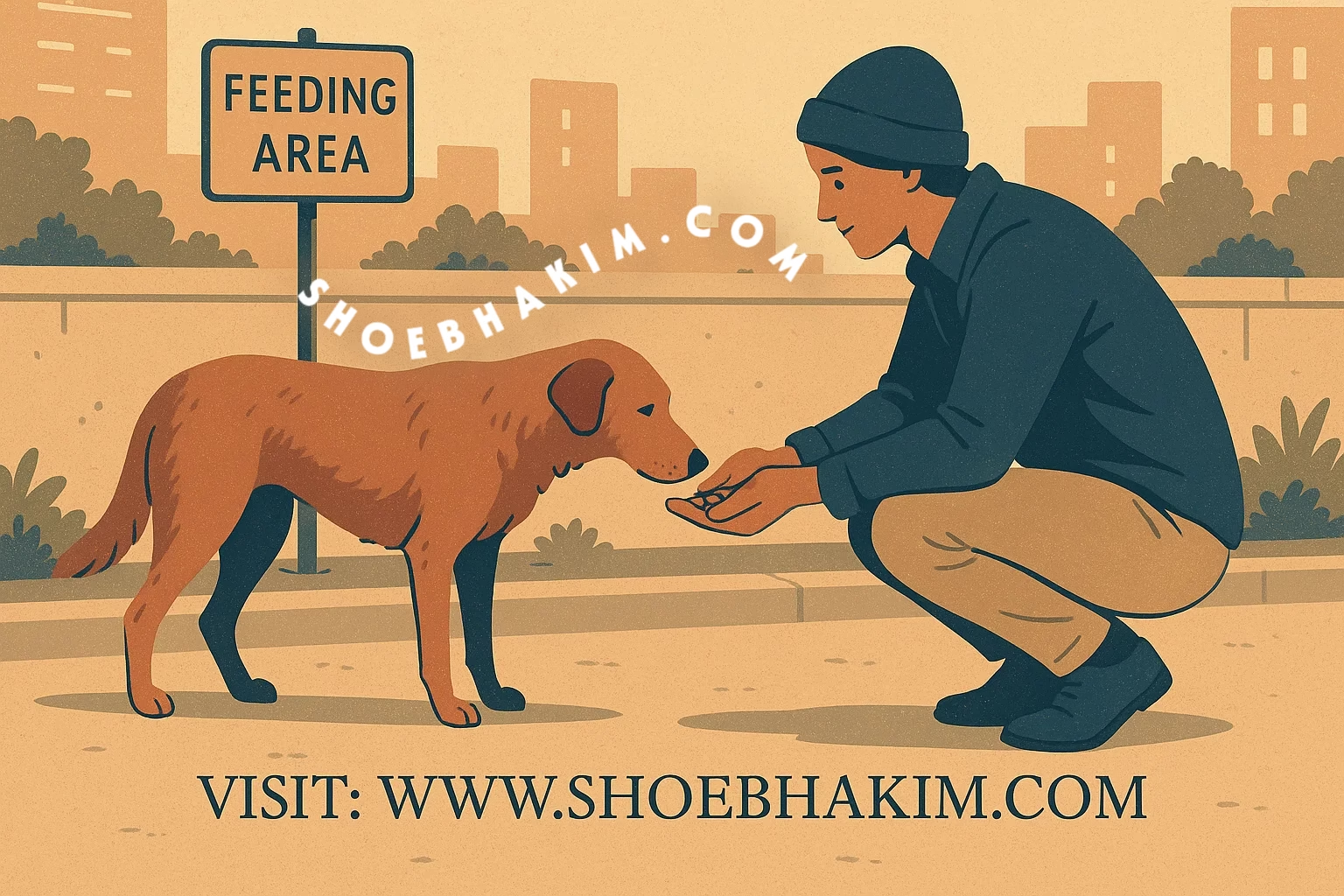
The complaint was based on the premise that feeding stray dogs on public roads is a violation of a Supreme Court order. However, as noted by Shruti Vinodhraj of the Tamil Nadu Animal Welfare Board, the same Supreme Court order mandates municipal authorities to establish dedicated feeding spaces. Until these designated spaces are available, feeding stray dogs cannot be stopped without forcing them to roam in search of food, potentially creating a greater public nuisance. This ambiguity creates a conflict for both citizens and law enforcement.
The case also brings to light the Animal Birth Control Rules, 2023, specifically Section 20, which makes it mandatory for residential welfare associations to create designated feeding spots. The lack of these facilities in many areas means that citizens who are compassionate towards animals may inadvertently violate a rule designed for public safety. This highlights a gap between the legal framework and its on-the-ground implementation.
Judicial Directives and Enforcement Challenges
The Supreme Court’s directive on stray animals aims to balance animal welfare with public safety. The ruling emphasizes the need for a systematic approach, which includes sterilizing and vaccinating strays, as well as creating dedicated feeding spaces. The Kotturpuram police’s decision to register a complaint, while legally sound in its procedural aspect, raises questions about resource allocation and priority. Critics argue that police inaction on more serious offenses, as mentioned in the prompt, contrasts sharply with their swift action on a complaint about feeding animals.
Case Law and its Relevance
- Jorawar Singh Mundy vs. Union of India and Ors., 2021 SCC Online Del 2306: This case, while not directly related to feeding, underscores the judiciary’s increasing focus on animal welfare. It highlights the courts’ recognition of animal rights and the need for a humane approach, which includes the provision of food and shelter. The case serves as a precedent for balancing public interest with the well-being of animals. It’s a reminder that a balanced view is essential for a just society.
- R. Rajagopala And Anr. Vs. State of Tamil Nadu (1994) 6 SCC 632: This case is relevant to the broader issue of freedom of expression and the right to privacy. While not directly about feeding animals, it reinforces the principle that citizens have a right to engage in lawful activities without unwarranted police interference. The act of feeding a stray, in itself, is a compassionate act and should not be criminalized unless it creates a clear and present danger.
Adv Shoeb Hakim notes that the police’s role should be to maintain public order while also being sensitive to social issues. The case highlights the importance of police training and a clear understanding of all legal provisions, not just isolated directives.
Adv Shoeb Hakim’s Analysis & Conclusions
The Kotturpuram incident is a classic example of a legal conflict arising from a social issue with a significant emotional component. The police’s action, while procedurally correct, has sparked a debate about the principle of equality before the law and selective enforcement. The case serves as a critical lesson in legal education, reminding us that laws must be applied with discretion and a full understanding of their context. It also highlights the need for a more comprehensive approach to managing stray animal populations, one that includes designated feeding areas as mandated by law.
Practical Tips and Recommendations:
- For Law Enforcement: Prioritize more serious offenses while handling complaints like this with diplomacy. Educate the public on designated feeding areas and work with municipal authorities to establish them.
- For Legal Professionals: Use this case as an opportunity to discuss the nuances of public interest litigation and the role of courts in social matters.
- For the Public: Be aware of local laws and directives. Advocate for designated feeding spaces in your community to avoid such conflicts.
Challenges and Opportunities:
- Challenges: The primary challenge is the emotional nature of the issue, which can lead to social media outrage and altercations. There is also a lack of legal clarity due to the slow implementation of laws like the Animal Birth Control Rules, 2023.
- Opportunities: This presents an opportunity for constructive dialogue between citizens, municipal authorities, and the police to create a more humane and legally compliant solution.
Quiz Engagement
Question 1: Which legal rule makes designated feeding spots for stray dogs mandatory in residential areas?
A) The Prevention of Cruelty to Animals Act, 1960
B) The Animal Birth Control Rules, 2023
C) The Public Nuisance Act, 1985
Question 2: Why do some animal welfare experts argue that feeding stray dogs on the street cannot be stopped yet?
A) It is a fundamental right of the feeders.
B) The Supreme Court has not yet made a final decision.
C) Designated feeding spaces, as mandated by the Supreme Court, have not been established.
Question 3: What is a Community Service Register (CSR) entry?
A) A formal legal complaint that leads to an immediate arrest.
B) A police entry to record a complaint for further action.
C) A form used by police for community outreach programs.
Quiz Answers: Question 1: B) The Animal Birth Control Rules, 2023 Question 2: C) Designated feeding spaces, as mandated by the Supreme Court, have not been established. Question 3: B) A police entry to record a complaint for further action.
Related to This Similar Cases/Articles You Must Read:
- https://www.livelaw.in/animal-rights/supreme-court-animal-welfare-board-india-animal-birth-control-rules-2023-stray-dogs-delhi-high-court-2023-238469
- https://www.indiatoday.in/law-today/story/supreme-court-gives-green-signal-to-animal-birth-control-rules-2023-for-stray-dog-control-2023-2334812-2023-03-17
- https://www.scconline.com/blog/post/2023/12/05/supreme-court-on-stray-dogs-and-right-to-life/
——–END OF ARTCILE FOR HUMANS-SEO RELATED CONTENTS STARTS FOR MACHINE READING ONLY—–
SOCIAL MEDIA VERSION
A recent case in Kotturpuram, Chennai, highlights the complex legal and social conflict over feeding stray dogs. Adv Shoeb Hakim breaks down the legal provisions and why the issue is more complicated than it seems. This is a must-read for legal professionals and anyone interested in animal welfare law. Read the full analysis and practical checklist.
The Kotturpuram incident has sparked debate on police priorities and the law on feeding stray dogs. Why are some issues prioritized over others? We dive into the legal nuances and the Animal Birth Control Rules, 2023. Read the full analysis and practical checklist.
Feeding stray dogs leads to a police complaint in Kotturpuram, Chennai. A legal and social conflict. We explore the Animal Birth Control Rules, 2023, and judicial directives. #AnimalLaw #LegalAnalysis #StrayDogs Read the full analysis and practical checklist.
SEO REQUIREMENTS
#CyberLaw #DigitalForensics #IndianLawyer #ShoebHakim #LegalTech #CyberCrimeIndia #AdvocateShoebHakim #MaharashtraPolice #ITActIndia #AnimalLaw #StrayDogs #LegalAnalysis #PublicNuisance #AnimalWelfare #IndianLaw
META DATA
Meta Title: Law on Feeding Stray Dogs in Kotturpuram, Chennai: A Legal Analysis
Focus Keyphrase: law on feeding stray dogs
Meta Description: Adv Shoeb Hakim analyzes the law on feeding stray dogs in Kotturpuram, Chennai, addressing the recent incident and the legal conflict between animal welfare and public order.
Author: Adv Shoeb Hakim
Publication Date: September 10, 2025
Slug: law-on-feeding-stray-dogs-kotturpuram
Post Serial Number: SHOEBHAKIM/SEP/2/10/253/ADVSHOART-P9N7W4L1
Meta Robots: index, follow
Breadcrumbs Title: Law on Feeding Stray Dogs
Canonical URL: https://www.shoebhakim.com/law-on-feeding-stray-dogs-kotturpuram
Description: A detailed legal analysis of the social and legal issues surrounding the feeding of stray dogs, with a focus on relevant laws, judicial directives, and a recent case study from Kotturpuram, Chennai.
DISCLAIMER
DISCLAIMER: The information contained in this document is purely fictional and is meant for entertainment purposes only. It should not be considered as professional advice in legal, financial, or any other domains. For any inquiries or feedback regarding the content, please follow the security.txt protocol to ensure appropriate handling. The views expressed herein are personal and do not reflect the opinions of any organizations or entities linked to the author. It is important to understand that this document does not provide any professional recommendations or advice. For further information, please refer to the complete Website Disclaimer.