
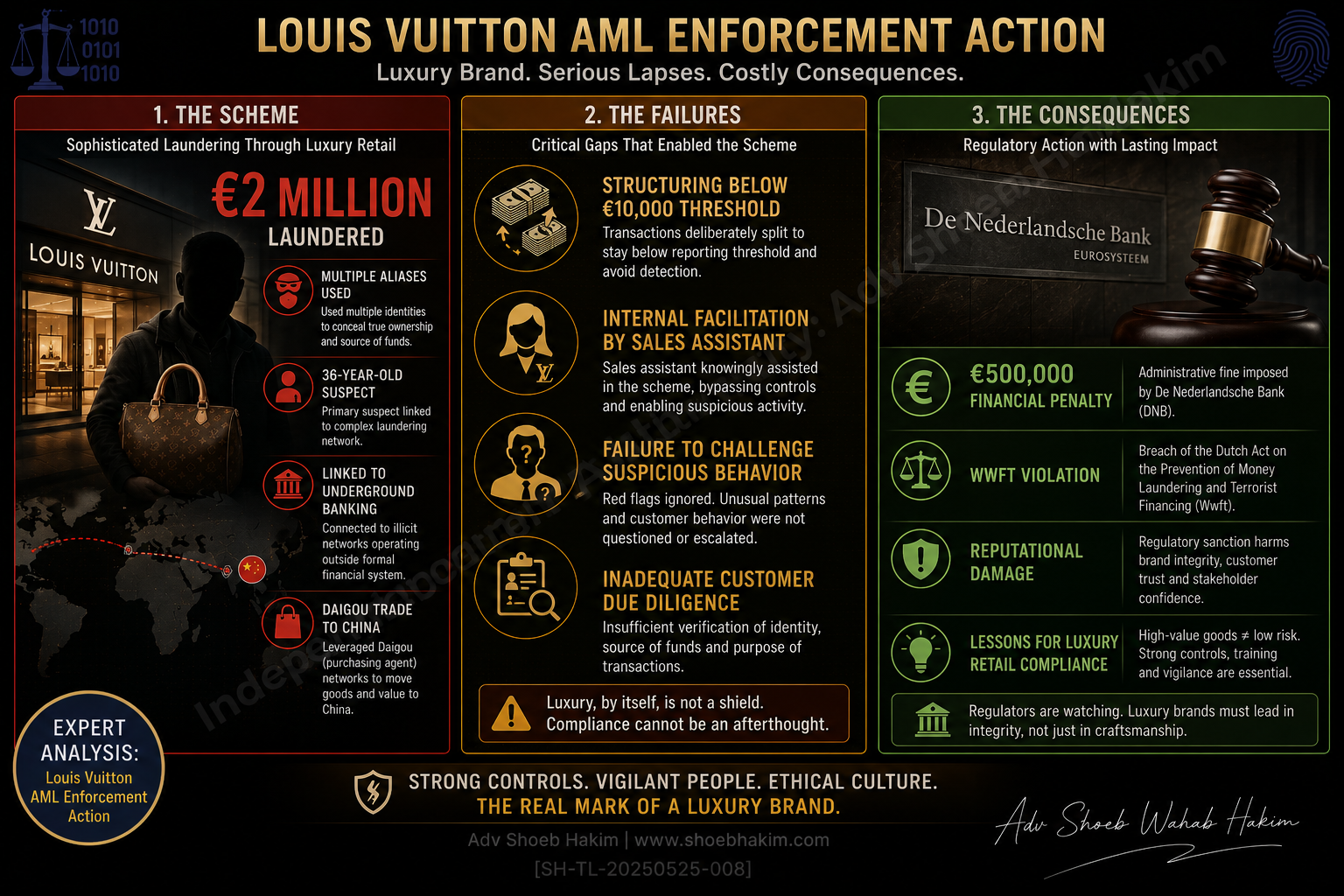
A luxury brand. A convicted underground banker. Multiple aliases. €2 million in criminal cash. A sales assistant who tipped off the suspect when spending neared compliance triggers. Louis Vuitton’s Dutch arm just learned that ignoring red flags comes with a €500,000 price tag. The case offers critical lessons for luxury retail, compliance professionals, and financial institutions.
Table of Contents
- Introduction: The Case
- The Laundering Scheme
- The Compliance Failures
- The Regulatory Framework: Wwft
- Why This Matters for Luxury Retail
- Key Lessons for Compliance Professionals
- Red Flags to Watch For
- Conclusion: Silence Is Not Compliance
- Frequently Asked Questions (FAQs)
1. Introduction: The Case
With 30+ years across cyber forensics, police training, banking compliance, and law, I have seen how criminals exploit industries that fail to take AML seriously. The Dutch arm of Louis Vuitton agreed to a €500,000 penalty with Dutch prosecutors for anti-money laundering (AML) failures. The retailer failed to adequately monitor repeat cash buyers and conduct mandatory customer due diligence, allowing a suspect to launder over €2 million.
The case demonstrates that luxury retail is not immune to money laundering. When cash meets high-value goods without proper due diligence, criminals will exploit the gap.
2. The Laundering Scheme
2.1 The Suspect
A 36-year-old suspect, linked to a convicted underground banker, used multiple aliases to repeatedly buy luxury items using criminal cash at various stores in the Netherlands.
| Aspect | Details |
|---|---|
| Suspect | 36-year-old, linked to convicted underground banker |
| Method | Multiple aliases |
| Amount | Over €2 million |
| Goods | Luxury items |
2.2 The Daigou Trade
The merchandise was shipped to China for resale, a process known as the “Daigou” trade. Daigou refers to the practice of purchasing luxury goods overseas for resale in China, often at significant markups.
How the Daigou trade works:
- Goods purchased with criminal cash in the Netherlands
- Shipped to China
- Resold at a profit
- Criminal proceeds converted into legitimate-looking assets
2.3 Structuring Transactions
The buyers purposefully structured their cash transactions to remain just under the €10,000 threshold that required mandatory reporting at that time. This classic structuring technique is a red flag that should have been detected.
| Aspect | Details |
|---|---|
| Threshold | €10,000 |
| Method | Transactions kept just below threshold |
| Purpose | Avoid mandatory reporting |
2.4 Internal Facilitation
Investigators from the Rotterdam District Court alleged that a former Louis Vuitton sales assistant assisted the suspect by:
- Tipping her off to new stock
- Warning her when her spending was nearing compliance triggers
This internal facilitation demonstrates that compliance failures are not just systemic—they can be actively enabled by employees.
3. The Compliance Failures
| Failure | Description |
|---|---|
| Inadequate monitoring | Failed to monitor repeat cash buyers |
| No customer due diligence | Failed to properly verify customer identities |
| No challenge of suspicious behavior | Failed to question unusual patterns |
| Fragmented oversight | Failed to connect transactions across multiple stores |
Prosecutors concluded that the company breached the Money Laundering and Terrorist Financing Prevention Act (Wwft) by failing to challenge suspicious behaviors and properly verify customer identities .
4. The Regulatory Framework: Wwft
The case was prosecuted under the Money Laundering and Terrorist Financing Prevention Act (Wwft) , the Dutch AML law that obliges all financial firms and designated non-financial businesses to:
- Conduct comprehensive customer due diligence
- Maintain updated risk profiles
- Proactively report suspicious transactions to the financial intelligence unit
Wwft Obligations:
| Obligation | Description |
|---|---|
| Customer due diligence | Verify customer identities |
| Transaction monitoring | Monitor unusual patterns |
| Reporting | Report suspicious transactions |
| Risk assessment | Assess and mitigate ML/TF risks |
5. Why This Matters for Luxury Retail
5.1 High-Value Goods Are Vulnerable
Luxury goods are portable, high-value, and easy to resell internationally. This makes them ideal for converting criminal cash into assets.
5.2 Cash Is Still a Risk
Despite the shift to digital payments, cash remains a primary vehicle for money laundering. Luxury retail must treat cash transactions with heightened scrutiny.
5.3 Internal Facilitators Are a Risk
Employees who actively help criminals evade controls are a significant risk. Training and monitoring are essential.
5.4 Regulatory Scrutiny Is Increasing
The Louis Vuitton case is part of a broader trend of regulatory enforcement against non-financial sectors.
6. Key Lessons for Compliance Professionals
1. Monitor repeat cash buyers – Even when individual transactions fall below reporting thresholds
2. Connect the dots across locations – A single store may not see the pattern; centralized monitoring does
3. Train employees to identify red flags – Internal facilitation can only happen when staff are not trained to recognize suspicious behavior
4. Verify customer identities – Multiple aliases should be detected
5. Challenge suspicious behavior – Silence is not compliance
6. Treat the Daigou trade as a red flag – Bulk purchases of luxury goods for international resale should trigger enhanced due diligence
7. Red Flags to Watch For
| Red Flag | Description |
|---|---|
| Structuring | Transactions kept just below reporting thresholds |
| Repeat cash purchases | Multiple cash purchases across different stores |
| Multiple identities | Suspect using multiple aliases |
| International resale | Goods shipped overseas for resale |
| Internal facilitation | Employees warning customers about compliance triggers |
8. Conclusion: Silence Is Not Compliance
Louis Vuitton’s Dutch arm agreed to a €500,000 penalty for AML failures that allowed a suspect to launder over €2 million. The case demonstrates that luxury retail is not immune to money laundering. When cash meets high-value goods without proper due diligence, criminals will exploit the gap.
Key Takeaways:
- Monitor repeat cash buyers – Even when individual transactions fall below reporting thresholds
- Connect the dots across locations – A single store may not see the pattern
- Train employees to identify red flags – Internal facilitation is a significant risk
- Verify customer identities – Multiple aliases should be detected
- Challenge suspicious behavior – Silence is not compliance
9. Frequently Asked Questions (FAQs)
Q1: What was the fine imposed on Louis Vuitton?
Louis Vuitton’s Dutch arm agreed to a €500,000 penalty with Dutch prosecutors for AML failures.
Q2: How much was laundered?
Over €2 million was laundered through the scheme.
Q3: What was the laundering method?
The suspect used multiple aliases to buy luxury items with criminal cash, structuring transactions to stay under the €10,000 reporting threshold.
Q4: What was the role of the sales assistant?
A former Louis Vuitton sales assistant tipped off the suspect about new stock and warned when spending was nearing compliance triggers.
Q5: What was the legal basis for the fine?
The Money Laundering and Terrorist Financing Prevention Act (Wwft).
Q6: What are the key lessons for luxury retail?
Monitor repeat cash buyers, connect transactions across stores, train employees to identify red flags, and challenge suspicious behavior.
Q: Why are retailers now being held to the same standards as banks?
Ans: Regulators have realized that criminals use retailers as “shadow banks” to integrate dirty cash. Consequently, designated non-financial businesses are now under the same strict AML obligations as traditional banks.
Q: What is the risk of “Internal Facilitation”?
Ans: Internal facilitation is the highest AML risk for any organization. It bypasses established controls and undermines the entire integrity of the compliance program.
Q: Can a brand be held liable for an employee’s actions?
Ans: Yes. Under the doctrine of vicarious liability, the employer is generally responsible for the actions of their employees if those actions occur within the scope of their employment or are enabled by the employer’s systems.
KNOWLEDGE CHECK QUIZ
Q: Why are luxury goods high-risk assets in money laundering investigations?
Ans: Luxury goods are portable, high-value, and universally liquid, making them an ideal vehicle for converting illicit cash into legitimate, tradable assets.
Q: What is the “Daigou” trade mentioned in the investigation?
Ans: It is the practice of purchasing luxury goods overseas for resale in China, which can be misused to integrate criminal proceeds into the legitimate economy.
Q: What was the primary internal failure at the Louis Vuitton stores?
Ans: A sales assistant acted as an internal facilitator, actively warning the suspect about stock and compliance triggers.
Q: How did the suspects evade the €10,000 threshold?
Ans: They used a process called “structuring,” where purchases were deliberately kept just below the €10,000 threshold that would trigger a mandatory report.
Adv. Shoeb Hakim
AML & Financial Crime Advisor
📌 Follow me on LinkedIn for daily AML and financial crime insights: https://www.linkedin.com/in/shoebhakim
📌 Visit my website for more articles: https://www.shoebhakim.com
📌 Visit my website for legal knowledge: https://www.vakilverse.com
📌 Visit my website for research fellowship: https://www.legalcomplaince.in
📌 Connect: https://www.linkedin.com/in/shoebhakim | https://shoebhakim.com/shoeb-hakim-blog/ | https://shoebhakim.com/book-now/
♻️ Share this article with your network.
Disclaimer: This article is for informational purposes only and does not constitute legal advice.
Hashtags: #AdvShoebHakim #LouisVuitton #AMLFailures #MoneyLaundering #LuxuryRetail #Compliance #Wwft #CustomerDueDiligence #Daigou #FinancialCrime #Netherlands #OpenbaarMinisterie #AML #KYC #TransactionMonitoring #CashTransactions #Structuring #InternalFacilitation #RetailCompliance #FinancialIntelligence #RegulatoryEnforcement #AntiMoneyLaundering #TerroristFinancing #HighValueGoods #LuxuryGoods #CrossBorderTrade #ChinaDaigou #EmployeeTraining #RedFlags #ComplianceCulture
Leave a Reply