

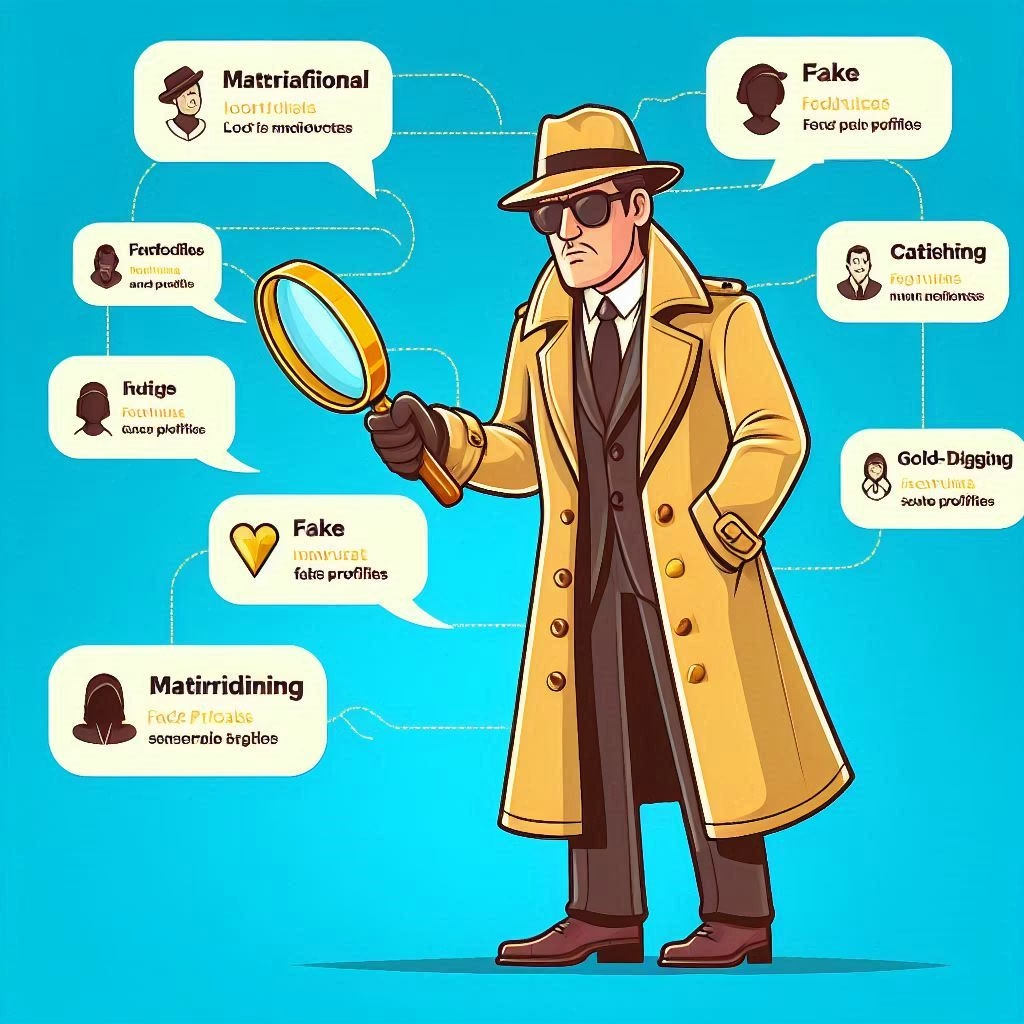
Types of Matrimonial Frauds 2026: 6 Common Scams & Prevention | Adv Shoeb Hakim

Types of matrimonial fraud

Updated: August 2026 | Reading Time: 10 minutes

Types of Matrimonial Frauds Guide by Adv. Shoeb Hakim

Introduction

Types of matrimonial frauds have become increasingly diverse and sophisticated in India’s growing online matrimony ecosystem. With over 30 million active users on matrimonial platforms and the market projected to reach $3.5 billion by 2027, scammers have developed elaborate schemes to exploit vulnerable individuals seeking genuine companionship and marriage.

Matrimonial frauds can take various forms, each with its own set of tactics and consequences. From fake profiles and dowry scams to NRI marriage fraud, job scams, identity theft, and emotional manipulation, fraudsters use increasingly sophisticated techniques to exploit victims.

Authored by Adv. Shoeb Hakim—a criminal defence, AML, digital forensics, and cybercrime specialist with decades of experience training police and judiciary—this comprehensive guide examines the various types of matrimonial frauds, their modus operandi, and practical prevention strategies for 2026.


Types of Matrimonial Frauds: Overview

The types of matrimonial frauds can be broadly categorised into six main categories. Each type employs different tactics but shares the common goal of financial or emotional exploitation.


1. Fake Profiles

Description

Fraudsters create fake profiles on matrimonial sites, using false information and photos to deceive potential partners. They often steal photographs from social media and fabricate professional and personal backgrounds to appear as ideal matches.

Common Tactics

  • Using stolen photographs from social media
  • Fabricating educational qualifications and professional credentials
  • Creating elaborate family backgrounds
  • Using AI-generated profile photos

Red Flags

  • Profiles that seem too perfect
  • Inconsistent information across profile sections
  • Refusal to video call
  • Reluctance to share social media presence
  • Limited or no social media footprint

Prevention Tips

  • Verify profile photos using reverse image search tools like Google Images
  • Check for consistency in the information provided
  • Insist on video calls before meeting in person
  • Use the platform’s verification features

2. Dowry Scams

Description

Some individuals marry with the intention of extorting dowry from the bride’s family and then abandoning the bride. This is one of the most damaging types of matrimonial frauds, combining marriage fraud with dowry extortion.

Common Tactics

  • Demanding cash, gold, or property as dowry before or during marriage
  • Creating fake family emergencies to extract more money
  • Threatening to abandon the bride if demands are not met
  • Abandoning the bride shortly after marriage without explanation

Red Flags

  • Urgent requests for dowry or gifts before marriage
  • Reluctance to allow family members to meet the groom’s family
  • Inconsistent information about family background
  • Pressure to complete marriage quickly

Legal Framework

  • Dowry Prohibition Act, 1961: Prohibits the giving or taking of dowry. Punishment: imprisonment up to 5 years and fine up to ₹15,000 or the amount of dowry.
  • Section 304B IPC (now BNS 86): Dowry death—punishable with imprisonment of 7 years to life.
  • Section 498A IPC (now BNS 85): Cruelty by husband or relatives—punishable with imprisonment up to 3 years.

Prevention Tips

  • Reject all dowry demands immediately
  • Verify the groom’s family background thoroughly
  • Document all financial transactions
  • Report dowry demands to the police

3. NRI Marriage Fraud

Description

Non-Resident Indians (NRIs) marry Indian women, promising a better life abroad, but often abandon them after taking dowry or other financial benefits. This is one of the most common types of matrimonial frauds in India.

Common Tactics

  • Posing as NRIs with lucrative jobs abroad
  • Creating elaborate stories about life in foreign countries
  • Demanding money for visa processing, travel, or other expenses
  • Abandoning the victim after marriage or after taking dowry
  • In some cases, already being married abroad

Red Flags

  • Unverifiable foreign address
  • Reluctance to share work details or proof of employment
  • Refusal to introduce family members
  • Rush to complete marriage without proper verification
  • Requests for money for visa processing or travel

Prevention Tips

  • Verify the person’s NRI status through independent sources
  • Check employment records and address details
  • Meet the person’s family and friends
  • Consider using professional background verification services
  • Never send money for visa processing or travel

4. Job Scams

Description

Fraudsters promise jobs or other opportunities to women they meet on matrimonial sites, only to extort money from them. This is a growing form of matrimonial fraud that exploits victims’ career aspirations.

Common Tactics

  • Promising lucrative job offers abroad or in major cities
  • Requesting money for “processing fees,” “training costs,” or “visa documentation”
  • Creating fake job offer letters
  • Conducting fake interviews over phone or video calls

Red Flags

  • Unsolicited job offers
  • Requests for money for processing fees or documentation
  • Vague details about the job or company
  • Pressure to pay quickly
  • Unprofessional communication style

Prevention Tips

  • Verify the company’s existence through independent sources
  • Check the company’s website and official contact information
  • Never pay for job offers
  • Consult the company’s HR department directly
  • Report suspicious job offers

5. Identity Theft

Description

Using stolen identities to create profiles and engage with unsuspecting individuals, leading to financial and emotional exploitation. This is one of the more sophisticated types of matrimonial frauds.

Common Tactics

  • Using stolen photographs and personal information
  • Creating fake profiles with real people’s identities
  • Using stolen Aadhaar or PAN details to verify profiles
  • Extracting money through various pretexts

Red Flags

  • Inconsistency between profile information and photos
  • Refusal to provide additional identification
  • Unverifiable background
  • Multiple profiles with similar details

Legal Framework

  • Section 66C of the IT Act: Identity theft—punishable with imprisonment up to 3 years and fine up to ₹1 lakh.
  • Section 66D of the IT Act: Cheating by personation using computer resources—punishable with imprisonment up to 3 years and fine.

Prevention Tips

  • Use reverse image search to verify profile photos
  • Verify identity through video calls
  • Cross-check information across multiple sources
  • Report suspicious profiles immediately

6. Emotional Manipulation

Description

Building a relationship based on lies and manipulation to gain trust and then exploit the victim financially or emotionally. This is often the underlying tactic in many types of matrimonial frauds.

Common Tactics

  • Professing love quickly to create emotional dependency
  • Creating fake emergencies to request money
  • Using guilt and emotional pressure to extract funds
  • Threatening to break up or leave if demands are not met

Red Flags

  • Rapid declaration of love
  • Reluctance to share personal details
  • Frequent excuses to avoid meeting in person
  • Requests for money
  • Emotional blackmail

Prevention Tips

  • Take time to build the relationship
  • Never send money to someone you have not met in person
  • Consult family and friends before making decisions
  • Trust your instincts—if something feels wrong, it probably is

Types of Matrimonial Frauds: Summary Table

Type of FraudCommon TacticsKey Red FlagsLegal Provisions
Fake ProfilesStolen photos, fabricated credentialsToo perfect, inconsistent info, no video callSection 66C IT Act
Dowry ScamsDowry demands, abandonment after marriageUrgent dowry requests, pressure to marry quicklyDowry Prohibition Act, BNS 86
NRI Marriage FraudFake NRI status, false promises abroadUnverifiable address, reluctance to share detailsSection 66D IT Act, BNS 318
Job ScamsFake job offers, processing feesUnsolicited offers, payment requestsSection 66D IT Act, BNS 318
Identity TheftStolen identities, fake profilesInconsistent info, unverifiable backgroundSection 66C IT Act
Emotional ManipulationLove bombing, fake emergenciesRapid declarations of love, requests for moneySection 66D IT Act, BNS 318

Real Incidents of Matrimonial Fraud

The following are news-reported incidents of matrimonial fraud, illustrating the real-world impact of these crimes:

Incident 1: Jyothi’s Case — ₹55+ Lakhs Lost Over 9 Years

ElementDetail
SourceDecode Internet (1 May 2024)
VictimJyothi (name changed), divorcee from Kerala
Amount LostMore than ₹55 lakhs
Duration2012 – 2020 (9 years)
PlatformBharat Matrimony
Fraudster’s Profile“Rohan,” claimed to be a 30-year-old Christian man working at the British Embassy in London
Modus OperandiBuilt a romantic relationship over years, met her family, proposed marriage, and requested money for visa processing and educational fees.
OutcomePolice complaint filed in 2020 after discovering the fraudster had been arrested for raping another woman.
StatusNews report; not a judicial precedent.

Incident 2: Teacher’s Case — ₹9.5 Lakh Lost in Gift Scam

ElementDetail
SourceMumbai Mirror (11 December 2020) ; Indian Express
Victim39-year-old divorced teacher
Amount Lost₹9.5 lakh
Fraudster’s Profile“Azad Ibrahim Hamza,” claimed to be a civil engineer based in the UK
Modus OperandiAfter chatting for a few days, the victim received a call from a fake customs official claiming a parcel with a diamond ring and £70,000 was held at customs. She paid multiple tranches as “customs duties.”
Legal ActionFIR registered at JJ Marg Police Station under IPC and IT Act sections.
StatusNews report; not a judicial precedent.

Note: These are news-reported incidents, not judicial precedents. They illustrate the real-world impact of matrimonial fraud but do not have case citations.


How to Protect Yourself from All Types of Matrimonial Frauds

Before You Engage

  • Use reputable matrimonial platforms with robust verification processes
  • Check platform reviews and safety features
  • Understand the platform’s verification process

During Engagement

  • Verify profile information through independent sources
  • Insist on video calls
  • Meet in public places
  • Involve family and friends
  • Never share financial information
  • Never send money

If You Suspect Fraud

  • Stop all communication
  • Document everything (screenshots, conversations, transactions)
  • Report to the matrimonial platform
  • File a police complaint at the cybercrime cell
  • Report to the National Cyber Crime Reporting Portal (https://cybercrime.gov.in)
  • Call Cyber Crime Helpline: 1930
  • Seek legal assistance

Conclusion

The types of matrimonial frauds are diverse and evolving—from fake profiles and dowry scams to NRI marriage fraud, job scams, identity theft, and emotional manipulation. Each type employs different tactics but shares the common goal of financial or emotional exploitation.

By understanding these types of matrimonial frauds, recognizing red flags, and following prevention measures, individuals can protect themselves from these devastating scams. Remember: genuine partners will never ask for money, never rush the relationship, and always be willing to verify their identity.


Frequently Asked Questions

Q1: What are the most common types of matrimonial frauds?

The most common types of matrimonial frauds include fake profiles, dowry scams, NRI marriage fraud, job scams, identity theft, and emotional manipulation.

Q2: What is NRI marriage fraud?

NRI marriage fraud involves fraudsters posing as Non-Resident Indians with lucrative jobs abroad, promising marriage and a better life, but abandoning the victim after taking dowry or other financial benefits.

Q3: What legal provisions apply to matrimonial fraud?

Legal provisions include Section 66C (identity theft) and Section 66D (cheating by personation) of the IT Act, Section 318 BNS (cheating), Section 336 BNS (forgery), and the Dowry Prohibition Act, 1961.

Q4: How can I avoid matrimonial frauds?

Avoid matrimonial frauds by verifying profiles, conducting background checks, insisting on video calls, never sharing financial information, never sending money, involving family, and using reputable matrimonial platforms.

Q5: What should I do if I suspect a matrimonial scam?

Stop all communication, document everything (screenshots, conversations, transactions), report to the matrimonial platform, file a police complaint, and report to the National Cyber Crime Reporting Portal.


📚 Related Legal Guides on Adv. Shoeb Hakim’s Website:

📌 Explore More on Adv. Shoeb Hakim’s Website:

By Adv. Shoeb Hakim
Criminal defence, AML, digital forensics, and cybercrime specialist; former General Counsel, Credit Suisse; training police and judiciary since 1995.

📌 Connect: https://www.linkedin.com/in/shoebhakim | https://shoebhakim.com/shoeb-hakim-blog/
📌 Visit my website for more articles: https://www.shoebhakim.com
📌 Visit my website for legal knowledge: https://www.vakilverse.com
📌 Visit my website for research fellowship: https://www.legalcomplaince.in

Disclaimer: This content is for informational purposes only and does not constitute legal advice. Readers should consult qualified legal counsel for advice on their specific circumstances.


Additional Page Metadata

  • Author: Adv. Shoeb Hakim
  • Author Bio: Adv. Shoeb Hakim is a Mumbai-based criminal defence, AML, digital forensics and cybercrime specialist. Former General Counsel at Credit Suisse. Has been training police and judiciary since 1996. Provides expert commentary on cybercrime, consumer protection, matrimonial fraud, and digital safety.
  • Article Publisher: Adv. Shoeb Hakim
  • Article Section: Cybercrime | Consumer Protection | Digital Safety | Matrimonial Fraud
  • Article Tags: Types of Matrimonial Frauds, Matrimonial Scams, Fake Profiles, Dowry Scams, NRI Marriage Fraud, Job Scams, Identity Theft, Emotional Manipulation, Cybercrime India, IT Act 66C, Section 66D, Matrimonial Safety, Adv Shoeb Hakim

#TypesOfMatrimonialFrauds #MatrimonialScams #FakeProfiles #DowryScams #NRIMarriageFraud #JobScams #IdentityTheft #EmotionalManipulation #Cybercrime #ITAct #Section66C #OnlineSafety #MatrimonyTips #DigitalSecurity #FraudPrevention #ConsumerProtection #AdvShoebHakim

Find