

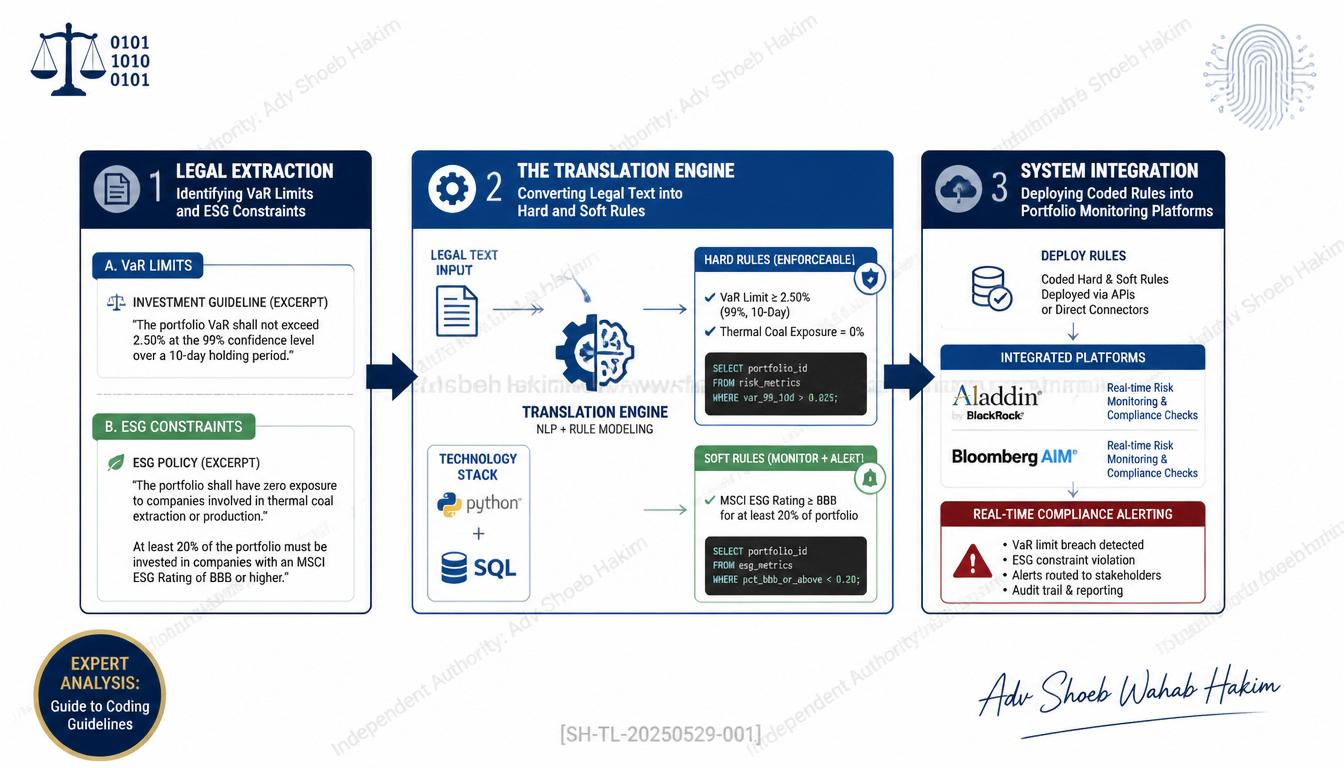
Translating investor agreements into actionable, machine-readable investment guidelines is a multi-disciplinary task involving legal, compliance, coding, and monitoring teams. This guide covers the complete lifecycle—from extracting clauses to continuous refinement—with practical examples and code snippets. Last updated: July 2026
Written by Adv. Shoeb Hakim, Criminal Defense Advocate, Digital Forensics Expert, and Former General Counsel – Credit Suisse, with over 29 years of experience in IT systems, 30+ years in criminal defense and compliance, and 15 years of litigation practice. Faculty for Maharashtra Police & Judicial Officers since 1996.
Why This Process Matters More Than Ever
Investment guideline coding is the bridge between legal intent and operational reality. When this bridge fails, portfolios suffer.
Consider this real-world example from a global asset manager: a rule required that no more than 5% of securities be in the BBB range at the time of purchase. A portfolio manager bought an unrated security expected to be BBB-rated. The rule didn’t flag it because the coding logic only checked rated securities—unrated ones were excluded entirely. Weeks later, when the security received its BBB rating, the portfolio was already above the limit .
The breach was caught post-trade, but the damage was done: the client was notified, compensated for losses, and the rule coding was updated to capture unrated securities .
This example underscores why a methodical, continuously improved process is non-negotiable.
How Do You Extract Relevant Clauses from an Investor Agreement?
Identify Guiding Provisions
Analyze the agreement for these core elements:
| Provision Type | Description | Example |
|---|---|---|
| Investment Objectives | Purpose and target outcomes of the fund | Long-term capital appreciation |
| Asset Allocation | Permissible ranges for equities, debt, derivatives | Equity ≤ 60% of AUM |
| Risk Tolerance | Limits on leverage, volatility, sector concentration | VaR ≤ 5% |
| Prohibited Investments | Specific exclusions | No tobacco, weapons, or ESG violators |
| Regulatory Constraints | SEBI, SEC, or local law compliance | PMLA, FATCA reporting |
| Liquidity & Redemption Terms | Timeframes and percentages for redemption | Monthly redemption ≤ 10% |
Document Key Points
Create a summary table of actionable guidelines for compliance teams. This traceability matrix becomes your audit trail.
From Practice: During my tenure as AVP – Head India AML at Credit Suisse, I authored detailed User Manuals with screenshot-level workflows for KYC and KRA uploads, ensuring 100% process adherence. The same principle applies here—every rule must be documented at a granular level.
How Do You Translate Legal Terms into Business Rules?
Standardize Language
Work with legal and compliance experts to convert legal jargon into precise investment rules.
Example: “Equity investments shall not exceed 60% of total AUM” becomes
EQUITY_MAX = 60%
| Legal Language | Business Rule |
|---|---|
| “The fund shall aim for long-term capital appreciation by investing primarily in equities” | Equity allocation target: 50-60% |
| “Portfolio risk metrics such as VaR shall not exceed 5%” | VaR threshold = 5% |
| “Exposure to a single sector shall not exceed 20%” | Sector cap = 20% |
Classify Rules
| Rule Type | Description | Example |
|---|---|---|
| Hard Rules | Must never be breached | “No investment in tobacco” |
| Soft Rules | Generate alerts when approached | “Equity allocation at 55%” |
Expert Insight: The gap between legal intent and technical implementation is where most compliance failures happen. Precise coding bridges that gap.
How Do You Develop Coded Parameters?
Identify Monitoring Software Requirements
Use platforms like Aladdin (BlackRock), Bloomberg AIM, or SimCorp Dimension to implement rules .
Code the Rules
Example: SQL for Maximum Equity Exposure
sql
SELECT Portfolio_ID, SUM(Equity_Allocation) AS Total_Equity
FROM Portfolio
WHERE Fund_Type = 'Mutual Fund'
GROUP BY Portfolio_ID
HAVING Total_Equity > 60;
Example: Python for Portfolio Data Retrieval & Analysis
python
import yfinance as yf
import pandas as pd

# Define portfolio assets and weights
tickers = ['AAPL', 'MSFT', 'GOOGL', 'AMZN']
weights = [0.25, 0.25, 0.25, 0.25]

# Download 5 years of historical data
data = yf.download(tickers, period='5y')['Adj Close']

# Calculate daily and annualized returns
daily_returns = data.pct_change()
annual_returns = daily_returns.mean() * 252

# Calculate portfolio return
portfolio_return = (annual_returns * weights).sum()
print(f"Expected Annual Portfolio Return: {portfolio_return:.2%}")
Example: Python for Markowitz Efficient Frontier (Optimization)
python
import numpy as np
import yfinance as yf
import scipy.optimize as sco

tickers = ['AAPL', 'MSFT', 'GOOGL']
data = yf.download(tickers, period='2y')['Adj Close']
returns = data.pct_change()

mean_returns = returns.mean() * 252
cov_matrix = returns.cov() * 252

def get_portfolio_metrics(weights):
    portfolio_return = np.sum(mean_returns * weights)
    portfolio_volatility = np.sqrt(np.dot(weights.T, np.dot(cov_matrix, weights)))
    sharpe_ratio = portfolio_return / portfolio_volatility
    return np.array([portfolio_return, portfolio_volatility, sharpe_ratio])

def min_sharpe_ratio(weights):
    return -get_portfolio_metrics(weights)[2]

constraints = ({'type': 'eq', 'fun': lambda x: np.sum(x) - 1})
bounds = tuple((0, 1) for _ in range(len(tickers)))

initial_guess = len(tickers) * [1. / len(tickers)]
result = sco.minimize(min_sharpe_ratio, initial_guess, method='SLSQP', bounds=bounds, constraints=constraints)

print("Optimal Weights:", [round(w, 2) for w in result.x])
Example: SQL for Compliance Rule Validation
sql
-- Validate that client data for compliance monitoring is complete
SELECT CLIENT_ID, NAME
FROM SCHEMA.CUSTOMERS
WHERE ADDRESS IS NULL OR LENGTH(TRIM(ADDRESS)) = 0;

-- Identify accounts exceeding issuer concentration limits
SELECT ACCOUNT_ID, ISSUER, SUM(MARKET_VALUE) AS TOTAL_EXPOSURE
FROM PORTFOLIO_HOLDINGS
GROUP BY ACCOUNT_ID, ISSUER
HAVING SUM(MARKET_VALUE) > (SELECT LIMIT_VALUE FROM COMPLIANCE_LIMITS WHERE LIMIT_TYPE = 'ISSUER_CONCENTRATION');
Test Coding Logic
Simulate data to validate the accuracy of coded rules. This includes stress testing and edge-case validation .
From Practice: At Tietoevry, I spearheaded ITSM automation using ServiceNow and Ansible, ensuring unalterable digital audit trails. The same rigor must apply to investment guideline coding.
How Do You Integrate with Portfolio Monitoring Systems?
Upload Rules
Use system-specific APIs or interfaces to upload coded parameters.
Enable Real-Time Monitoring
Ensure systems trigger alerts for violations or deviations. Modern compliance monitoring requires robust systems that can handle both pre-trade and post-trade checks .
From Practice: At J.P. Morgan Asset Management, I monitored compliance frameworks across India, Europe, and the USA. The key insight? Global oversight requires systems that adapt to multiple regulatory regimes simultaneously.
How Do You Monitor, Escalate, and Report?
Periodic Reviews
Update coded guidelines based on amendments to investor agreements or regulatory changes. Establish a review cycle—quarterly or semi-annually .
Incident Handling
Investigate alerts, log incidents, and take corrective actions.
Real-World Example: When the BBB-rated security breach was identified, the steps taken were :
- The breach was captured immediately
- The rule coding error was identified
- The issue was escalated to stakeholders
- Rule coding was updated to capture unrated securities
- The portfolio manager adjusted holdings to bring the rule back into compliance
- The client was notified and compensated for related losses
Sample Clauses from an Investor Agreement
Section: Investment Objectives
“The fund shall aim for long-term capital appreciation by investing primarily in equities, with a maximum allocation of 60% to equity instruments and the remainder in debt instruments.”
Section: Prohibited Investments
“The fund shall not invest in companies involved in tobacco production, alcohol manufacturing, or controversial weapons.”
Section: Risk Management
“Portfolio risk metrics such as Value-at-Risk (VaR) shall not exceed 5% of the fund’s value under normal market conditions.”
Section: Sector Concentration
“Exposure to a single sector shall not exceed 20% of the total portfolio.”
What Tools Are Used to Code and Monitor Guidelines?
| Category | Tools |
|---|---|
| Portfolio Monitoring | Aladdin (BlackRock), Bloomberg AIM, SimCorp Dimension |
| Coding Platforms | Python, SQL, R, C++, Java, platform-specific languages |
| Risk Analysis | MSCI RiskMetrics, Morningstar Direct, Barra |
| Documentation | SharePoint, DocuWare for clause traceability |
| Optimization Libraries | scikit-portfolio, PyPortfolioOpt, CVXPY |
Frequently Asked Questions
What is investment guideline coding?
Investment guideline coding is the process of translating legal agreements between AMCs and investors into machine-readable rules that automated portfolio monitoring systems can enforce .
What is the difference between hard and soft rules?
Hard rules enforce absolute restrictions (e.g., “no tobacco investments”) and automatically block violations. Soft rules trigger alerts when thresholds are approached but not yet breached (e.g., “equity allocation nearing 55%”).
How often should coded guidelines be reviewed?
Establish a review cycle—quarterly or semi-annually—to ensure rules remain accurate and aligned with both client and regulatory expectations .
What regulatory frameworks impact guideline coding in India?
Key frameworks include SEBI regulations, FIU-IND reporting (CTR, CCR, NTR), PMLA compliance, and FATCA protocols.
How do coders and compliance teams continuously improve rules?
The process follows a cycle: monitor breaches, escalate issues, analyze root causes, update rule logic, test fixes, deploy updates, and audit effectiveness. This ensures systems evolve with market conditions and regulatory changes .
Conclusion
Coding from investor agreements ensures that compliance is embedded into the operational fabric of asset management companies. By methodically converting legal terms into actionable rules, monitoring teams can safeguard investments, ensure regulatory adherence, and maintain client trust.
Key Takeaways:
- Translate legal clauses into precise, testable business rules
- Classify rules as hard (absolute) or soft (alert-based)
- Use industry-standard tools like Aladdin, Bloomberg AIM, Python, and SQL
- Establish continuous improvement cycles for rule refinement
- Maintain audit trails for regulatory and forensic scrutiny
About the Author
Adv. Shoeb Hakim is a multidisciplinary legal strategist, defense advocate, and trainer working across the courtroom, the compliance room, and the digital evidence lab.
Career Highlights:
- Practicing criminal defense at the Bombay High Court and Supreme Court since 1996
- Served as General Counsel/Chief Compliance Officer at Credit Suisse, Angel Broking, and IL&FS
- Built AML systems for global banks, reducing fraud by 35% and compliance breaches by 50%
- Trained Maharashtra Police officers and Judicial Magistrates on digital forensics and evidence admissibility (65B/BSA)
- Served as Global Risk Governance Consultant at J.P. Morgan Asset Management
- Advanced Diploma in Software Engineering (Aptech, 1994-1996)
- Certified in Cyber Crime Investigation (Asian School of Cyber Laws, 2008)
Connect: LinkedIn | Blog | Book Consultation
#CodingCompliance #InvestorAgreements #AssetManagement #RegulatoryAdherence #LegalToActionable #InvestmentSafeguard #ClientTrust #OperationalExcellence #ComplianceCulture #MonitoringTeams #RiskManagement #FinancialIntegrity #InvestmentStrategy #LegalFramework #TrustInInvestments #AssetProtection #OperationalEfficiency #ComplianceMatters #InvestmentCompliance #RegulatoryCompliance #SEBI #PMLA #FATCA #Aladdin #Bloomberg #Python #SQL #Fintech #RegTech #advshoebhakim
Views expressed are personal and based on professional experience. Always consult with qualified legal and compliance professionals for specific advice.