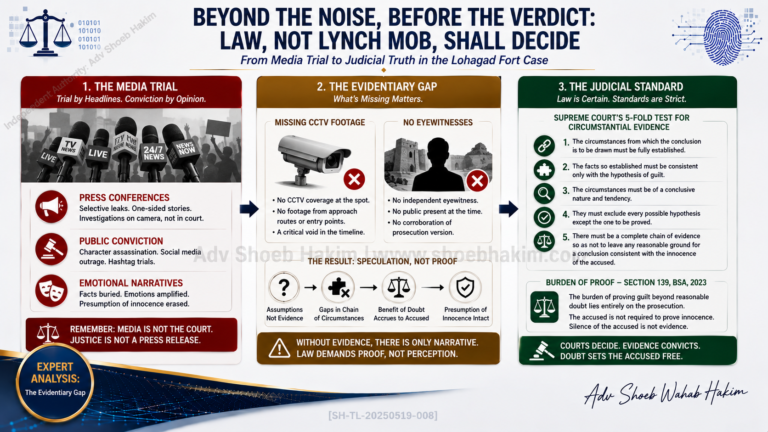
“Breaking Down the Landmark Goa Consent Case: A Turning Point in Consent and Legal Interpretation”

Why Adv Shoeb Hakim Thinks You Must Read This:
The Goa Consent Case has emerged as a significant legal precedent, reshaping the discourse around consent, individual rights, and legal interpretation in India. This article delves into the case’s nuances, explaining why it holds national relevance and how it could influence future legal rulings.
Here’s what you’ll gain:
- A detailed breakdown of the case, including its legal context and judgment.
- Insights into consent laws and their broader implications in India.
- Practical implications for individuals, lawmakers, and judicial authorities.
Whether you’re a legal practitioner, a student, or simply a concerned citizen, this case offers profound lessons on the evolving nature of consent in law.
Case Overview: Goa Consent Case
The Goa Consent Case pertains to an incident where consent and its interpretation became the crux of a judicial decision. The case, decided by the Goa Bench of the Bombay High Court, examined whether consent obtained under certain circumstances could be considered valid and legally binding.
Key Questions Addressed by the Court:
- What constitutes free and informed consent under Indian law?
- Can consent obtained under undue pressure or false pretenses hold legal validity?
- How should courts balance individual autonomy with societal norms?
The ruling provided clarity on these questions while underscoring the sanctity of individual choice.
Legal Foundation: Defining Consent in Indian Law
The concept of consent finds its roots in various sections of the Indian Penal Code (IPC) and civil laws. Key provisions include:
- Section 375 of the IPC: Defines consent in cases of sexual offenses, emphasizing that it must be free, voluntary, and informed.
- Contract Law: Requires consent in agreements to be free from coercion, fraud, or undue influence.
- Judicial Precedents: Previous cases like R v. Clarence (1888) and State of Punjab v. Gurmit Singh (1996) have contributed to the evolving definition of consent.
The Goa Consent Case builds on these principles, adapting them to contemporary societal challenges.
Highlights of the Judgment
- Free and Voluntary Consent is Paramount: The court reiterated that any consent obtained through coercion, deception, or manipulation is void.
- The Context Matters: The ruling highlighted the need to evaluate the circumstances under which consent was given, rather than viewing it as an isolated act.
- Protecting Individual Autonomy: By focusing on the rights of individuals, the judgment strengthens legal protections against exploitation.
This judgment aligns with global trends, where courts are increasingly adopting a progressive stance on matters of consent and personal autonomy.
Implications of the Judgment
For Individuals:
The case serves as a reminder to be vigilant about their rights and the conditions under which they provide consent.
For Lawmakers:
It highlights the need for legislative clarity in defining and safeguarding consent, particularly in gray areas.
For the Judiciary:
The judgment sets a precedent for interpreting consent laws, ensuring they evolve with societal norms and technological advancements.
Adv Shoeb Hakim’s Insights, Analysis & Conclusions
The Goa Consent Case is a landmark decision that reaffirms the judiciary’s role as the custodian of individual rights.
By emphasizing the nuanced interpretation of consent, the court has upheld the balance between personal autonomy and legal accountability.
This case also underscores the importance of education and awareness around legal rights, as informed citizens are less likely to fall victim to coercive practices.
For legal practitioners, this judgment offers a robust framework for defending cases involving disputed consent.
As society and technology evolve, the interpretation of consent will become increasingly complex. This case is a reminder that legal systems must adapt to these changes while staying true to the principles of fairness, equity, and justice.
#advshoebhakim #shoebhakim #advshoiabhakim #GoaConsentCase #LegalInterpretation #IndianJudiciary #ConsentLaws #BombayHighCourt #IndividualRights #HumanRightsLaw #ConsentMatters #JudicialPrecedents #LegalAwareness #CourtJudgmentsIndia #ProgressiveJudiciary #IndianLegalSystem #LandmarkCases #AutonomyAndLaw #LegalAnalysisIndia #HumanRightsProtections #ModernLaw
DISCLAIMER
It is important to note that the information provided herein is not intended to serve as professional advice in fields such as medicine, finance, cybersecurity, legal matters, taxation, or emotional well-being. The content is purely for informational and entertainment purposes and should not be construed as expert guidance.
Should you have any concerns or wish to provide feedback regarding this material, please adhere to the security.txt protocol. The views expressed in this content do not necessarily represent those of any organizations with which I may be associated. For further details, please refer to the full Website Disclaimer.