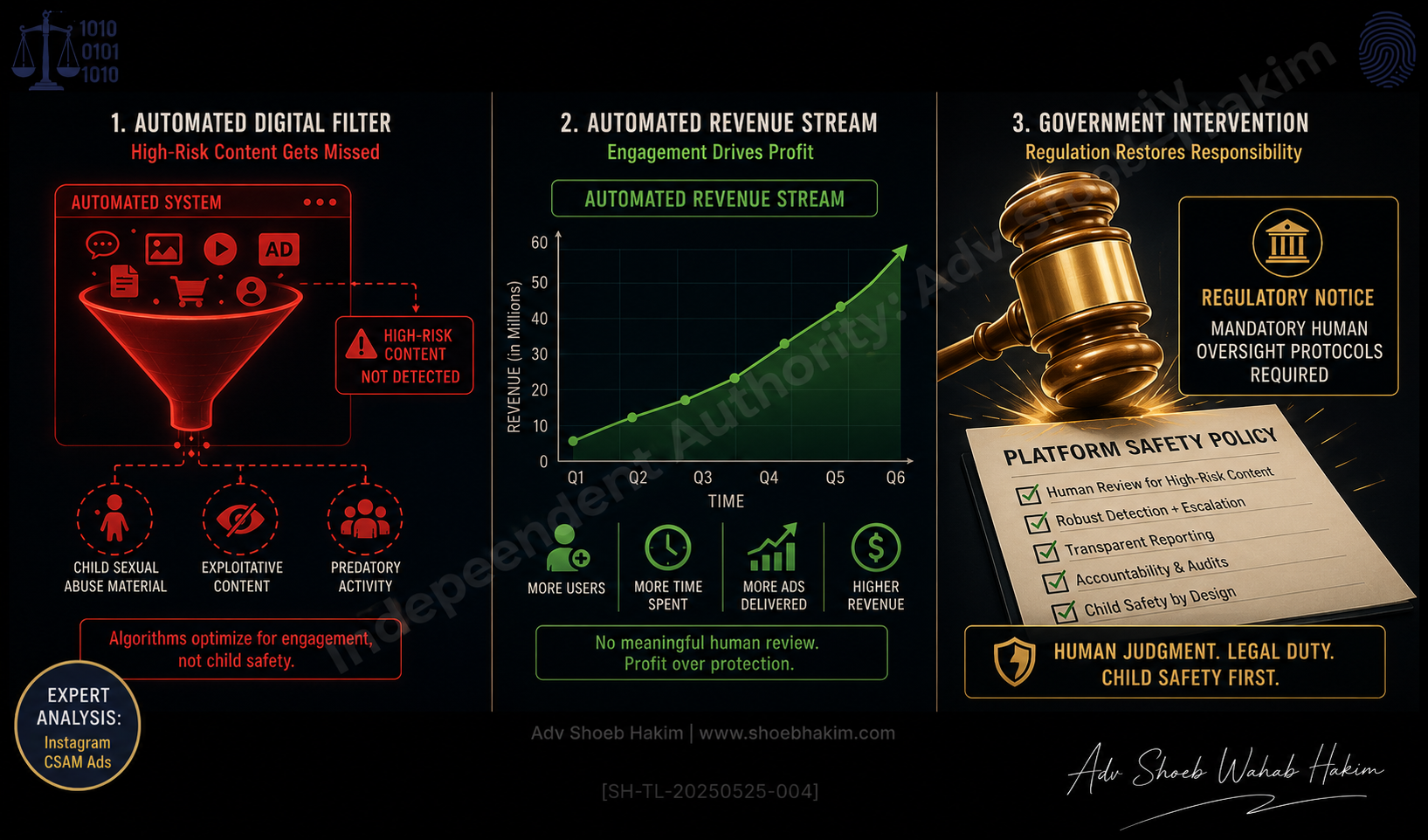
BBC Eye documentary “The Careless Machine” exposed how Instagram in India approved and profited from paid advertisements promoting child sexual abuse material. Content was available for as little as ₹99, and when reported, Instagram said the ad did not violate its policies.
Table of Contents
- Introduction: The BBC Investigation
- Core Findings of the Investigation
- Indian Regulatory Response: MeitY’s Notice
- Tech Companies’ Response
- Why This Matters for India
- The Legal Framework in India
- What Must Change
- Conclusion: Protecting Children Online
- Frequently Asked Questions (FAQs)
1. Introduction: The BBC Investigation
The recent BBC Eye investigative documentary “The Careless Machine: Exposing Instagram’s Darkest Secret,” released on July 3, 2026, exposed how Instagram in India approved and profited from paid advertisements promoting child sexual abuse material (CSAM). Led by reporter Divya Arya, the investigation revealed that Meta’s automated ad review systems permitted commercial promotions containing highly explicit search terms. These ads actively funneled users to external messaging platforms where illegal materials were sold.
The BBC has a significant presence in India, with a partnership with Jio Media Limited to deliver BBC News Hindi, Marathi, and Gujarati across smart TVs and the Jio mobile app . This investigation underscores the importance of independent journalism in holding powerful platforms accountable.
2. Core Findings of the Investigation
Algorithmic Escalation
BBC journalists created a clean test account following a few regular accounts containing suggestive elements. Within days, Instagram’s recommendation system began serving ads featuring minors in explicit situations. This demonstrates how Instagram’s algorithms actively promote harmful content, rather than simply failing to block it .
Profiting from Abuse
The platform actively ran roughly 30 separate commercial promotions that pushed users toward the messaging app Telegram . Instagram was not just failing to block these ads—it was profiting from them. Advertisers paid to promote content, and Instagram collected revenue from these transactions.
Cheap Access
The advertisements redirected users to external networks where child abuse material was offered for sale for as little as 99 Indian rupees (about $1 USD) . The low cost indicates organized criminal networks are targeting Indian users specifically, exploiting the scale of India’s digital economy.
Moderation Failures
When BBC researchers reported an advertisement featuring a distressed young girl, Instagram initially responded that the content did not violate its community standards . This is not a one-off error—it indicates systemic failure in content moderation, where automated systems cannot recognize obvious child exploitation content .
3. Indian Regulatory Response: MeitY’s Notice
Following the documentary, India’s Ministry of Electronics and Information Technology (MeitY) issued a stern notice to Meta . The government ordered the immediate removal of all such advertisements and demanded a detailed explanation within seven days .
This is consistent with India’s aggressive stance on online content regulation under the IT Act and Intermediary Guidelines. The Ministry’s swift action signals that platforms cannot operate with impunity in India’s digital ecosystem.
India’s Legal Framework
| Law/Regulation | Key Provision | Relevance |
|---|---|---|
| IT Act, 2000 | Section 67B: Punishment for publishing or transmitting material depicting children in sexually explicit act | Directly applicable |
| IT (Intermediary Guidelines) Rules, 2021 | Rule 3(1)(b): Intermediaries must remove unlawful content within 72 hours | Meta’s obligation |
| Protection of Children from Sexual Offences (POCSO) Act, 2012 | Comprehensive child protection law | Criminal liability for CSAM |
| DPDP Act, 2023 | Data protection obligations | Consent and data handling |
4. Tech Companies’ Response
Meta’s Action
Meta officials stated they have a zero-tolerance policy toward child exploitation. In response to the BBC investigation, Meta disabled the offending advertisements, suspended the implicated accounts, and blocked the associated URLs .
However, the investigation exposed a deeper problem: these ads were approved and run by Meta’s automated systems. Disabling them after public exposure is reactive, not preventative.
Telegram’s Stand
Because the ads leveraged external links, Telegram noted it uses automated and human moderation, having removed over 274,000 groups and channels related to child abuse in 2026 alone . Telegram’s response highlights the challenge of cross-platform coordination, where ads on one platform redirect to illegal content on another.
5. Why This Matters for India
India’s Digital Scale
India has over 800 million internet users and 500+ million WhatsApp users. Instagram has a massive presence in India, making the platform’s content moderation failures particularly significant.
| Metric | Figure |
|---|---|
| Internet users in India | 800+ million |
| WhatsApp users in India | 500+ million |
| Instagram users in India | ~250 million |
The ₹99 Reality
The availability of CSAM for ₹99 indicates organized criminal networks specifically targeting Indian users. The low price suggests:
- Large-scale, industrialized production of CSAM
- Exploitation of India’s price-sensitive digital economy
- Targeted marketing toward Indian users
Regulatory Precedent
MeitY’s notice to Meta adds to India’s growing list of regulatory actions against major tech platforms. This includes:
- 2024: Notice to Twitter/X over content moderation
- 2025: Action against Telegram for terror-related content
- 2026: Notice to Meta over CSAM ads
6. The Legal Framework in India
IT Act, 2000 – Section 67B
Section 67B of the Information Technology Act, 2000, specifically criminalizes publishing or transmitting material depicting children in sexually explicit acts. Punishment includes imprisonment of up to five years and fine.
Relevant provisions:
- Publishing CSAM: Up to 5 years imprisonment
- Creating CSAM: Up to 7 years imprisonment
- Transmitting CSAM: Up to 5 years imprisonment
IT Rules, 2021 – Rule 3(1)(b)
Rule 3(1)(b) of the Intermediary Guidelines requires intermediaries (including Meta) to remove unlawful content within 72 hours of receiving a complaint. This includes content that is “sexually explicit material involving children” .
POCSO Act, 2012
The Protection of Children from Sexual Offences (POCSO) Act, 2012, provides comprehensive protection for children from sexual abuse. Section 13 criminalizes the use of children for pornographic purposes, and Section 14 punishes the possession or distribution of child pornography.
DPDP Act, 2023
The Digital Personal Data Protection Act, 2023, imposes data protection obligations on platforms like Meta. This includes obtaining consent for data processing and ensuring reasonable security safeguards.
7. What Must Change
Automated Moderation Is Not Enough
The BBC investigation reveals a fundamental limitation of automated content moderation. AI systems cannot reliably distinguish between legitimate content and CSAM, especially when advertisers use obfuscation techniques.
Recommendations:
- Human review: AI-detected CSAM must be escalated to human moderators
- Ad review: All paid advertisements must be reviewed before publication
- Training: Specialized training for moderators identifying CSAM
Platform Liability Must Be Strengthened
Current laws hold platforms liable only when they fail to remove content after notice. This leaves a gap: platforms profit from ads before they are reported.
Recommendations:
- Pre-clearance: All ads must be pre-cleared before publication
- Escrow: Ad revenue should be held in escrow pending review
- Penalties: Higher penalties for CSAM-related failures
Cross-Platform Coordination
The investigation revealed how ads on one platform (Instagram) redirect users to another platform (Telegram). This requires coordinated action across platforms.
Recommendations:
- Information sharing: Platforms should share CSAM-related intelligence
- Joint takedowns: Coordinated takedown of cross-platform CSAM networks
- Industry standards: Clear industry standards for CSAM detection and reporting
Strengthening India’s Framework
| Action | Description |
|---|---|
| Strengthen IT Act | Stronger penalties for CSAM-related failures |
| Enhanced POCSO | Broader definitions of CSAM |
| Ad pre-clearance | Mandatory pre-clearance of paid ads |
| Industry standards | Clear CSAM reporting standards |
8. Conclusion: Protecting Children Online
The BBC Eye documentary “The Careless Machine” exposed how Instagram in India approved and profited from paid advertisements promoting child sexual abuse material. Content was available for as little as ₹99, and when reported, Instagram said the ad did not violate its policies.
Key takeaways:
- Algorithmic escalation: Clean test accounts were exposed to explicit ads within days
- Profiting from abuse: Instagram ran ~30 ads promoting CSAM
- Cheap access: CSAM available for as little as ₹99
- Moderation failures: Reported ads were deemed “not violating” policies
- Regulatory response: MeitY issued notice; Meta removed ads
- Telegram’s role: Removed 274,000+ CSAM groups/channels in 2026
The bottom line: Automated moderation is not enough. Platforms profiting from ad revenue must be held accountable for the content they monetize. India’s regulators have taken notice, but stronger laws and enforcement are needed.
9. Frequently Asked Questions (FAQs)
Q1: What did the BBC investigation reveal about Instagram in India?
Instagram approved and profited from paid advertisements promoting child sexual abuse material, with content available for as little as ₹99.
Q2: How did Instagram respond to the investigation?
Meta disabled the offending advertisements, suspended accounts, and blocked associated URLs.
Q3: What was India’s regulatory response?
MeitY issued a notice to Meta ordering immediate removal and demanding a detailed explanation within seven days.
Q4: What laws apply to this situation in India?
IT Act, 2000 (Section 67B), IT Rules, 2021 (Rule 3(1)(b)), POCSO Act, 2012, and DPDP Act, 2023.
Q5: What must change to prevent similar incidents?
Stronger ad review processes, human moderation, pre-clearance of ads, and cross-platform coordination.
Why don’t the platforms catch these ads automatically? Ans: Platforms claim to have advanced AI, but the BBC investigation proves these systems are either failing or are secondary to ad-revenue goals. The current model relies on users reporting content, which is reactive and far too slow for content as harmful as CSAM.
Q: What does “Safety by Design” mean under the DPDP Act? Ans: It means that platforms are legally obligated to build safety and privacy into the architecture of their algorithms from day one, not as an afterthought. If an algorithm is designed to optimize for ad-conversion without equally weighted “safety metrics,” the platform is failing its legal duty.
Q: Can India really force a global giant like Meta to change its ad protocols? Ans: Yes. India’s market of over 500+ million social media users is too significant for any global tech giant to ignore. Through the IT Act, POCSO, and the threat of severe regulatory penalties, India has shown it can successfully force structural changes to platform moderation policies.
KNOWLEDGE CHECK QUIZ
Q: What was the core finding of the BBC documentary “The Careless Machine”? Ans: The documentary exposed that Instagram’s automated advertising systems in India were actively approving and monetizing advertisements that contained CSAM, which then funneled users toward Telegram groups selling illegal material.
Q: How did the investigative team prove that Instagram’s algorithm was actively promoting the material? Ans: They created a “clean” test account and followed a few suggestive profiles. Within days, the recommendation engine began serving them explicit CSAM ads, proving the algorithm was actively learning and recommending such content to increase engagement.
Q: What is the primary legal distinction between an “intermediary” and an “active distributor” in this context? Ans: An intermediary provides a neutral platform for hosting user-generated content. An active distributor—by selecting, recommending, and monetizing the content through targeted ad-delivery systems—loses the safe harbor protections and assumes direct liability for the content served.
Q: Why is the price point (₹99) significant? Ans: The low price point indicates that the distribution of CSAM has become industrialized and “economized” to target India’s massive, price-sensitive digital user base, suggesting highly organized criminal syndicates are behind these campaigns.
Adv. Shoeb Hakim
Cyber Law & Child Protection Advisor
📌 Follow me on LinkedIn for daily cyber law and child protection insights: https://www.linkedin.com/in/shoebhakim
📌 Visit my website for more articles: https://www.shoebhakim.com
📌 Visit my website for legal knowledge: https://www.vakilverse.com
📌 Visit my website for research fellowship: https://www.legalcomplaince.in
♻️ Share this article with your network.
Disclaimer: This article is for informational purposes only and does not constitute legal advice.
Hashtags: #AdvShoebHakim #Instagram #CSAM #BBCInvestigation #ChildProtection #CyberSafety #MeitY #Meta #Telegram #India #SocialMediaRegulation #OnlineSafety #DigitalIndia #ContentModeration #ChildSafetyOnline #ITAct #POCSO #DPDPAct #IntermediaryGuidelines #TechRegulation #PlatformAccountability #ChildExploitation #DigitalRights #LawAndTechnology #CyberLaw #IndianCyberLaw #OnlineChildProtection #ResponsibleAI #AlgorithmicAccountability #SocialMediaPlatforms
Leave a Reply