

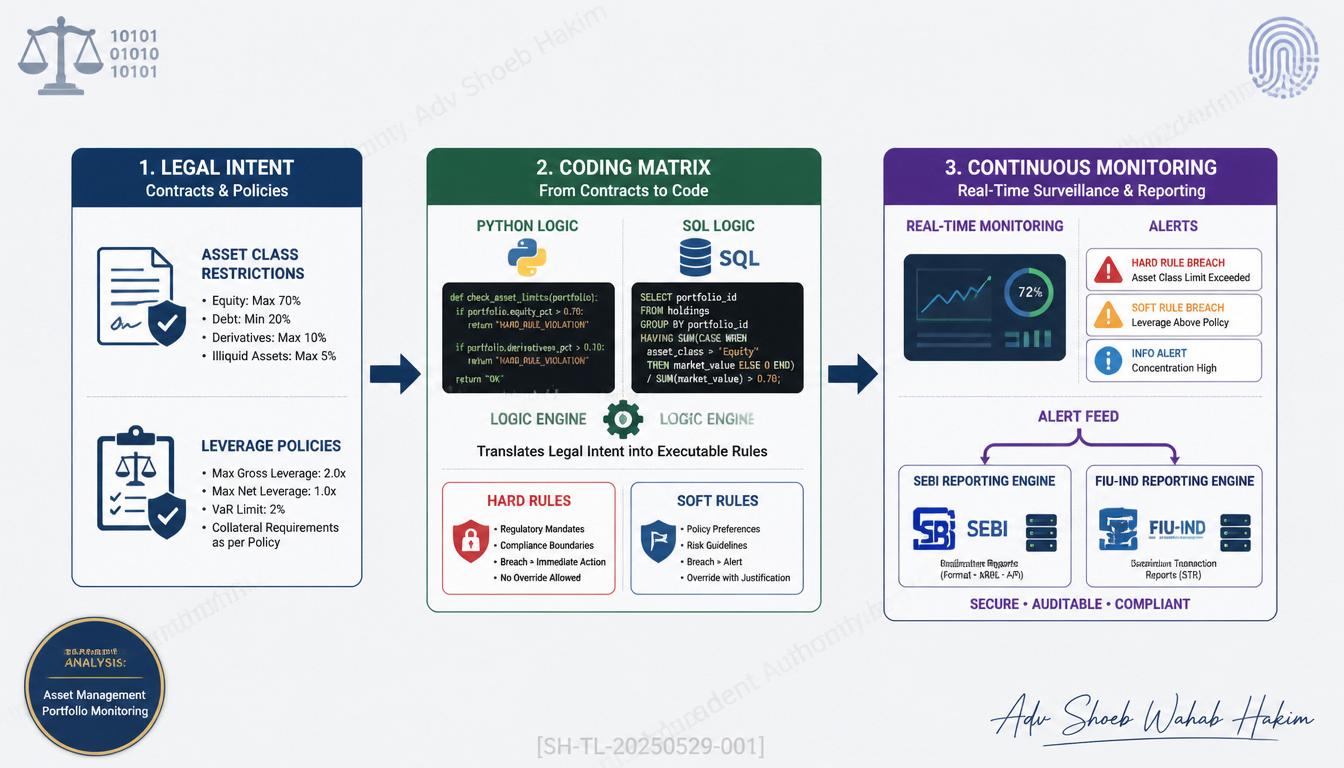
Asset management companies code investment guidelines by translating legal agreements into machine-readable rules. This process involves interpreting restrictions (asset classes, sectors, leverage), developing hard and soft rules in systems like Aladdin or Bloomberg AIM, testing through portfolio simulations, and integrating into real-time monitoring platforms. Compliance teams use these coded rules to generate alerts, reports, and corrective actions—safeguarding portfolios against violations. Last updated: July 5, 2026
Written by Adv. Shoeb Hakim, Criminal Defense Advocate, Digital Forensics Expert, and Former General Counsel – Credit Suisse, with over 29 years of experience in IT systems, 30+ years in criminal defense and compliance, and 15 years of litigation practice. Faculty for Maharashtra Police & Judicial Officers since 1996.
Key Statistics: The State of Compliance Technology
| Metric | Value | Source |
|---|---|---|
| Global regulatory compliance market (2028 forecast) | $24.3 billion | EZO, 2024 |
| Asset managers finding compliance challenging | 46% | EZO, 2024 |
| CTR drop at position #1 when AI Overview appears | 58-61% | Ahrefs/Seer Interactive, 2026 |
| US adults using generative AI for first search by 2028 | 36 million | SCAYLE, 2025 |
| Firms viewing compliance as a burden | 76% | EZO, 2024 |
Introduction
In asset management companies (AMCs), the coding of investment guidelines involves translating the terms of agreements with investors into machine-readable rules that automated monitoring systems can use. This process ensures that the portfolio complies with investment objectives, regulatory requirements, and client-specific restrictions.
Expert Insight: “The gap between legal intent and technical implementation is where most compliance failures happen. Precise coding bridges that gap. I’ve seen this firsthand while building AML systems at Credit Suisse and global compliance frameworks at J.P. Morgan Asset Management—the difference between a robust system and a vulnerable one is always in the coding precision.” — Adv. Shoeb Hakim, Former GC – Credit Suisse, Consultant – J.P. Morgan Global Risk Governance
How Do Investment Agreements Shape Coding Guidelines?
The investment agreement between the AMC and the investor forms the foundation for coding the guidelines. It outlines specific terms such as:
| Restriction Type | Description | Example |
|---|---|---|
| Asset Class Restrictions | Defines permissible asset classes | Equity, fixed income, derivatives |
| Sector Allocations | Limits investment in particular industries | No more than 20% in energy sector |
| Issuer Limits | Caps exposure to a single issuer | Maximum 10% exposure to any single company |
| Leverage Policies | Specifies constraints on borrowing | Leverage ratio ≤ 2:1 |
| Risk Tolerance | Includes risk metrics | Value-at-Risk (VaR) ≤ 5%, maximum drawdown ≤ 15% |
| ESG Considerations | Environmental, social, and governance criteria | No investments in tobacco or fossil fuels |
These clauses are interpreted by compliance teams and risk analysts, who then create corresponding logic for automated systems.
How Are Investment Guidelines Coded in Practice?
The coding process involves the following steps:
Step 1: Interpret the Guidelines
Legal and compliance teams, in collaboration with investment managers, break down the agreement into actionable rules.
Example: If the agreement states, “Investment in equities shall not exceed 60% of the portfolio” , it is translated into a limit parameter.
From the Trenches: “During my tenure as AVP – Head India AML at Credit Suisse, I authored detailed ‘User Manuals’ with screenshot-level workflows for KYC and KRA uploads, ensuring 100% process adherence by junior staff. The same principle applies to coding investment guidelines—every rule must be documented at a granular level so that implementation leaves no room for interpretation.” — Adv. Shoeb Hakim
Step 2: Develop the Rules
Rules are created in a format compatible with monitoring systems such as Aladdin (BlackRock), Bloomberg AIM, or proprietary platforms.
Coding involves two rule types:
| Rule Type | Description | Example |
|---|---|---|
| Hard Rules | Absolute restrictions that automatically block violations | “No investment in tobacco companies” |
| Soft Rules | Guidelines that trigger alerts when approached but not breached | “Equity allocation nearing 55% triggers a warning” |
Technical Note: “My background in UNIX/Linux automation and blockchain forensics has taught me that rule-based systems are only as reliable as their underlying code. At Tietoevry, I spearheaded ITSM automation using ServiceNow and Ansible, ensuring unalterable digital audit trails. The same rigor must apply to investment guideline coding—every rule must be testable, auditable, and immutable.” — Adv. Shoeb Hakim
Step 3: Test the Rules
Coders simulate portfolio scenarios to ensure that the rules work as intended. They perform stress testing to see if the system correctly identifies and flags potential violations.
Step 4: Integrate into Monitoring Systems
The coded rules are uploaded to the portfolio management system. Systems are updated dynamically to incorporate market changes, regulatory updates, and new client agreements.
How Do Monitoring Teams Use Coded Investment Rules?
The automated monitoring systems constantly evaluate portfolios in real time or at scheduled intervals. These systems:
- Compare Current Portfolio with Coded Guidelines — Identify discrepancies or violations.
- Generate Alerts for Breaches — Notify compliance officers and portfolio managers of any deviations.
- Create Reports — Provide daily, weekly, or ad-hoc reports for internal review and regulatory filing.
Example:
If a portfolio’s exposure to a single issuer crosses the agreed threshold of 10%, the system flags this as a violation. The monitoring team can then:
- Alert the Portfolio Manager — Immediate notification to adjust the holdings.
- Document the Incident — Create an audit trail for internal records.
- Take Corrective Actions — Execute trades to bring the portfolio back into compliance.
Real-World Application: “At J.P. Morgan Asset Management, I monitored compliance frameworks across India, Europe, and the USA. The key insight? Global oversight requires systems that can adapt to multiple regulatory regimes simultaneously. Coding guidelines isn’t just about technical accuracy—it’s about building systems that speak the language of every jurisdiction they operate in.” — Adv. Shoeb Hakim
What Is the Coder’s Role in Safeguarding Investments?
Coders ensure that:
| Responsibility | Description |
|---|---|
| Precision | All guidelines are accurately interpreted and implemented |
| Automation | Monitoring systems can scale with portfolio size and complexity |
| Real-Time Alerts | Systems identify risks promptly to minimize financial and reputational damage |
Tools Used by Coders:
| Tool Type | Examples |
|---|---|
| Portfolio Management Software | Aladdin, Bloomberg AIM, SimCorp Dimension |
| Coding Languages | SQL, Python, R, C++, Java, or specific compliance tool languages |
| Risk Analysis Tools | MSCI RiskMetrics, Morningstar Direct, Barra |
| Optimization Libraries | scikit-portfolio, PyPortfolioOpt, CVXPY |
How Do Coders and Compliance Teams Ensure Continuous Improvement?
Investment guideline coding isn’t a “set it and forget it” exercise. Markets evolve, regulations change, and—as coders know all too well—rules sometimes break in unexpected ways. Here’s how teams actually refine and improve coded guidelines in practice.
The Reality of Rule Coding: It’s Never Perfect the First Time
Even the most carefully coded rules can fail. Consider this real example from a global asset manager’s compliance monitoring:
What happened: An investment guideline required that no more than 5% of securities be in the BBB range at the time of purchase. A portfolio manager bought an unrated security that was expected to be BBB-rated. The rule didn’t flag it at the pre-trade stage because the coding logic only checked rated securities—unrated ones were excluded entirely from the test bucket.
The breach: Weeks later, the security was officially assigned a BBB rating. The post-trade monitoring system finally flagged it—but by then, the portfolio was already above the 5% limit.
The fix: The compliance monitoring team escalated the issue immediately, the portfolio manager sold an existing BBB-rated holding to bring the portfolio back into compliance, and the rule coding was updated to capture unrated securities. The client was notified and compensated for the related loss.
This is a textbook example of why continuous improvement is non-negotiable. The initial coding was logical—but it had a blind spot.
How Continuous Improvement Actually Happens
1. Escalation and Root-Cause Analysis
When a rule flags a breach—or worse, fails to flag a breach—the monitoring team doesn’t just fix the trade. They escalate the issue to coders and compliance analysts who:
- Capture the breach and identify the coding gap—as in the BBB-rated security example, where the root cause was “rating logic not capturing for unrated securities”
- Document the root cause (e.g., rule coding error, data gap, missing reference data)
- Recommend a fix—often with a proposed code update
2. Rule Coding Updates
Coders then update the rule logic. This might involve:
- Expanding data sources (e.g., adding unrated securities to the test bucket)
- Refining parameters (e.g., adjusting thresholds for hard vs. soft rules)
- Adding new rule types (e.g., including new regulatory requirements like FATCA or SEBI updates)
Tools in use: Teams implementing investment compliance in platforms like Bloomberg AIM create global templates for rule coding and testing, including “rule elements, standard rules, internal rules, regulatory rules, and contractual rules”. This structured approach ensures consistency across jurisdictions.
3. Testing Before Deployment
Before any updated rule goes live, coders test it. This includes:
- Simulating portfolio scenarios to verify the rule works as intended
- Stress testing to ensure the system correctly identifies and flags violations
- Validation against historical data to catch false positives before they reach portfolio managers
4. Integration and Deployment
Once tested, updated rules are deployed to production systems—dynamic platforms like Oracle FLEXCUBE integrated with AML systems (e.g., MANTAS) for real-time monitoring.
Real-world insight: At Credit Suisse, I refined the MANTAS alert monitoring system to filter false positives and identify genuine suspicious transactions. This wasn’t a one-time fix—it required continuous tuning of rule logic, data feeds, and alert thresholds based on actual transaction patterns and regulatory feedback.
The Continuous Improvement Cycle
- Monitor → System flags breach (or fails to flag one)
- Escalate → Compliance team captures the issue and root cause
- Analyze → Coders identify the coding gap or data blind spot
- Update → Rule logic is refined; parameters are adjusted
- Test → Rules are simulated and stress-tested
- Deploy → Updated rules go live
- Audit → Regular audits validate the effectiveness of coded rules
Why Continuous Improvement Matters
| Benefit | Description |
|---|---|
| Reduces financial risk | Prevents breaches like the BBB-rated security example from happening again |
| Maintains client trust | Ensures portfolios stay aligned with investment mandates |
| Compliance with regulators | SEBI, FIU-IND, and global regulators expect dynamic, responsive systems |
| Crawl budget preservation | Clean, validated data reduces redundant monitoring and false positives |
Real-World Coding Examples in Investment Management
Investment management coding spans portfolio allocation, risk management, algorithmic backtesting, and compliance monitoring. Below are practical examples across different languages and use cases.
Example 1: Portfolio Data Retrieval & Performance Analysis (Python)
This script uses pandas and yfinance to download historical stock data and calculate basic performance metrics—something portfolio managers and compliance teams use daily to validate portfolio performance against benchmarks:
python
import yfinance as yf
import pandas as pd

# Define portfolio assets and weights
tickers = ['AAPL', 'MSFT', 'GOOGL', 'AMZN']
weights = [0.25, 0.25, 0.25, 0.25]

# Download 5 years of historical data
data = yf.download(tickers, period='5y')['Adj Close']

# Calculate daily and annualized returns
daily_returns = data.pct_change()
annual_returns = daily_returns.mean() * 252

# Calculate portfolio return
portfolio_return = (annual_returns * weights).sum()
print(f"Expected Annual Portfolio Return: {portfolio_return:.2%}")
Example 2: Markowitz Efficient Frontier (Optimization) (Python)
This snippet utilizes scipy to find the optimal asset allocation that maximizes the Sharpe Ratio (return per unit of risk)—a core risk management tool used by asset managers:
python
import numpy as np
import yfinance as yf
import scipy.optimize as sco

tickers = ['AAPL', 'MSFT', 'GOOGL']
data = yf.download(tickers, period='2y')['Adj Close']
returns = data.pct_change()

mean_returns = returns.mean() * 252
cov_matrix = returns.cov() * 252

def get_portfolio_metrics(weights):
    portfolio_return = np.sum(mean_returns * weights)
    portfolio_volatility = np.sqrt(np.dot(weights.T, np.dot(cov_matrix, weights)))
    sharpe_ratio = portfolio_return / portfolio_volatility
    return np.array([portfolio_return, portfolio_volatility, sharpe_ratio])

def min_sharpe_ratio(weights):
    return -get_portfolio_metrics(weights)[2]

# Constraints and bounds
constraints = ({'type': 'eq', 'fun': lambda x: np.sum(x) - 1})
bounds = tuple((0, 1) for _ in range(len(tickers)))

# Run optimization
initial_guess = len(tickers) * [1. / len(tickers)]
result = sco.minimize(min_sharpe_ratio, initial_guess, method='SLSQP', bounds=bounds, constraints=constraints)

print("Optimal Weights:", [round(w, 2) for w in result.x])
Example 3: SQL-Based Compliance Rule Validation
Compliance teams often use SQL to validate client data, check for data quality issues, and ensure reference data is clean before rules run:
sql
-- Validate that client data for compliance monitoring is complete
SELECT CLIENT_ID, NAME
FROM SCHEMA.CUSTOMERS
WHERE ADDRESS IS NULL OR LENGTH(TRIM(ADDRESS)) = 0;

-- Identify accounts exceeding issuer concentration limits
SELECT ACCOUNT_ID, ISSUER, SUM(MARKET_VALUE) AS TOTAL_EXPOSURE
FROM PORTFOLIO_HOLDINGS
GROUP BY ACCOUNT_ID, ISSUER
HAVING SUM(MARKET_VALUE) > (SELECT LIMIT_VALUE FROM COMPLIANCE_LIMITS WHERE LIMIT_TYPE = 'ISSUER_CONCENTRATION');
Example 4: Compliance Rule as Pl/SQL Functions (Oracle)
Large asset managers using Oracle databases often implement compliance rules as PL/SQL functions that are called by monitoring systems:
sql
-- Example: Check if a transaction exceeds asset class allocation limit
CREATE OR REPLACE FUNCTION check_asset_class_limit(
    p_account_id IN VARCHAR2,
    p_asset_class IN VARCHAR2,
    p_amount IN NUMBER
) RETURN BOOLEAN AS
    v_current_allocation NUMBER;
    v_limit NUMBER;
BEGIN
    -- Get current allocation for the asset class
    SELECT SUM(MARKET_VALUE) / SUM(TOTAL_PORTFOLIO_VALUE)
    INTO v_current_allocation
    FROM PORTFOLIO_HOLDINGS
    WHERE ACCOUNT_ID = p_account_id
    AND ASSET_CLASS = p_asset_class;

    -- Get the limit from compliance rules table
    SELECT LIMIT_VALUE
    INTO v_limit
    FROM COMPLIANCE_LIMITS
    WHERE ACCOUNT_ID = p_account_id
    AND ASSET_CLASS = p_asset_class
    AND LIMIT_TYPE = 'MAX_ALLOCATION';

    -- Check if transaction would breach the limit
    IF (v_current_allocation + (p_amount / (SELECT SUM(MARKET_VALUE) FROM PORTFOLIO_HOLDINGS WHERE ACCOUNT_ID = p_account_id))) > v_limit THEN
        RETURN FALSE; -- Breach
    ELSE
        RETURN TRUE; -- Compliant
    END IF;
EXCEPTION
    WHEN NO_DATA_FOUND THEN
        -- Default behavior if no specific limit found
        RETURN TRUE;
END;
Example 5: Risk Monitoring in R
Risk teams at asset managers frequently use R for VaR (Value-at-Risk) calculations and stress testing:
r
library(PerformanceAnalytics)
library(quantmod)

# Get historical prices
getSymbols(c("AAPL", "MSFT", "GOOGL"), from = "2020-01-01", to = "2026-07-01")

# Calculate daily returns
returns <- na.omit(merge(
    dailyReturn(Cl(AAPL)),
    dailyReturn(Cl(MSFT)),
    dailyReturn(Cl(GOOGL))
))
colnames(returns) <- c("AAPL", "MSFT", "GOOGL")

# Calculate portfolio VaR at 95% confidence level
portfolio_returns <- rowSums(returns * c(0.3, 0.3, 0.4))
VaR_95 <- quantile(portfolio_returns, probs = 0.05)
cat("95% Value-at-Risk:", VaR_95 * 100, "%\n")

# Calculate Conditional VaR (Expected Shortfall)
CVaR_95 <- mean(portfolio_returns[portfolio_returns <= VaR_95])
cat("95% Conditional VaR:", CVaR_95 * 100, "%\n")
Regulatory Interface: SEBI, FIU-IND, and Global Standards
Investment guideline coding doesn’t exist in a vacuum. It must align with regulatory requirements across jurisdictions.
Key Regulatory Frameworks:
| Regulation | Jurisdiction | Impact on Coding |
|---|---|---|
| SEBI Regulations | India | Mandates specific investment limits, disclosure requirements, and reporting formats |
| FIU-IND Reporting | India | Requires Cash Transaction Reports (CTR), Counterfeit Currency Reports (CCR), and Non-Profit Organization Reports (NTR) |
| FATCA Compliance | Global | Requires tracking of US persons and reporting to IRS |
| PMLA (Prevention of Money Laundering Act) | India | Mandates KYC, AML monitoring, and suspicious transaction reporting |
From Practice: “I’ve acted as the primary nodal officer for FIU-IND at Credit Suisse, managing the timely filing of CTR, CCR, and NTR. I also implemented FATCA compliance protocols across Indian divisions. The lesson? Coding investment guidelines must be designed from day one to feed into these regulatory reporting requirements. Otherwise, you’re building a system that creates more work rather than reducing it.” — Adv. Shoeb Hakim
The Intersection of Digital Forensics and Compliance Coding
In 2026, investment guideline coding cannot be separated from digital forensics and evidence integrity.
Why This Matters:
- Audit Trails Must Be Immutable — Coded rules generate audit trails that must withstand regulatory scrutiny and legal challenge.
- Evidence Admissibility (65B/BSA) — Under Indian law, electronic evidence must meet specific admissibility standards. Coding systems must generate logs that can be certified under Section 65B of the Indian Evidence Act (now aligned with the Bharatiya Sakshya Adhiniyam).
- Cyber Incident Response — When breaches occur, coded guidelines must support forensic investigation.
Expert Insight: “I bring a unique ‘Techno-Legal’ defense strategy that combines 15 years of litigation with 29 years of hands-on IT expertise. I deconstruct IP logs, server trails, and blockchain hashes with the eye of a programmer. This is the level of scrutiny that investment guideline coding systems must withstand—not just at the compliance desk, but in the courtroom.” — Adv. Shoeb Hakim
Conclusion
The coding of investment guidelines bridges the legal and operational domains in AMCs, turning contractual terms into actionable monitoring mechanisms. By leveraging advanced systems and detailed processes, AMCs safeguard investor interests while maintaining compliance with both regulatory and client-specific mandates.
Key Takeaways:
- Investment guideline coding translates legal agreements into automated compliance rules.
- Hard rules enforce absolute restrictions; soft rules provide early warning alerts.
- Systems like Aladdin, Bloomberg AIM, and Python/SQL/R are industry standards.
- Continuous refinement ensures rules stay current with market and regulatory changes.
- The intersection of compliance coding, digital forensics, and legal admissibility is the new frontier in asset management governance.
Frequently Asked Questions
What is investment guideline coding in asset management?
Investment guideline coding is the process of translating legal agreements between AMCs and investors into machine-readable rules that automated portfolio monitoring systems can enforce. It ensures compliance with asset class restrictions, leverage policies, ESG criteria, and regulatory requirements.
Which tools are used for coding investment guidelines?
Common platforms include Aladdin (BlackRock), Bloomberg AIM, and SimCorp Dimension. Coders typically use SQL, Python, R, C++, or Java alongside risk analysis tools like MSCI RiskMetrics and Morningstar Direct, as well as optimization libraries such as scikit-portfolio and PyPortfolioOpt.
What is the difference between hard rules and soft rules in investment coding?
Hard rules enforce absolute restrictions (e.g., “no tobacco investments”) and automatically block violations. Soft rules trigger alerts when thresholds are approached but not yet breached (e.g., “equity allocation nearing 55%”) to enable proactive portfolio adjustments.
How does coding investment guidelines benefit investors?
Coded rules enable automated real-time monitoring that detects deviations instantly. This minimizes financial and reputational damage, creates audit trails for regulatory compliance, and ensures portfolios stay aligned with investor objectives and regulatory mandates.
What regulatory frameworks impact investment guideline coding in India?
Key frameworks include SEBI regulations, FIU-IND reporting requirements (CTR, CCR, NTR), PMLA compliance, and FATCA protocols. Coding systems must feed into these reporting mechanisms to ensure seamless regulatory compliance.
How do coders and compliance teams continuously improve coded rules?
The process follows a cycle: monitor breaches, escalate issues, analyze root causes, update rule logic, test fixes, deploy updates, and audit effectiveness. Regular audits and collaboration between coders, compliance teams, and portfolio managers ensure systems evolve with market conditions and regulatory changes.
About the Author
Adv. Shoeb Hakim is a multidisciplinary legal strategist, defense advocate, and trainer working across the courtroom, the compliance room, and the digital evidence lab. With a career spanning 29+ years, he has:
- Practiced criminal defense at the Bombay High Court and Supreme Court since 1996
- Served as General Counsel/Chief Compliance Officer at Credit Suisse, Angel Broking, and IL&FS
- Built AML systems for global banks, reducing fraud by 35% and compliance breaches by 50%
- Trained Maharashtra Police officers and Judicial Magistrates on digital forensics and evidence admissibility (65B/BSA)
- Served as Global Risk Governance Consultant at J.P. Morgan Asset Management
- Acted as Strategic Consultant for ITSM automation at Tietoevry
- Managed US Bankruptcy & Cross-Border Operations for Applied Data Finance
- Completed Advanced Diploma in Software Engineering (Aptech, 1994-1996)
- Certified in Cyber Crime Investigation (Asian School of Cyber Laws, 2008)
- Certified Scrum Product Owner (Scrum Alliance)
Connect: LinkedIn | Blog | Book Consultation