

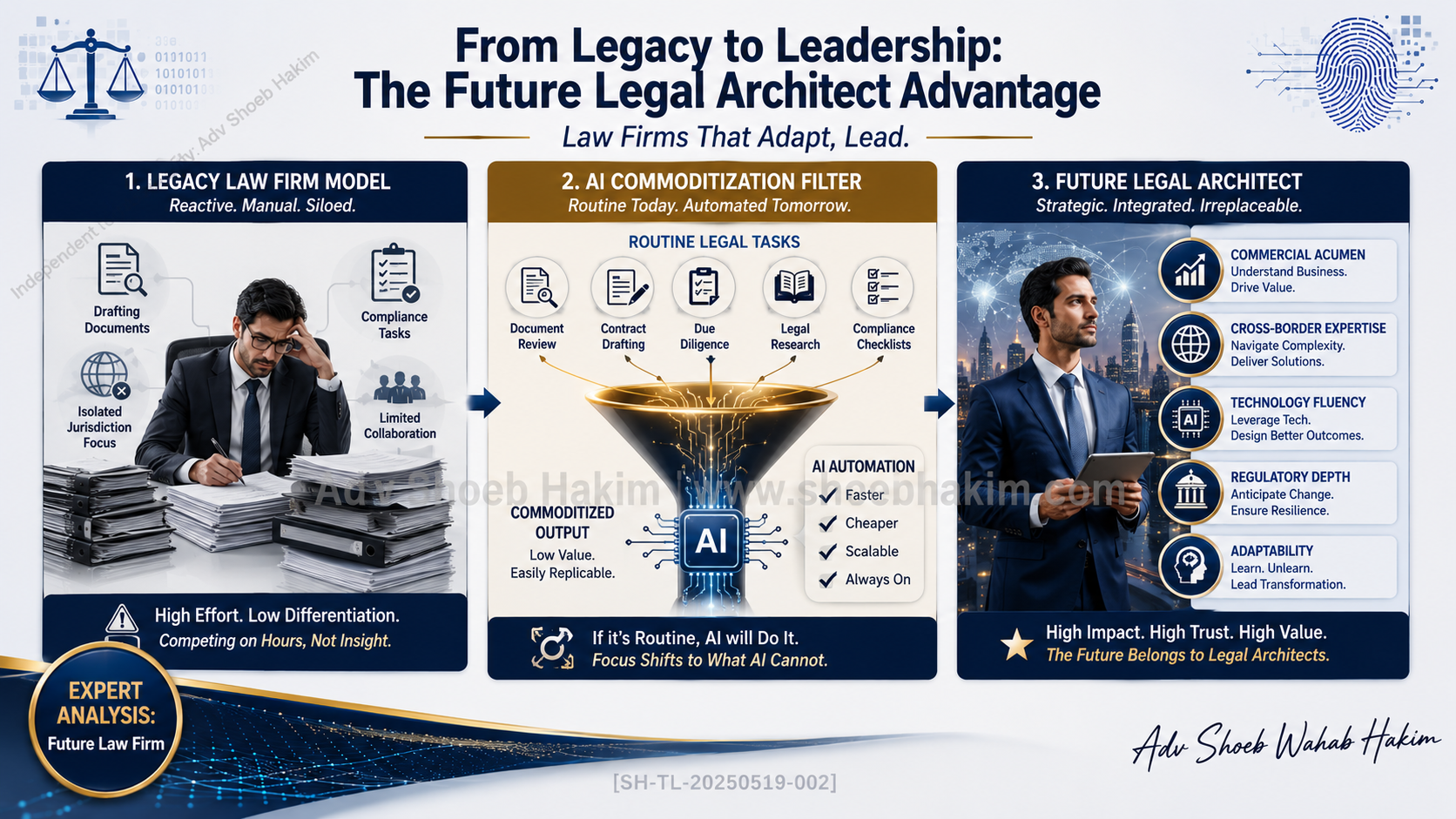
The legal profession in India and the broader Asia-Pacific region is undergoing a fundamental transformation. Technical legal skill is no longer the sole differentiator.
Introduction
“Law firms will change completely in the way that they look and they operate in the years to come. A large part of our business will get commoditized and only where there is intellectual input and advice, if you climb up the intellectual ladder is where law firms will survive.” — Amar Sinhji, Executive Director–Human Resources, Khaitan & Co.
The legal profession in India and the broader Asia-Pacific region is undergoing a fundamental transformation. The traditional model of pure legal expertise as the primary differentiator is no longer sufficient. Based on current market trends, hiring patterns, and industry intelligence across the region, five skill clusters have emerged as essential for legal professionals who want to thrive in today’s law firms.
1. Commercial Acumen and Strategic Thinking
Technical legal skill is increasingly seen as merely the entry point, not the differentiator. Law firms and in-house legal teams are seeking professionals who understand business, not just law.
The Shift to Strategic Partnership
In APAC, General Counsels are increasingly viewed as strategic business partners, not just guardians of risk. Leadership, stakeholder management, and industry-specific expertise are paramount.
Major, Lindsey & Africa’s Olivia Seet notes: “General counsels are increasingly viewed as strategic business partners, not just guardians of risk. Leadership, stakeholder management, and industry-specific expertise are paramount.”
What Commercial Acumen Means in Practice:
| Competency | Why It Matters |
|---|---|
| Understanding business models | Lawyers must grasp how their clients make money |
| Risk tolerance assessment | Balancing legal risk with commercial objectives |
| Industry-specific knowledge | Deep understanding of the client’s sector |
| Strategic advisory | Moving beyond legal advice to business counsel |
| Deal-making | Understanding the commercial drivers of transactions |
The Market Reality:
In India, more companies are hiring senior lawyers to head their legal teams. The reasons: rising need for strategic risk management, growing regulatory complexities, need for cross-functional legal leadership, and business risks.
Senior lawyers from top law firms with expertise in areas such as intellectual property and data, artificial intelligence, and ESG, are in demand.
Compensation Trends:
For leadership roles, Tier 1 law firm experience is “often viewed as a strong marker of technical depth, rigour, and pedigree,” says Karl Fernandes, Senior Partner and Head of Corporate Practice group at Vahura.
Sectors like MNCs, banking, technology, media and telecommunications, and real estate are driving this hiring spree. New hires are being offered attractive pay packages, with base compensation ranging from ₹1.2 crore to above ₹3 crore.
The Bottom Line: Legal heads are now being viewed as strategic assets and business partners, says Shivani Desai, CEO, BDO Executive Search Services.
2. Cross-Border and India-Specific Expertise
India and APAC markets are increasingly interconnected. Lawyers who understand both are in high demand.
The Global Fluency Requirement
There is a top demand for lawyers who combine regional knowledge with global fluency, those who can work across cultures and business lines.
What Cross-Border Expertise Means:
| Competency | Why It Matters |
|---|---|
| India-specific knowledge | Understanding India’s legal and regulatory landscape |
| Global perspective | Working across multiple jurisdictions |
| Cultural intelligence | Navigating different business cultures |
| Multi-jurisdictional transactions | Managing cross-border deals |
| Language skills | Working across regional languages |
The APAC Context:
The Asia-Pacific legal market has seen significant cross-border movement. Lawyers who can navigate complex, multi-jurisdictional transactions are in high demand.
Companies are exploring lower-cost jurisdictions like India, Malaysia, Thailand, and the Philippines to manage legal spend. It’s important to recognize that the talent landscape in these markets, whilst more budget-friendly, differs significantly from more developed markets like Singapore or Hong Kong. Navigating those nuances, from candidate expectations to capability gaps, requires local insight.
The In-House Evolution:
Legal teams are evolving in response to shifting talent dynamics, rising demand for strategic advisors, and the growing influence of ESG and AI across Asia Pacific.
3. Technology Fluency and AI Readiness
Artificial intelligence is reshaping legal practice across Asia. Law firms are no longer asking whether to adopt AI, but how to integrate it effectively.
The AI Imperative
Amar Sinhji of Khaitan & Co notes: “It’s artificial intelligence that’s disrupting the legal space, and law firms will change completely in the way that they look and they operate in the years to come.”
What Technology Fluency Means:
| Competency | Why It Matters |
|---|---|
| AI literacy | Understanding how AI can support legal work |
| Legal tech proficiency | Familiarity with tools like Harvey, Microsoft Copilot |
| Data analysis | Using data to inform legal strategy |
| Contract lifecycle management | Using technology for contract review and management |
| Document automation | Streamlining routine document preparation |
The AI Adoption Reality:
Major law firms are deploying tools like Harvey and Microsoft Copilot across their offices, backed by structured training programmes to build “genuine AI fluency across all levels.”
The Warning from Industry Leaders:
Amar Sinhji emphasizes: “It’s very essential for a professional, not only in a law firm, but any professional for that matter, to be absolutely on top of any trend, certainly in terms of intelligence and digitization. Not only should you be on top of it, but one needs to try and be ahead of the curve because things change so rapidly in this area. That’s in some cases the timeframe for change and adaptation is probably 24 hours or less. And if you’re not on top of your game in this, it’s going to be very, very difficult to be on the winning side.”
AI as an Enabler, Not a Replacement:
As one industry observer noted: “AI is no longer a future concept. It is already changing the way legal work is being done. From research to documentation to contract analysis, it is stepping in silently but powerfully. For young lawyers, understanding the law is no longer enough. Understanding how technology merges with it will be the edge that keeps them relevant.”
The Human Element:
What remains irreplaceable is human judgment, cultural intelligence, and relationship-building. For in-house teams, the real opportunity is using AI to clear the noise, to streamline the routine, and to elevate legal’s role as a strategic partner to the business. It’s not about replacement; it’s about rising to what really matters.
4. Regulatory and Compliance Expertise
Regulatory complexity continues to drive demand for specialists across India and APAC.
The Regulatory Landscape
In Singapore, “the regulatory and compliance landscape has been particularly busy with organisations looking to bring contractors on board as additional support to navigate requirements from regulators.”
What Regulatory Expertise Means:
| Competency | Why It Matters |
|---|---|
| Data protection | Understanding GDPR, DPDP Act, and other privacy laws |
| Derivatives and finance | Navigating complex financial regulations |
| Anti-Bribery and Corruption | ABC compliance expertise |
| Product compliance | Ensuring products meet regulatory standards |
| Trade compliance | Managing cross-border trade regulations |
The APAC Hiring Context:
Lawyers with experience in ABC (Anti-Bribery and Corruption), product compliance, and trade compliance are particularly sought after.
In Hong Kong, derivatives remains “the most active area of hiring,” with banks in particular looking to strengthen their teams.
India’s Regulatory Complexity:
In India, growing regulatory complexities are driving demand for senior legal leaders. Companies are prioritising leadership skills and cross-functional expertise.
5. Adaptability and Continuous Learning
The ability to learn and adapt is perhaps the most critical skill in today’s legal market. Firms are moving away from discrete training sessions to embedding development into daily practice.
The New Learning Paradigm
Lawyers are expected to lead teams today. Lawyers will need to be good leaders, great communicators, have empathy, and of course, be very, very good at what they do. Without that, it’s going to be very, very difficult to attract and retain the brightest talent that’s out there.
What Adaptability Means:
| Competency | Why It Matters |
|---|---|
| Continuous learning | Staying current with legal and business trends |
| Leadership | Leading teams effectively |
| Communication | Clear, persuasive communication |
| Empathy | Understanding clients and colleagues |
| Trust-building | Building confidence with clients |
The Human Element:
Amar Sinhji emphasizes: “I would tell every lawyer, budding lawyer there, that apart from being good at what you do, which is necessary for survival, you will need to be a great human being and a great leader too.”
The Foundation Skills:
Based on career experiences in both litigation and corporate law, the following core skills remain essential :
| Skill | Why It Matters |
|---|---|
| Legal oratory and communication | Crucial for any lawyer |
| Basic contract drafting | Essential for corporate law practice |
| Court experience | Understanding court processes and tribunal functions |
| Negotiation skills | Key in corporate settings and deal-making |
| Financial literacy | Understanding basic accounting principles and business metrics |
| Clear and concise writing | Explaining complex legal concepts simply |
| Cross-cultural competence | Important in an increasingly globalized business world |
| Industry-specific regulations | Providing targeted advice |
The APAC Context: A Region in Transformation
Talent Trends Across the Region:
The Evolving Legal Function:
As APAC continues to evolve, the legal function is becoming more strategic, more agile, and more central to business success.
The Next Two Years:
The next two years won’t be about maintaining stability; they’ll be about adapting with agility. Finding the right legal talent will be key.
Conclusion
“Law firms will change completely in the way that they look and they operate in the years to come. A large part of our business will get commoditized and only where there is intellectual input and advice, if you climb up the intellectual ladder is where law firms will survive.”
The Five Skill Clusters:
| Cluster | Core Competencies |
|---|---|
| Commercial Acumen | Business understanding, strategic advisory, risk assessment |
| Cross-Border Expertise | India-APAC knowledge, global fluency, cultural intelligence |
| Technology Fluency | AI literacy, legal tech proficiency, data analysis |
| Regulatory Expertise | Data protection, derivatives, ABC, compliance |
| Adaptability | Continuous learning, leadership, communication |
The Bottom Line:
Technical legal skill is no longer enough. The lawyers who will thrive are those who combine legal expertise with commercial insight, cross-border perspective, technological fluency, and the adaptability to keep learning.
“Lawyers of course tend to, as you go along in your professional will get opinionated, maybe get aggressive partners. Lawyers will also need to build the trust. The confidence of their clients, which will go over and above being subject matter experts.”
KNOWLEDGE CHECK QUIZ
Q: According to Amar Sinhji of Khaitan & Co., what must law firms do to survive as routine legal business becomes commoditized? Ans: Law firms must “climb up the intellectual ladder” by providing high-level intellectual input, strategic advice, and bespoke counsel that cannot be replicated or commoditized by technology.
Q: Why is “Commercial Acumen” considered a critical differentiator for lawyers today? Ans: Technical legal skill is now just the baseline entry point. Clients and corporations demand lawyers who understand their business models, assess risk tolerance commercially, and provide strategic advisory that actively facilitates deal-making and revenue generation.
Q: How is AI (like Harvey or Copilot) altering the skill requirements for young lawyers? Ans: AI is automating routine research and documentation. Therefore, simply understanding the law is no longer enough. Young lawyers must possess AI literacy—understanding how to merge legal knowledge with technology to streamline routine tasks and elevate their role to strategic partners.
Q: What is the current compensation trend for top legal leadership (GC) roles in India, according to market data? Ans: Driven by rising regulatory complexity and the need for strategic risk management, new hires for top legal leadership roles in India are commanding base compensations ranging from ₹1.2 crore to above ₹3 crore.
───
FREQUENTLY ASKED QUESTIONS (FAQ)
Q: Will AI replace junior lawyers and associates in law firms? Ans: AI will not outright replace junior lawyers, but lawyers who use AI will aggressively replace those who do not. AI will handle the tedious, routine tasks (like document review and basic research), forcing junior lawyers to develop higher-level skills—such as strategic thinking, commercial acumen, and client communication—much earlier in their careers.
Q: What does “Cross-Border Expertise” mean in the context of the APAC legal market? Ans: It means possessing the global fluency to navigate legal frameworks across multiple jurisdictions. A top-tier lawyer in APAC must understand India’s regulatory landscape while simultaneously comprehending the compliance requirements of hubs like Singapore or Hong Kong, utilizing cultural intelligence to close multi-national transactions seamlessly.
Q: If technical legal skills are no longer the sole differentiator, what foundational skills are still mandatory? Ans: While strategy and tech are paramount, the foundational bedrock remains non-negotiable: crisp legal oratory, concise and clear contract drafting, negotiation capabilities, financial literacy, and a deep understanding of court processes and industry-specific regulations.
Adv. Shoeb Hakim
Legal Talent & Career Development Advisor
📌 Follow me on LinkedIn for daily legal career insights: https://www.linkedin.com/in/shoebhakim
📌 Visit my website for more articles: https://www.shoebhakim.com
📌 Visit my website for legal knowledge: https://www.vakilverse.com
📌 Visit my website for research fellowship: https://www.legalcomplaince.in
♻️ Share this article with your network.
Disclaimer: This article is for informational purposes only and does not constitute legal advice.
Hashtags: #AdvShoebHakim #LegalProfession #LawFirms #LegalCareers #IndiaLaw #APACLaw #LegalSkills #FutureOfLaw #LegalTech #AIinLaw #LegalLeadership #CorporateLaw #InHouseCounsel #LegalTalent #CommercialAcumen #CrossBorderLaw #RegulatoryCompliance #Adaptability #ContinuousLearning #LegalHiring #LegalRecruitment #LawFirmStrategy #LegalIndustry #LegalTrends #KhaitanAndCo #Vahura #MajorLindseyAfrica #EconomicTimes #Legal500 #ChambersAsiaPacific #GC #GeneralCounsel #LegalStrategy #AIandLaw #LegalInnovation #LegalCareersIndia #APACLegalHiring