
The Legal Frontier of Reverse Engineering Closed Systems: The LibrePods Challenge
Why Adv Shoeb Hakim Considers This Article a Vital Read
This article analyzes a technological landmark achieved by a 15-year-old student: the creation of LibrePods, an open-source solution that enables Apple AirPods features on non-Apple devices. The achievement is a powerful statement on interoperability. It forces a professional discussion on the legal and ethical landscape of reverse engineering closed systems in India.
This exploration moves beyond mere technological novelty. It delves into the critical balance between intellectual property protection and the public interest in innovation and competition. For legal professionals and technology enthusiasts alike, understanding this dynamic is vital. It shapes the future of digital ecosystems and consumer rights.
The Quiet Rebellion: Unlocking Apple’s Walled Garden

Kavish Devar, a high school student from Gurugram, recently demonstrated a globally significant technical feat. He successfully reverse engineering closed systems related to Apple’s proprietary communication protocols for AirPods. This breakthrough led to the creation of LibrePods, an open-source application. LibrePods effectively tricks AirPods into believing they are connected to an official Apple device. Consequently, Android and Linux users can now access features previously locked within the Apple ecosystem.
This includes advanced functionalities like ear detection, noise-control modes, and precise battery readings. The project’s detailed documentation, openly shared on GitHub, showcases a mastery of digital forensics and network analysis. This accomplishment is a classic example of young developers challenging the limits set by massive technology corporations. It highlights the growing tension between tightly closed product ecosystems and the open-source movement that champions user autonomy.
GOOGLE ADVERTISMENT STARTS
GOOGLE ADVERTISMENT ENDS
Legal Analysis: Reverse Engineering and the Indian Copyright Act
The core legal question surrounding LibrePods and similar tools is whether reverse engineering closed systems constitutes copyright infringement or circumvention of technological protection measures. The legal position in India offers a distinct perspective, primarily governed by the Copyright Act, 1957, which was recently amended in 2012.
1. Interoperability: The Legal Safe Harbour
Reverse engineering is generally not illegal in India. It is instead governed by a nuanced set of exceptions built into copyright law. The Copyright Act provides a crucial exception under Section 52. Specifically, Section 52(1)(ab) permits the lawful possessor of a computer program to perform acts necessary to obtain information. This information must be essential for achieving interoperability with an independently created computer program. Therefore, the LibrePods project fits squarely within this legal doctrine. The goal is achieving interoperability between the AirPods and the Android/Linux operating systems.
2. Contractual Overreach vs. Public Policy
Apple’s End-User License Agreements (EULAs) typically contain clauses explicitly prohibiting reverse engineering. This creates a conflict between contract law and statutory copyright law. However, if a contract clause violates public policy, it may be deemed void under the Indian Contract Act, 1872. Consequently, the statutory right to reverse engineer for interoperability is established for the public good. Thus, a blanket contractual prohibition attempting to override this statutory right is potentially unenforceable. Courts tend to favour innovation and competition when private contracts attempt to stifle legitimate use.
3. Trade Secrets and Digital Rights Management (DRM)
The reverse engineering effort successfully bypassed a proprietary, undisclosed communication protocol. This protocol could be considered a Trade Secret. However, trade secret protection is typically lost if the secret can be discovered through lawful, independent means, such as reverse engineering closed systems of a publicly sold product. Furthermore, the action is likely protected as long as the student only analyzes and uses the necessary interface information, avoiding any copying of expressive elements.
Expert Legal Commentary by Adv Shoeb Hakim
The LibrePods story is a vivid demonstration of the power of open-source ethos against proprietary monopolies. With my 29 years of experience in IT and my practice as a Legal Technologist, I view this as a necessary push toward open standards.
Proprietary ecosystems restrict consumer choice and limit third-party innovation. This is detrimental to the digital economy. The brilliance of Kavish Devar lies not just in the code he wrote, but in the spotlight he cast on this anti-competitive practice. Therefore, while celebrating this technical victory, developers must be mindful of the legal framework. The law must adapt faster to protect the “right to repair” and the “right to interoperability.”
The current legal safeguards under the Copyright Act offer a defensive shield. Meanwhile, the growing trend of device manufacturers locking down hardware demands legislative clarity. Future amendments to the IT Act or the introduction of specific consumer protection acts could mandate open standards for critical communication interfaces. This would foster genuine competition.
Practical Checklist for Open-Source Developers
Developers aiming to achieve interoperability through reverse engineering closed systems must adhere to strict legal boundaries.
Motive Assessment: Ensure the sole purpose is to achieve interoperability, not to copy the original expression or intellectual property.
Clean Room Procedure: Implement a “clean room” method. One team analyzes the proprietary code to understand the interface specifications. A separate, insulated team then develops the compatible code based only on those specifications.
No Code Copying: Do not copy any expressive element of the original proprietary code, only the functional principles, ideas, and communication protocols.
License Review: Review the End-User License Agreement (EULA). Be prepared to argue that the EULA clause restricting reverse engineering violates the statutory right to interoperability.
Documentation Trail: Maintain detailed records of the reverse engineering process. This demonstrates legitimate intent and provides strong evidence for the interoperability defense in court.
Frequently Asked Questions (FAQ) on Digital Interoperability
Q: What is the difference between reverse engineering and piracy?
Reverse engineering is the process of examining a product to understand its design, ideas, and functional concepts. Conversely, piracy is the unauthorized reproduction or distribution of copyrighted material. Reverse engineering for interoperability is generally legal. Piracy is a criminal violation of copyright law.
Q: Can a company sue me for circumventing their DRM?
A company can certainly initiate a lawsuit. However, India’s Copyright Act includes exceptions allowing circumvention of technological measures. This is permitted solely for the purpose of identifying and analyzing elements necessary for interoperability. The success of the lawsuit depends on proving the circumvention went beyond this limited scope.
Q: Is the code in an API protected by copyright?
The functionality, ideas, and underlying principles of an Application Programming Interface (API) are generally not protected by copyright. Only the specific, expressive code used to implement that functionality is protected. The US Supreme Court’s ruling in Google LLC v. Oracle America, Inc. (2021) suggests that declaring functional code fair use is important for innovation. This principle aligns with India’s pro-interoperability stance.
Adv Shoeb Hakim’s Analysis & Conclusions:
The LibrePods case serves as a valuable case study. It clearly illustrates the friction between established corporate giants and agile, young innovators. This dynamic perfectly summarizes the modern legal-tech battleground.
The work by Kavish Devar proves that closed technological walls are merely engineering challenges. They are not absolute legal barriers. It reinforces the significance of Section 52(1)(ab) of the Copyright Act. This section acts as a constitutional check against monopolistic intellectual property claims. It ensures that innovation does not stagnate simply because one company controls a key interface. For instance, in my work on digital forensic analysis, access to proprietary protocols is sometimes necessary. This is required to extract evidence crucial for a legal case. Without the interoperability exemption, such necessary forensic work could be legally hampered.
My recommendation to the legal fraternity is clear. We must proactively champion the cause of open standards and interoperability. This is not anti-business; it is pro-innovation. The rise of open-source projects like LibrePods indicates a consumer demand for freedom and flexibility. Legal technology must reflect this demand. Therefore, developers should proceed with confidence but within the legal boundaries detailed in the Practical Checklist. This strategic approach promotes progress while acknowledging the supremacy of the law.
Quiz: Test Your Legal-Tech Knowledge
- What is the primary legal justification in India for reverse engineering software like the AirPods protocol?A. Fair dealing for private research.B. Obtaining information for interoperability.C. The right to repair provision in the IT Act.
- Under Indian law, which legal framework offers a statutory exception that might override a contract’s blanket ban on reverse engineering?A. The Digital Personal Data Protection Act, 2023.B. The Bharatiya Nyaya Sanhita, 2023 (BNS).C. The Copyright Act, 1957.
- What specific part of a computer program is generally not protected by copyright, making it a legitimate target for reverse engineering analysis?A. The expressive source code.B. The underlying ideas and functionality.C. The user interface design elements.
Answers: 1. B; 2. C; 3. B.
| Author | Adv. Shoeb Hakim |
| Specialization | Legal Technologist, Cybercrime Law, Digital Forensics, Trial Lawyer |
| Years of Practice | 15 years licensed to practice law since 2015. Total IT experience: 29 years since 1996. |
| Primary Firm | Vakilverse.com (Commercial Content) |
| Personal Platform | ShoebHakim.com (Thought Leadership) |
| Last Updated | December 10, 2025 |
DISCLAIMER: The information contained in this document is purely fictional and is meant for entertainment purposes only. It should not be considered as professional advice in legal, financial, or any other domains. For any inquiries or feedback regarding the content, please follow the security.txt protocol to ensure appropriate handling. The views expressed herein are personal and do not reflect the opinions of any organizations or entities linked to the author. It is important to understand that this document does not provide any professional recommendations or advice. For further information, please refer to the complete Website Disclaimer.
--------END OF ARTICLE FOR HUMANS-SEO RELATED CONTENTS STARTS FOR MACHINE READING ONLY-----
GOOGLE ADVERTISMENT STARTS
GOOGLE ADVERTISMENT ENDS
SEO/Metadata for Machine Reading
Focus Key Phrase: reverse engineering closed systems
#TAGS: #CyberLaw #DigitalForensics #IndianLawyer #ShoebHakim #LegalTech #CyberCrimeIndia #AdvocateShoebHakim #MaharashtraPolice #ITActIndia #Interoperability #OpenSourceLaw #CopyrightAct #AirPodsAndroid #TechLaw
Meta Description: 15-year-old Kavish Devar cracked Apple’s system. Adv Shoeb Hakim analyzes the legal status of reverse engineering closed systems for interoperability under the Indian Copyright Act.
Slug Format: the-legal-frontier-of-reverse-engineering-closed-systems-the-librepods-challenge
Serial Number: SHOEBHAKIM/DECEMBER/2/10/344/ADVSHOART+Q4J7T9R2
Breadcrumbs Title: Legal Frontier of Reverse Engineering
Meta Robots: index, follow, max-snippet:-1, max-image-preview:large, max-video-preview:-1
Image Metadata
| Element | Content |
| Descriptive File Name | reverse-engineering-closed-systems-shoebhakim-librepods-legal.webp |
| Alt Text | Adv Shoeb Hakim analysis of reverse engineering closed systems like AirPods for interoperability and legal defense under Indian Copyright Act. |
| Title Text | The Legal Challenge of Reverse Engineering Closed Systems by Adv Shoeb Hakim |
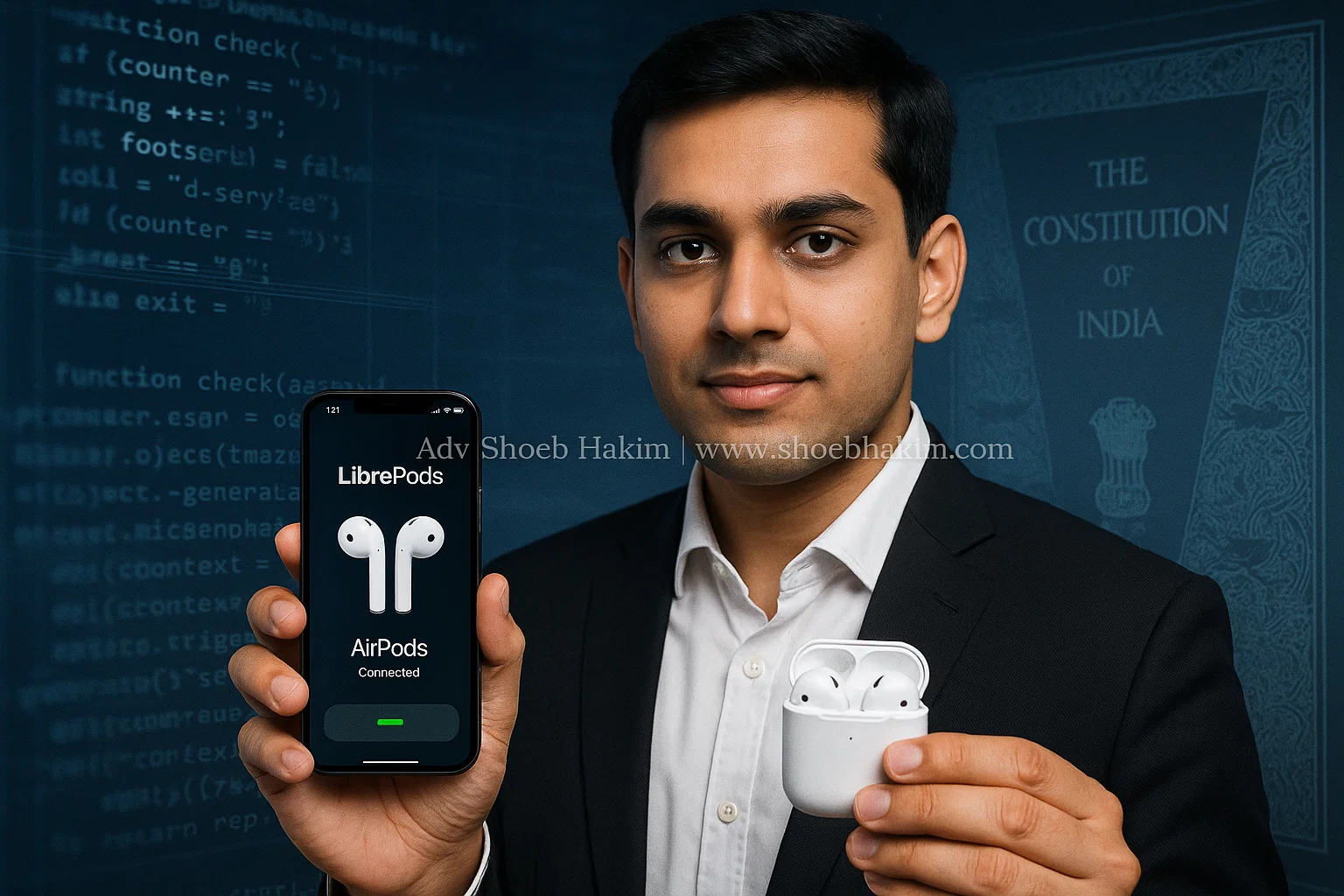
| Caption | A 15-year-old’s open-source project, LibrePods, challenges the legal boundaries of reverse engineering proprietary tech for interoperability. |
| Description | Detailed visual representing the legal-tech crossover of reverse engineering proprietary communication protocols (AirPods) for public benefit and interoperability on platforms like Android and Linux. Essential for understanding Section 52 of the Indian Copyright Act. |
Social Media Promotion
Target Audience: Legal Professionals, Law Students, and Tech Developers interested in Intellectual Property and Cyber Law.
| Platform | Post Content (Character/Word Count Conscious) |
| LinkedIn (Thought Leadership) | The legal fight for interoperability is here. A 15-year-old reverse-engineered Apple’s AirPods protocol, opening a debate that directly impacts Indian IP law. As a Legal Technologist, I break down the crucial Section 52 of the Copyright Act: When is reverse engineering closed systems a legal right? For legal professionals and developers, understanding the ‘interoperability safe harbour’ is non-negotiable for future innovation and competition. Read my analysis. #LegalTech #IntellectualProperty #CyberLaw #AdvShoebHakim #OpenSourceLaw |
| Facebook (Distinctive Viewpoint) | A “Quiet Rebellion” against Big Tech? 🤯 Young Indian innovator Kavish Devar just proved that proprietary walls aren’t impenetrable. His LibrePods app unlocks AirPods features on Android! But what does the law say about this kind of reverse engineering closed systems? My latest article on ShoebHakim.com explains why the Indian Copyright Act protects this kind of innovation, provided you follow the strict legal ‘interoperability’ checklist. Share your thoughts below: Should Big Tech be forced to open their APIs? #TechLaw #AirPodsAndroid #DigitalRights #ShoebHakim |
| Twitter (Conversational Engagement) | That 15-year-old who cracked AirPods for Android? Legally, that’s a WIN for interoperability. My take: India’s Copyright Act provides a crucial defense for reverse engineering closed systems. This is vital to protect innovation against corporate monopolies. Don’t breach IP, but know your rights to interoperate. #LegalTech #OpenSource #CopyrightAct #AdvShoebHakim |