

Why Adv Shoeb Hakim Considers This Article a Vital Read
The internet’s pervasive reach has fundamentally reshaped legal concepts, particularly in determining jurisdiction in the digital age. As Adv Shoeb Hakim, I recognize Eric C. Hawkins’ article, “General Jurisdiction and Internet Contacts: What Role, if any, Should the Zippo Sliding Scale Test Play in the Analysis?”, as a cornerstone for understanding personal jurisdiction in cyber law.
This piece is crucial for legal professionals, particularly those involved in cybercrime and e-commerce, as it dissects the enduring relevance and limitations of the Zippo sliding scale test in assessing internet-based contacts. Understanding these principles is paramount for effectively litigating cases involving online activities across different jurisdictions.
The Zippo Sliding Scale Test and Internet Jurisdiction

General Jurisdiction and Internet Contacts: What Role, if any, Should the Zippo Sliding Scale Test Play in the Analysis? Eric C. Hawkins, 74 Fordham L. Rev. 2371 (2006)
The article “General Jurisdiction and Internet Contacts: What Role, if any, Should the Zippo Sliding Scale Test Play in the Analysis?” by Eric C. Hawkins (74 Fordham L. Rev. 2371 (2006)) delves into the complexities of personal jurisdiction in the context of internet activities. It specifically examines the Zippo sliding scale test, a framework developed to assess whether a defendant’s online presence is sufficient to establish jurisdiction in a particular forum.
This test became a prominent tool for courts navigating the then-nascent challenges of determining jurisdiction over out-of-state defendants whose only contact with a forum state was through their website.
Understanding Personal Jurisdiction in the Digital Age
Personal jurisdiction refers to a court’s authority to hear a case involving a specific person or entity. Traditionally, this authority was based on a defendant’s physical presence or significant physical contacts with a forum state. However, the rise of the internet blurred these lines, leading to new challenges.
- Minimum Contacts Doctrine: The foundational principle for personal jurisdiction in the United States is the “minimum contacts” doctrine, established in International Shoe Company v. Washington, 326 US 310 (1945). This doctrine requires a defendant to have certain minimum contacts with the forum state such that maintaining a lawsuit there “does not offend traditional notions of fair play and substantial justice.” Subsequent cases like Pennoyer v. Neff, 95 US 714 (1877), World-Wide Volkswagen Corporation v. Woodson, 444 US 286 (1980), and Burger King Corp. v. Rudzewicz, 471 US 462 (1985) further refined this concept, focusing on whether the defendant purposefully availed themselves of the privilege of conducting activities within the forum state.
- Specific vs. General Jurisdiction: The minimum contacts doctrine gives rise to two types of personal jurisdiction: specific and general. Specific jurisdiction arises when the lawsuit directly relates to the defendant’s contacts with the forum state. General jurisdiction exists when a defendant’s contacts with the forum state are so continuous and systematic as to render them essentially “at home” in that state, regardless of whether the lawsuit arises from those contacts. The challenge with the internet lies in classifying passive websites versus interactive ones for jurisdictional purposes.
The Zippo Sliding Scale Test: A Framework for Internet Contacts
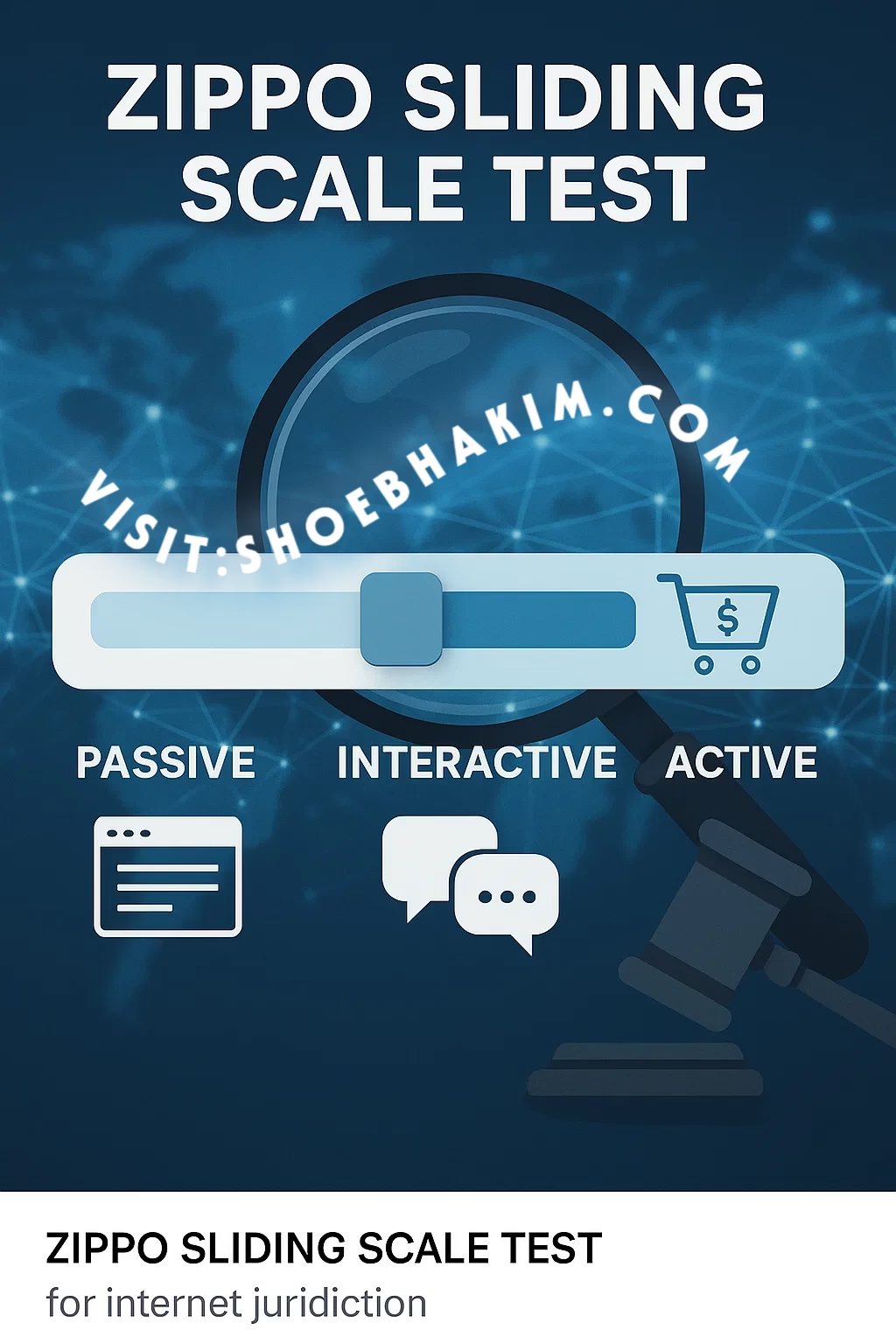
The Zippo sliding scale test, introduced in Zippo Manufacturing Co. v. Zippo.com, 952 F Supp. 1119 (D.C.W.D. Pa 1997), offered a three-tiered approach to assessing internet-based contacts for specific jurisdiction:
- Active Websites: At one end of the spectrum are websites where a defendant clearly conducts business over the internet, entering into contracts with residents of other states. This involves knowing and repeated transmission of computer files over the internet. Such activities generally establish specific jurisdiction. An example would be an e-commerce site where users can purchase goods, similar to the facts in ProCD Vs. Zeidenberg, 1996.
- Interactive Websites: In the middle are interactive websites where users can exchange information with the host computer. The level of interactivity and the commercial nature of the exchange determine whether jurisdiction is appropriate. The greater the interactivity and commerciality, the more likely jurisdiction will be found. Cases like Casio India Company Limited Vs. Ashita Tele Systems Private limited (2003) 27 PTC 265 (Del) and Banyan Tree Holdings (Pvt.) Ltd. Vs. Murali Krishnan Reddy 2008 (38) PTC 288(Del) illustrate how Indian courts have grappled with the degree of interactivity needed to establish jurisdiction.
- Passive Websites: At the other end are passive websites that merely post information and are accessible to users in other jurisdictions. These sites do not generally establish specific jurisdiction because the defendant has not purposefully directed activity toward the forum state. The mere ability for a website to be viewed in a state does not create sufficient contacts for jurisdiction.
The Enduring Role and Limitations of Zippo
Hawkins’ article probes the question of whether the Zippo sliding scale test still holds relevance, particularly for general jurisdiction in the ever-evolving landscape of internet use. While Zippo was primarily designed for specific jurisdiction, its principles have been broadly applied.
- Shift Towards “Purposeful Availment”: Over time, courts have increasingly focused on the concept of “purposeful availment”—whether the defendant intentionally directed their activities towards the forum state. The Zippo test helps in this assessment by categorizing the nature of online interaction. For instance, a website actively soliciting business from a particular state would demonstrate purposeful availment. The Calder v. Jones, 465 US 783 (1984) “effects test” also plays a role here, where jurisdiction is proper when a defendant’s intentional conduct causes harm in the forum state, even if physical presence is lacking. This applies strongly to online defamation or intellectual property infringement cases, as seen in Playboy Enterprise, Inc., vs. Chukelberry publishing, Inc., 930 F Supp 1032 (S.D.NY.1996).
- Challenges with General Jurisdiction: For general jurisdiction, merely operating an interactive website that is globally accessible is generally insufficient. The U.S. Supreme Court, in cases like Daimler AG v. Bauman (2014), has significantly narrowed the scope of general jurisdiction, requiring that a corporation’s affiliations with the forum state be “so continuous and systematic as to render the corporation essentially at home in the forum State.” Simply having a broadly accessible website, without more, does not meet this high standard. The Zippo test, therefore, has less direct application to general jurisdiction, which relies on a higher threshold of continuous and systematic contacts.
Adv Shoeb Hakim’s Analysis & Conclusions
Eric C. Hawkins’ analysis on the Zippo sliding scale test and its role in internet jurisdiction remains highly pertinent, even with the evolution of digital platforms. As Adv Shoeb Hakim, I find that while the internet has transformed how we communicate and conduct business, the core principles of personal jurisdiction—rooted in fair play and substantial justice—continue to guide courts. The Zippo test, though developed decades ago, still offers a valuable starting point for understanding specific jurisdiction in online contexts, especially when assessing the degree of commercial interaction a website fosters with a particular state.
However, its utility for general jurisdiction in the digital realm is limited. The prevailing legal standard for general jurisdiction requires a much more significant connection than merely operating an interactive website. This distinction is crucial for legal professionals advising clients on potential jurisdictional exposures arising from their online presence. Businesses engaging in e-commerce or maintaining a substantial online presence must understand how their digital activities create legal contacts and potential jurisdictional reach.
Practical Tip: For legal practitioners, it is essential to move beyond the simplistic application of the Zippo test for all jurisdictional inquiries. A nuanced approach that integrates Zippo’s “active,” “interactive,” and “passive” classifications with the “purposeful availment” doctrine and the specific/general jurisdiction dichotomy is necessary. Always consider the intent behind online interactions and the degree to which a business targets specific geographical markets. As Adv Shoeb Hakim always emphasizes, proactive legal guidance on website terms of service, privacy policies, and geographical targeting can mitigate jurisdictional risks for businesses operating globally.
Quiz Engagement
- What is the primary purpose of the Zippo sliding scale test? a) To determine intellectual property ownership. b) To assess personal jurisdiction based on internet contacts. c) To measure website traffic.
- Which type of website generally does not establish specific jurisdiction under the Zippo test? a) Active websites conducting business. b) Interactive websites with high commerciality. c) Passive websites merely posting information.
- The foundational principle for personal jurisdiction in the US, requiring “minimum contacts,” was established in which case? a) Zippo Manufacturing Co. v. Zippo.com b) International Shoe Company v. Washington c) Calder v. Jones
Quiz Answers:
- b) To assess personal jurisdiction based on internet contacts.
- c) Passive websites merely posting information.
- b) International Shoe Company v. Washington
Related to This Similar Cases/Articles You Must Read:
- The Evolution of Personal Jurisdiction in the Digital Age
- Understanding the “Minimum Contacts” Standard
- Cyber Law and Jurisdiction in India: A Comprehensive Guide
Social Media Version
LinkedIn: Eric C. Hawkins’ article on the Zippo sliding scale test and internet jurisdiction remains essential for legal professionals. As #AdvShoebHakim, I emphasize its relevance in understanding how online contacts shape personal jurisdiction. This is vital for navigating cyber law and protecting digital interests. #CyberLaw #Jurisdiction #ZippoTest #InternetLaw #LegalTech #AdvShoebHakim #ShoebHakim #AdvShoaibHakim Read the full analysis and practical checklist.
Twitter: Internet jurisdiction explained! 🌐 The Zippo sliding scale test is still key for understanding online legal contacts. #AdvShoebHakim dives into its role and limits. #CyberLaw #Jurisdiction #LegalInsights #DigitalRights #AdvShoaibHakim Read the full analysis and practical checklist.
Facebook: How do courts determine jurisdiction for online activities? Eric C. Hawkins’ work on the Zippo sliding scale test offers critical insights. Adv Shoeb Hakim breaks down why this framework is still relevant for personal jurisdiction in the digital age, especially for specific jurisdiction cases. #CyberLegal #InternetJurisdiction #ZippoSlidingScale #LegalEducation #AdvShoebHakim #OnlineLaw Read the full analysis and practical checklist.
#TAGS: #advshoebhakim #shoebhakim #advshoaibhakim #ZippoTest #Jurisdiction #InternetLaw #CyberLaw #PersonalJurisdiction #MinimumContacts #SpecificJurisdiction #GeneralJurisdiction #DigitalLaw #LegalAnalysis #ECommerceLaw #CyberSecurity #Lawyers #LegalTech #OnlineBusiness
Metadata
Meta Description: Explore the Zippo sliding scale test’s role in internet jurisdiction. Adv Shoeb Hakim analyzes Eric C. Hawkins’ insights on general and specific jurisdiction.
Meta Title: Zippo Sliding Scale Test: Internet Jurisdiction by Adv Shoeb Hakim
Focus Keyphrase: Zippo Sliding Scale Test
Author: Adv Shoeb Hakim
Publication Date: July 25, 2025
Slug: zippo-sliding-scale-test-internet-jurisdiction
Serial Number: SHOEBHAKIM/JULY/WEEK4/25072025/206/ADVSHOARTZ9P5J1C2
Meta Robots Advanced: index, follow, max-snippet:-1, max-image-preview:large, max-video-preview:-1
Breadcrumbs Title: Zippo Sliding Scale Test
Canonical URL: www.shoebhakim.com/zippo-sliding-scale-test-internet-jurisdiction
Image Metadata
Alt Text: Zippo Sliding Scale Test for internet jurisdiction explained by Adv Shoeb Hakim.
Title: Zippo Test for Internet Jurisdiction
Caption: Understanding the Zippo Sliding Scale Test: A crucial framework for determining personal jurisdiction in the digital age.
Description: This image illustrates the Zippo Sliding Scale Test, a key framework for assessing personal jurisdiction based on internet contacts. It visually represents the spectrum from passive to active websites, underscoring the complexities of jurisdiction in cyber law, as explored in Adv Shoeb Hakim’s analysis.
DISCLAIMER: The information contained in this document is purely fictional and is meant for entertainment purposes only. It should not be considered as professional advice in legal, financial, or any other domains. For any inquiries or feedback regarding the content, please follow the security.txt protocol to ensure appropriate handling. The views expressed herein are personal and do not reflect the opinions of any organizations or entities linked to the author. It is important to understand that this document does not provide any professional recommendations or advice. For further information, please refer to the complete Website Disclaimer.