

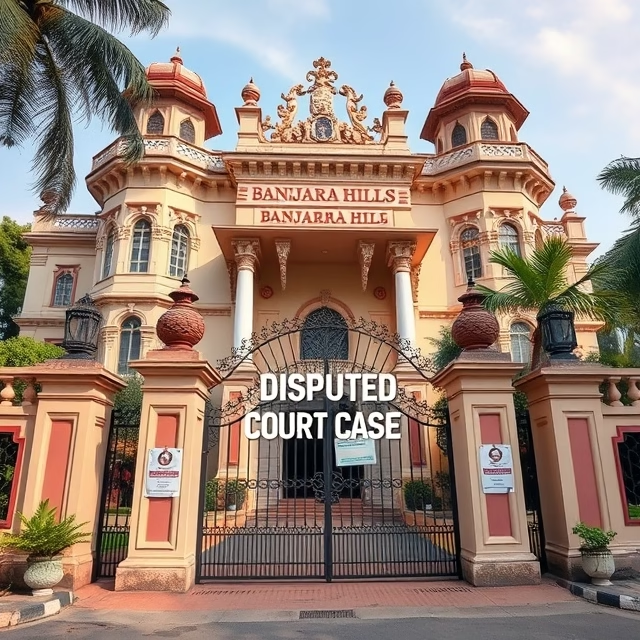
“Adv S.Hakim Explains: Ownership Dispute Over ₹3,000 Crore ‘Royal’ Home in Hyderabad’s Banjara Hills”
Why Adv Shoeb Hakim Considers This Article a Vital Read
The ₹3,000 crore “Royal” mansion in Hyderabad’s upscale Banjara Hills is at the center of an intense ownership battle, shedding light on the complexities of property disputes in India. This high-stakes case involves multiple claimants, historical land deeds, and allegations of forgery, making it a fascinating study of law, real estate, and family dynamics.
This article delves into the legal intricacies surrounding the dispute, the role of historical documentation in property claims, and the broader implications for India’s property laws. With insights from Adv Shoeb Hakim, we break down this complex case for tech, law, and banking enthusiasts.
The Dispute: A Battle for Hyderabad’s Most Valuable Property
The luxurious mansion, often referred to as a “royal home,” spans several acres in Banjara Hills and is valued at over ₹3,000 crore. Its opulent architecture, prime location, and historical significance make it one of Hyderabad’s most prestigious properties. However, its ownership is now fiercely contested in the courts.
The Claimants
- Heirs of the Original Owner: Descendants of the mansion’s original owner claim that the property was unlawfully transferred through forged documents.
- Real Estate Developer: A prominent real estate company asserts that it lawfully purchased the property from the alleged rightful owners.
- Third-Party Individuals: Some individuals claim partial ownership based on historical deeds and tenancy agreements.
Key Issues in the Case
Forgery Allegations
The primary heirs allege that fraudulent sale deeds were created to transfer ownership to unrelated parties. These deeds are now under scrutiny for potential forgery.
Historical Documentation
The mansion’s history dates back to the pre-Independence era, and its documentation is extensive. However, discrepancies in land records, title deeds, and tenancy agreements complicate the dispute.
Legal Questions
- Validity of Sale Deeds: Are the sale deeds authentic or forged?
- Heirship Claims: Do the claimants have sufficient evidence to prove their lineage and rightful ownership?
- Property Transfer Rules: Were all legal formalities followed in the property’s sale?
Legal Framework
Key Laws Involved
- Transfer of Property Act, 1882:
This Act governs the legal transfer of property, ensuring that ownership changes are valid and binding. - Indian Succession Act, 1925:
Provides guidelines for inheritance and distribution of property among legal heirs. - Indian Penal Code, 1860:
Sections 463, 464, and 468 address forgery and the creation of fraudulent documents.
Judicial Precedents
- Bhim Singh v. Kan Singh (1980): The Supreme Court held that a sale deed can be declared void if it is proven to be fraudulent.
- Krishna Pillai v. Gopalan (1957): Established the importance of proving heirship through authentic documentation in property disputes.
Implications of the Dispute
For Real Estate in India
- Market Uncertainty: High-profile property disputes can deter investors and slow down real estate transactions.
- Stricter Documentation: Developers and buyers are increasingly cautious about verifying property records.
For Families with Legacy Properties
- Prolonged Legal Battles: Disputes like this highlight the need for clear succession planning and proper documentation.
- Inheritance Planning: Families are realizing the importance of legally formalizing inheritance agreements.
For Legal Professionals
- Evolving Case Law: This case could set new precedents in addressing ownership disputes involving historical properties.
Simplified Example
Scenario: A mansion built in 1940 is inherited by three siblings. Over time, a developer acquires the property using a disputed sale deed. One sibling alleges forgery and files a case, resulting in years of litigation. This scenario mirrors the complexities in the Hyderabad case.
Proposed Solutions
- Digital Land Records: Transitioning to blockchain-based systems for land records can prevent forgery and ensure transparency.
- Heirship Certificates: Encouraging families to obtain legal heirship certificates can streamline inheritance claims.
- Mandatory Legal Checks: Introducing stricter guidelines for verifying sale deeds during property transactions.
Visual Insights
Infographic 1: Timeline of the Banjara Hills Property Dispute
- 1940s: Mansion constructed by the original owner.
- 1990s: Property leased to tenants.
- 2000s: Alleged sale through disputed deeds.
- 2024: Court battle intensifies with multiple claimants.

Adv Shoeb Hakim’s Analysis & Conclusions
The ₹3,000 crore property dispute in Banjara Hills highlights the importance of due diligence, clear documentation, and transparent processes in real estate transactions. Cases like this underscore the need for robust mechanisms to resolve property disputes efficiently.
Call-to-Action
- For Families: Prioritize estate planning to avoid prolonged disputes over legacy properties.
- For Real Estate Developers: Invest in legal due diligence to minimize risks associated with property acquisitions.
- For Legal Experts: Advocate for technological solutions, such as blockchain, to enhance the transparency and security of property records.
As Adv Shoeb Hakim aptly observes, “This case is a reminder of how legacy properties can turn into battlegrounds when documentation is unclear. It is a call for reform in land governance and inheritance laws.”
#advshoebhakim #shoebhakim #advshoaibhakim #banjarahillsmansion #propertydisputes #realestateindia #legalupdates #propertylaws #inheritancedisputes #blockchainlandrecords #forgeryindisputes #indianlaw #legacyproperties #realestatelaw #propertyownership #digitallandrecords #realestatescams #indianjudiciary #estateplanning #legalframeworkindia #propertyownershipindia
DISCLAIMER:
It is important to note that the information provided herein is not intended to serve as professional advice in fields such as medicine, finance, cybersecurity, legal matters, taxation, or emotional well-being. The content is purely for informational and entertainment purposes and should not be construed as expert guidance.
Should you have any concerns or wish to provide feedback regarding this material, please adhere to the security.txt protocol. The views expressed in this content do not necessarily represent those of any organizations with which I may be associated. For further details, please refer to the full Website Disclaimer.